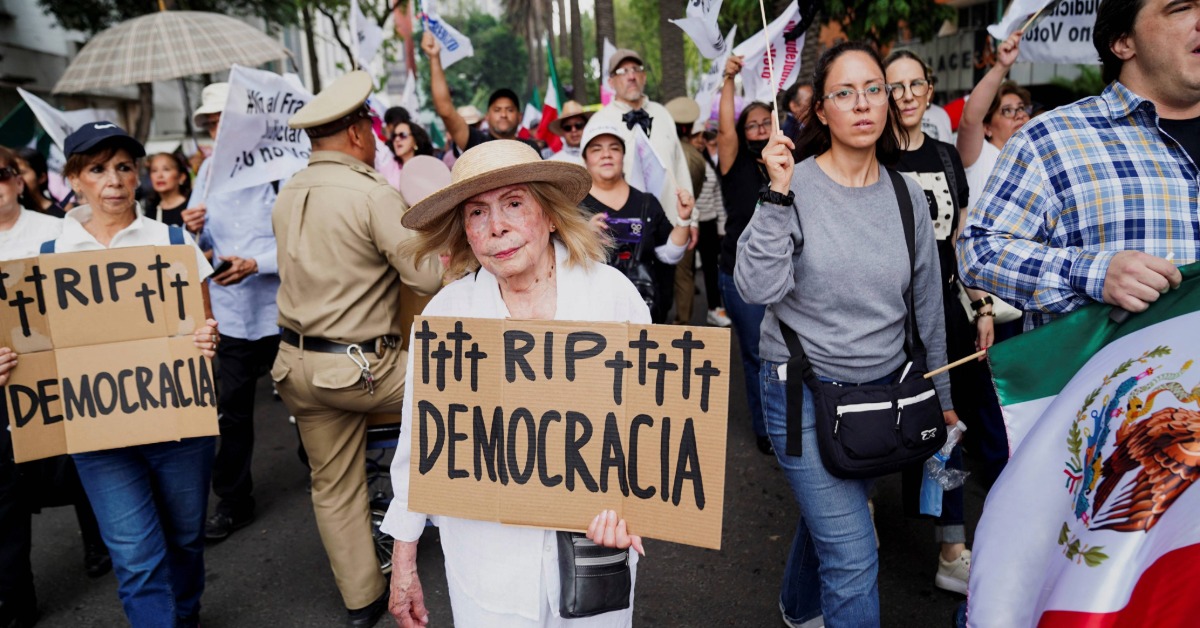
Mexico still holds elections, but a new democracy assessment says the country’s institutional guardrails are getting weaker. The label it uses sounds technical, yet its meaning is concrete: less confidence in judicial independence, more concern about concentrated power, and new questions about how far formal elections alone can protect the system. The finding also comes with an important caveat. The report itself says countries near these thresholds should be read carefully, because the line between democracy and autocracy is not always sharp.
A harsher label than it first sounds
Mexico has moved into what researchers describe as a democratic gray zone in the new V-Dem Democracy Report. In the report’s own regime table, Mexico is coded as EA+. That means electoral autocracy with enough measurement overlap to remain close to the higher democratic category. In plain language, V-Dem sees Mexico near the line between electoral democracy and electoral autocracy.
This is new. Last year’s report still placed Mexico in the lower band of electoral democracy. The 2026 edition moves it one step down. It also ranks Mexico fifth in its ranking of the sharpest recent cases of democratic erosion.
What the gray zone actually means
V-Dem is a research project based at the University of Gothenburg. It tracks more than 600 attributes of democracy across 202 countries and territories. Its regime labels are built from broader scores on election quality, civil liberties, equality before the law, and legislative and judicial constraints on executive power.
That is why the phrase gray zone matters. The line between categories is not clean. Researchers see Mexico as close enough to the threshold that some uncertainty remains. This is not the same as saying Mexico has stopped holding elections or has become a closed dictatorship. It is a warning that the country’s safeguards are weakening and that the margin separating democracy from autocracy has narrowed.
How Mexico got here
The report traces Mexico’s current slide to the political realignment that followed Andrés Manuel López Obrador’s 2018 victory and Morena’s rise. Researchers say that period brought more concentrated control over the executive and legislature, weaker judicial constraints, and a larger military role in civilian affairs. In one of the report’s broader indicator sections, Mexico also appears among the countries where government efforts to censor the media have worsened most over the last decade.
The judiciary sits at the center of the latest warning. The report says Morena-led judicial reform turned the courts into a new arena of electoral politics. Mexico then held its first nationwide judicial election in June 2025. Supporters said the reform would open the court system, which many citizens saw as opaque and corrupt. Critics said it weakened an independent check on power and made the courts more exposed to party influence.
The election itself added to the concern. Turnout was just above 12.5 percent and below 13.5 percent, according to the national electoral authority. An international observation mission later said voters had limited information about the candidates and that key rules had to be defined while the process was already underway.
Why the warning matters
Democracy ratings can sound abstract, but they point to practical issues. Residents raise questions about whether courts can still review the state on equal terms. For businesses and investors, they shape perceptions of contract enforcement and regulatory predictability. For foreign residents, they help explain why constitutional reforms that seem technical can affect permits, disputes, property rights, and trust in public institutions.
Mexico is not being described as a country without elections. It is being described as a country where elections alone may no longer reassure outside observers that power is effectively restrained. That distinction matters. Many modern autocratic systems keep ballots, parties, and formal institutions. What weakens first is often the ability of courts, legislatures, and watchdog bodies to push back against the governing coalition.
A global trend, with an important caveat
The Mexico finding sits inside a broader V-Dem argument that democracy is weakening worldwide. The 2026 report says the world ended 2025 with 92 autocracies and 87 democracies, and that 74 percent of the global population now lives under autocratic rule. Because Mexico is one of Latin America’s largest countries, its movement carries more weight than a similar shift in a smaller state.
Still, the report itself offers a reason for caution. In a commentary published alongside it, senior V-Dem investigators say some headline category shifts can overstate the gap between countries near the threshold. Their point is that these labels rest on continuous scores rather than a simple yes-or-no test. That does not erase Mexico’s decline. It does mean the classification should be read as a serious warning, not as the last word on Mexico’s political system.
Mexico’s immediate test is not whether elections continue. They will. The deeper question is whether checks and balances can still limit the ruling coalition in practice after the court overhaul and other institutional changes. That is the line the new report says Mexico is now testing.
With information from V-Dem Institute, Democracy Report 2026