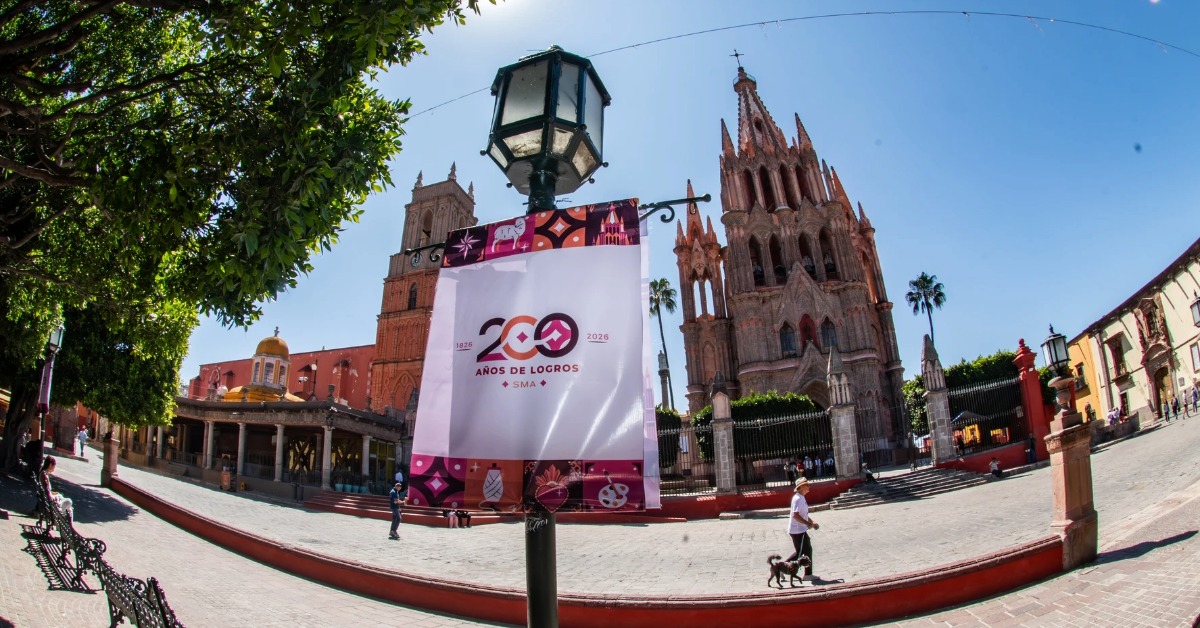
San Miguel de Allende is turning March into a public countdown to a very specific date. A parade kicks off the bicentennial program, but the calendar is designed to bring people back to the plazas on weekends. Along the way are tributes, tunas, and visiting groups meant to underline why this anniversary matters now. City officials say March is only the first phase. The next announcements should clarify how far the celebration will stretch into 2026 and what comes next.
A bicentennial built as a public identity push
San Miguel de Allende is framing its bicentennial as more than a single day on the calendar. The official anniversary falls on March 8, marking the 1826 decree that granted city status and a new name. Local officials are using the theme “200 años de logros” to pair civic history with public programming. The March agenda runs March 6–30 and keeps most activity in the Centro Histórico. It is presented as the opening phase of a plan expected to continue through 2026. The design is consistent across weekends, with performances staged in shared public spaces. Organizers say the lineup includes mariachi, tunas, and ballets from Mexico and abroad. The same message also highlights 12 invited countries, a signal of the international tone. Officials also mention school talks that trace the city’s development across the last two centuries. For expats, the setup makes the story easy to follow from the street, not a theater seat.
The March 6 kickoff centers on a parade and plaza stage
The first public moment is timed for Friday, March 6, and it is designed for on-foot viewing. A desfile is set to leave the Oratorio at 6:30 pm and finish at Plaza Cívica. There, the city plans an opening act that runs into the night in a central zone near the historic center. Event listings place the Plaza Cívica program from 7:00 pm to 11:00 pm, with an inaugural segment. The opening performance is scheduled for 8:00 pm. One of the first featured acts is Costa Rica’s Asociación Folclórica de Investigación Costarricense La Lajuela. The municipal outline adds live music and bandas de viento along the route and at the plaza. Organizers also say the parade will carry the flags of 12 invited countries. In practice, that creates two viewing options, one along the route and one at the finish. The kickoff also signals how the month will work, with culture presented in public spaces rather than ticketed halls.
Weekends keep returning to Jardín Allende
After opening night, the schedule shifts toward the Jardín Principal, often listed as Jardín Allende. The March plan leans on weekends, with two musical presentations per day mentioned for several dates. The result is a repeating rhythm that brings audiences back to the same central plaza. Several nights are framed as tributes that connect the anniversary to wider regional culture. A concert tribute to José Alfredo Jiménez is set for March 14 in Jardín Allende. A separate homage to Fray José de Guadalupe Mojica is scheduled for March 19 at Iglesia La Tercera Orden. The Encuentro Nacional de Tunas follows on March 21, returning to the main garden. Late in the month, the Banda Sinfónica del Estado de Guanajuato is listed for March 29. The program closes on March 30 with Wapa México, combining music, song, and dance. Most presentations are scheduled for evening hours, with times posted by date. Tourism listings describe these as public events with no ticket sales shown.
March 11 adds a formal state milestone
Beyond performances, the bicentennial includes a formal political marker tied to the date. The Congreso de Guanajuato is scheduled to hold a Sesión Solemne on March 11 in San Miguel de Allende. State documents describe the Explanada del Jardín Principal Allende as the official venue for that session. The aim is to mark 200 years since the city status and the name San Miguel de Allende were granted. Municipal messaging places that moment inside a wider year-long framework, not a one-week celebration. Officials have said more activities are planned, with details expected later in March. The city also points to weekend programming extending into April and May, again centered in public spaces. For expat residents, the civic session and the plaza concerts offer two ways to read the anniversary. One is institutional recognition, and the other is street-level culture that repeats across the month. Together, they show how the city is staging the bicentennial in layers across 2026.
With information from Gobierno Municipal de San Miguel de Allende