First came the fire. Then came the spill. Now crews are trying to keep hydrocarbon residue out of the waterways around Dos Bocas. Regulators and nearby communities still want answers. The cleanup in Tabasco is about more than one refinery incident. It reaches into fishing waters, environmental oversight, and the credibility of one of Mexico’s biggest energy projects. What happened after the March 17 fire helps explain why this story now extends far beyond the plant’s perimeter.
A spill after the fire
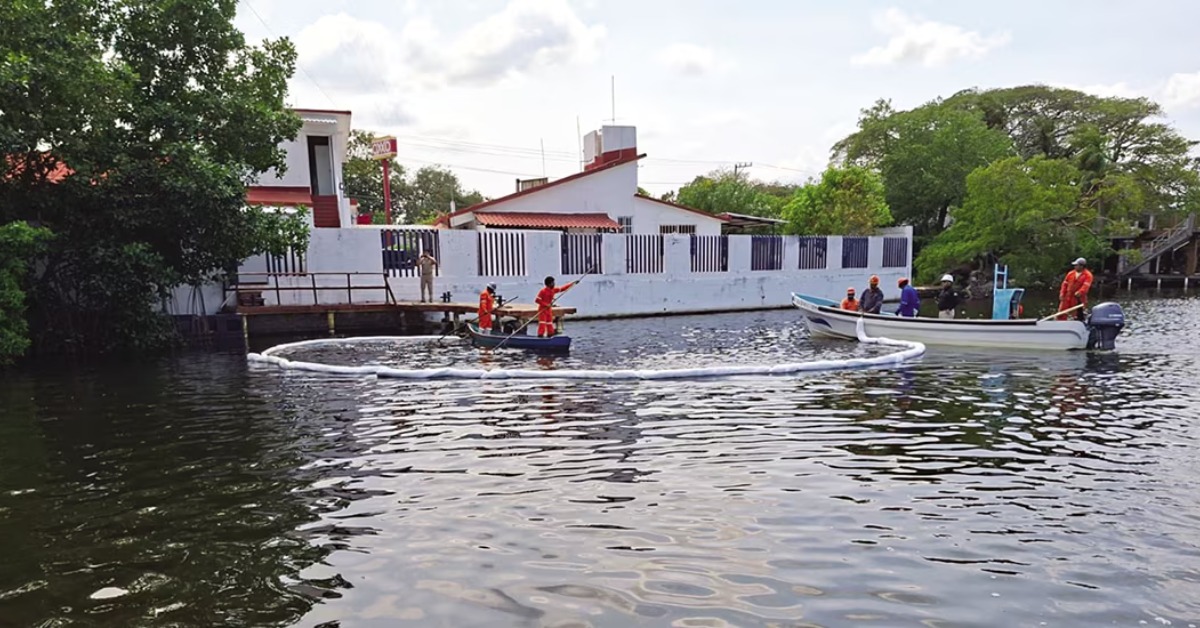
A crude spill near Dos Bocas has widened cleanup efforts in Tabasco. It came days after a deadly fire at the Olmeca refinery. Federal authorities say hydrocarbon residue was found around the port zone and Río Seco, a waterway near the complex. Crews moved to contain the spill, recover contaminated material, and keep it from reaching Laguna Mecoacán.
The spill appears tied to the March 17 incident outside the refinery perimeter. According to Pemex, heavy rains caused oily water to overflow from the refinery area. The liquid pooled outside the site and later ignited. Five people died, including one Pemex worker. Pemex says the storage area was not damaged and that the immediate danger to the public had been controlled. The environmental response, however, did not end there. In the days that followed, authorities detected hydrocarbon residue in nearby waters and expanded the cleanup.
Why the waterways matter
This is not only an industrial accident story. It is also a story about water contamination. The response has centered on Río Seco, where authorities installed barriers and absorbent recovery equipment. The goal is to prevent oil from reaching Laguna Mecoacán. Port authorities also restricted navigation there after the residue was detected. Federal officials said about 240 kilograms of crude-soaked waste had been collected by the weekend. Later reports, citing Pemex, said the response had grown to 350 workers, supported by boats and extra containment gear.
That focus matters because the area around Paraíso is not only an industrial zone. It is part of a coastal landscape tied to fishing and sensitive water systems. When authorities talk about protecting nearby lagoons, they are also talking about livelihoods. The federal government says the cleanup is meant to protect marine ecosystems and regional fishing communities while monitoring continues.
Why Dos Bocas matters nationally
For international readers, Dos Bocas is more than a local refinery name. The Olmeca refinery is one of Mexico’s flagship energy projects. It was built to reduce the country’s dependence on imported fuels. Reuters reported that the plant began operating in 2024 and has a design capacity of 340,000 barrels a day. It has also faced delays and operating problems and has not consistently reached that level.
That national importance helps explain why even a spill outside the plant draws close attention. Any incident at Dos Bocas becomes a test of industrial safety, environmental response, and government oversight. It also raises a harder question. Was the March 17 fire a weather-driven accident, or did it expose deeper weaknesses in stormwater control, residue management, and emergency planning?
What happens next
The immediate task is containment. Profepa is inspecting the site for compliance with environmental rules. ASEA plans a site inspection. It has also asked Pemex for a root-cause investigation. That step matters because cleanup alone will not answer the bigger question. Authorities still need to explain how the spill happened, whether safeguards failed, and what must change to prevent another release.
The incident comes during a tense period for the Gulf Coast. Authorities are also dealing with other reports of hydrocarbon contamination in Tabasco and Veracruz. That does not mean the cases share the same source. It does mean this latest spill will face even closer scrutiny. For Pemex and the federal government, the test now goes beyond collecting waste. They must show that a flagship refinery can operate without repeatedly putting nearby communities and waterways at risk.
With information from Pemex