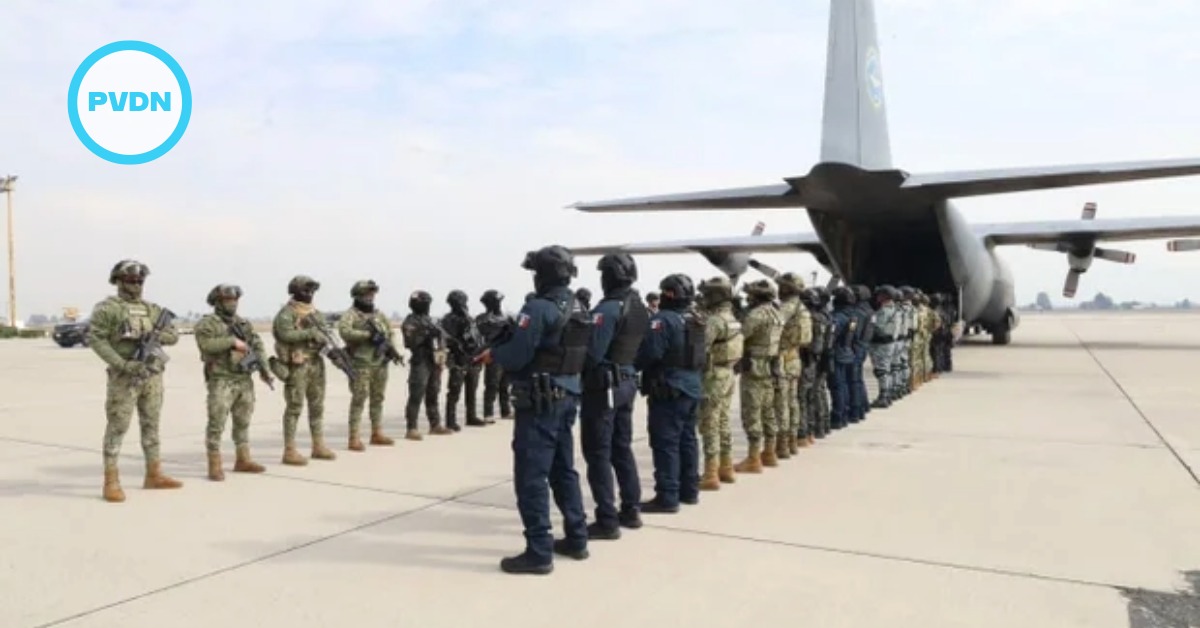
Under the cloak of a high-security operation, Mexico quietly handed dozens of its most notorious prisoners over to U.S. authorities. Officials in Mexico insist the suspects – allegedly top cartel operatives – posed too great a threat to stay on home soil. The unprecedented transfer, involving multiple military aircraft, comes amid Washington’s growing pressure for tougher action on cartels. Both nations framed it as a cooperative crackdown with certain conditions attached. So what prompted this bold move, and what might it signal about the future of cross-border security?
High-Risk Criminals Handed Over in Joint Operation
In an extraordinary move, the Mexican government has transferred 37 imprisoned members of organized crime groups into the custody of the United States. The handover took place on Tuesday in a carefully coordinated operation involving the security authorities of both countries. Mexico’s Security Minister, Omar García Harfuch, announced that the inmates were considered “high-impact criminals” who “represented a real threat to the country’s security.”
Under heavily armed guard, the prisoners were escorted from a maximum-security facility (the Altiplano prison in the State of Mexico) to awaiting aircraft. A fleet of seven Mexican Air Force planes then flew the suspects to multiple U.S. destinations, including Washington, D.C., New York, Houston, San Antonio, San Diego, and others. Each of the individuals being sent north has outstanding charges or indictments in the United States, most related to drug trafficking and organized crime.
Mexican authorities stressed that this operation was conducted lawfully and in accordance with established bilateral agreements. “The operation was carried out in accordance with the National Security Law and under bilateral cooperation mechanisms, with full respect for national sovereignty,” García Harfuch noted on social media. Crucially, officials secured a commitment from the U.S. Department of Justice that none of the transferred suspects will face the death penalty. (Mexico, which has no death penalty, generally requires such assurances before extraditing its citizens.) With that guarantee in place, dozens of shackled cartel suspects – 36 men and one woman – were effectively delivered into U.S. hands to stand trial.
Notorious Cartel Figures in the Mix
This batch of prisoners includes operatives from several of Mexico’s most powerful criminal cartels. According to officials, those handed over come from groups such as the Sinaloa Cartel (also known as the Pacific Cartel), the Jalisco New Generation Cartel (CJNG), the Gulf Cartel, the Beltrán Leyva organization, and the Northeast Cartel (a Zetas offshoot), among others. Many are mid- to high-level figures alleged to have orchestrated drug trafficking, violent crimes, and other illicit operations.
One of the most prominent names is Ricardo González Sauceda, alias “El Ricky,” identified as a leader of the Northeast Cartel; he was wanted in the U.S. and is now among the transferred. Another notable case is Pedro Inzunza Noriega – the father of a top Beltrán Leyva cartel boss – who was arrested in Mexico last month after U.S. prosecutors indicted him on terrorism-related drug charges. Even a few figures tied to the Sinaloa cartel’s old guard and the CJNG’s enforcement wings appear on the list. The presence of a female suspect, reportedly known as “La Señora” and linked to CJNG, also stands out. While most of these individuals might not be household names, they are considered major operators within the underworld and were sufficiently feared that keeping them in Mexican prisons was deemed untenable.
Mexican officials have indicated that removing these cartel operatives from local prisons is partly to prevent them from continuing to orchestrate criminal activities from behind bars. In the past, high-profile drug lords have managed to communicate orders and foment violence even while incarcerated, exploiting corruption or loopholes in the prison system. By sending these suspects to the U.S., Mexico aims to cut off that capability and ensure they face justice in a more secure and distant jurisdiction. “With this transfer, 92 high-impact criminals have now been sent to the U.S. during this administration, preventing them from generating violence in our country,” García Harfuch said, highlighting the cumulative impact. Indeed, this week’s operation marks the third large-scale transfer of cartel prisoners in the last year.
Earlier, in February 2025, Mexican authorities sent 29 suspected cartel figures north (a group that notably included infamous drug lord Rafael Caro Quintero and former Zetas kingpins). A second mass handover in August 2025 saw another 26 suspects shipped out. Adding the latest 37 brings the total to 92 – reflecting an unprecedented campaign of extraditions at this scale. This represents a dramatic shift in Mexico’s approach to tackling organized crime, effectively outsourcing the prosecution of many top-tier suspects to U.S. courts.
Bilateral Cooperation Amid US Pressure
The handover comes at a time of heightened tension – and cooperation – between Mexico and the United States over drug cartels. Washington has been pressing Mexico to take more aggressive action against the powerful trafficking networks that funnel narcotics across the border. U.S. President Donald Trump, in particular, has ratcheted up pressure, even floating the idea of unilateral intervention against cartels inside Mexico. In recent months, Trump has publicly warned that if Mexico can’t control the cartels, the U.S. might take matters into its own hands. He has even mentioned the possibility of sending U.S. military forces over the border to target cartel strongholds – a prospect that alarmed many in Mexico. Just earlier this month, Trump spoke of “ground attacks” against Mexican drug trafficking networks and praised U.S. operations that destroyed cartel-linked targets at sea. These kinds of statements have put the Mexican government in a delicate position, balancing national sovereignty with a need to demonstrate tangible results against organized crime.
Against that backdrop, Mexico’s decision to collaborate closely by extraditing suspects can be seen as a goodwill gesture and a strategic move. By handing over wanted cartel figures, Mexico addresses U.S. concerns and potentially averts more extreme measures being contemplated in Washington. The transfers allow U.S. prosecutors to bring major criminals to justice (under stricter prison conditions and, in many cases, heavier sentences) while reducing the burden and risk on Mexican soil. It’s a clear signal that Mexico is willing to cooperate rather than confront the U.S. on security matters – up to a point. After the latest prisoner transfer, Mexican President Claudia Sheinbaum reiterated that U.S. military intervention on Mexican territory is “not necessary.” She emphasized that her administration is tackling the problem and that bilateral collaboration will continue, alluding to successes like a reported 50% drop in fentanyl seizures at the U.S.-Mexico border due to joint efforts. In essence, Mexico is saying: We have this under control, and we’re proving it by working with you.
Calls for Transparency and Future Implications
While this mass extradition drew praise from some quarters as a bold strike against the cartels, it has also raised questions within Mexico. The spectacle of Mexican nationals being whisked away by foreign authorities – even with government approval – is unusual and has prompted debate about legal procedures. Opposition lawmakers and human rights observers are asking on what legal basis such transfers are conducted and whether Mexico is sidestepping its own justice system. The president of Mexico’s Chamber of Deputies, for example, publicly urged the government to be transparent about the mechanism used to deliver these crime bosses to the U.S. She insisted that any cooperation must adhere to bilateral treaties and international law. Legal analysts have echoed those concerns, noting that extraditions typically involve lengthy court processes and protections. In these recent transfers, however, the government invoked national security grounds to expedite handovers, which some see as a slippery slope. There is an implicit trade-off: Mexico relinquishes its chance to try these suspects at home, effectively entrusting U.S. courts with punishing them, in return for immediate removal of dangerous figures from its territory.
For many observers, the immediate benefit of these extraditions is clear – it neutralizes threats swiftly and showcases unity with the U.S. in fighting drug trafficking. The longer-term implications, however, remain to be seen. Will this cooperative approach genuinely curb cartel violence in Mexico, or merely relocate the problem? Some in Mexico worry that relying on the U.S. to dispense justice could become a crutch, or even encourage Washington to demand greater leverage over Mexico’s security decisions. On the other hand, supporters argue that this strategy is a pragmatic way to handle an urgent crisis. For communities in Mexico (including expatriates who call the country home), any measure that promises to reduce the reach of violent cartels is understandably welcome. Removing nearly a hundred high-level criminals from the equation in one year is no small feat, and it may ease immediate pressures in certain regions. Still, it underscores the depth of the cartel challenge that Mexico feels compelled to send so many of its worst offenders abroad.
As these 37 suspects begin their journey through the U.S. justice system, Mexico will watch closely for signs of reciprocal commitment – such as continued intelligence sharing and resources from the U.S. to combat the drug trade at its source. The collaborative crackdown has opened a new chapter in cross-border security relations. It is a chapter marked by unprecedented coordination, but also by an undercurrent of coercion, given the looming threat of U.S. intervention. How this balance plays out will influence not just the fate of the extradited prisoners but the broader fight against organized crime in Mexico going forward. For now, Mexico’s government is presenting the mass transfer as a victory: a removal of dangerous actors from its soil and a reaffirmation that it won’t allow its prisons to serve as headquarters for cartel operations. The message to the cartels is unmistakable – nowhere, not even a prison cell, is a safe haven if you continue to wreak havoc. And the message to Washington is equally clear – Mexico is willing to cooperate robustly, as long as its sovereignty is respected in the process.
With information from Milenio, CBS News, Al Jazeera, Xinhua News