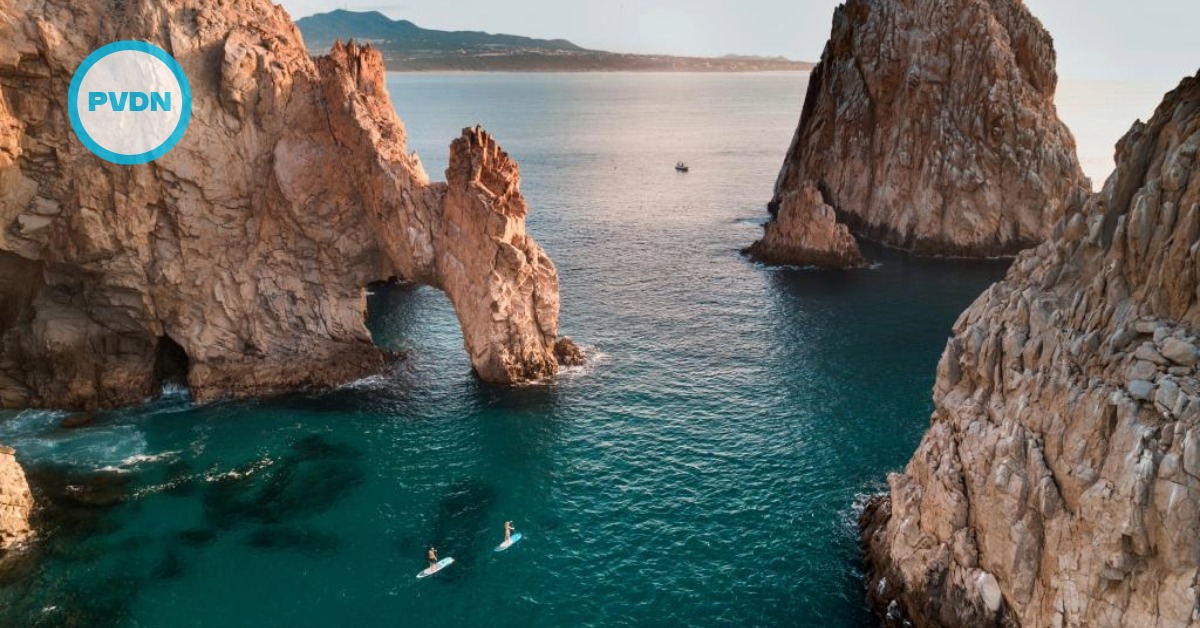
Los Cabos has become one of Mexico’s most global beach destinations, drawing nearly four million visitors a year and commanding some of the country’s highest hotel rates. Yet behind the images of private villas and golf-course condos, the destination is working to keep space for the Mexican families who helped build its reputation long before direct flights from Frankfurt or Panama were on the map.
Local tourist board figures show how tight that balance has become. In the first seven months of 2025, about 847,000 Mexican travelers flew into Los Cabos, against roughly 2.35 million international visitors. That means the domestic market still represents around a third of total tourists, even as foreign traffic delivers most of the revenue. Maintaining that share is now a central policy goal.
For Rodrigo Esponda, head of the Los Cabos tourism fund, the starting point is air connectivity. A few years ago, only seven Mexican cities had direct flights to the destination. Today, there are 16 non-stop domestic routes from cities such as Guadalajara, Tijuana, Mérida, and Puebla, plus a daily flight from the Felipe Ángeles International Airport serving Mexico City’s northern metro area. New services on low-cost carriers have reduced the need for connecting flights through Mexico City, trimming both travel time and costs for national visitors.
At the same time, the international network has exploded. Los Cabos is now linked to more than 30 cities in the United States and over 10 in Canada, alongside a growing roster of routes from mid-size U.S. markets like Nashville, St. Louis, and Indianapolis. A seasonal flight from Frankfurt, operated on wide-body aircraft, and a new connection from Panama open direct gateways from Europe and South America. These routes are designed around high-spend travelers who stay longer and spend more per day, but they also anchor year-round demand that helps fill planes and hotel rooms in shoulder seasons.
Los Cabos tourism balance
The risk is obvious: as foreign demand grows, prices can climb out of reach for locals. Average hotel rates in Los Cabos have risen sharply in recent years, from around 280 dollars per night before the pandemic to well over 450 dollars in 2024, according to the local tourism board. Visitor spending per stay has also increased, with guests staying just over six nights on average and leaving a larger economic footprint than in previous years.
Tourism officials insist that rising rates do not mean the door is closed to Mexican travelers. Esponda and his team talk about “products at different price points” as a deliberate strategy. Alongside ultra-luxury resorts charging several hundred dollars a night, they highlight mid-range hotels and vacation rentals where a room can still be found for roughly 100 dollars per night in certain periods. Domestic package deals reinforce that lane: typical bundles that include flights and three nights for two people from Mexican cities are priced around 1,800 dollars, while comparable packages from the United States and Canada can approach 4,000 dollars or more.
The result is a segmented market that asks more from international visitors while trying not to shut out the domestic middle class. Foreign travelers still dominate the skies. In a typical summer month, about two-thirds of air passengers to Los Cabos arrive on international flights, and nearly all of those come from the United States and Canada. Many of these visitors stay ten days or longer and can easily spend over 3,000 dollars each during their trip, especially when long-haul flights from Europe are involved.
Keeping Mexican tourists in the mix depends on more than hotel pricing. It also requires beaches and basic experiences that do not demand a resort wristband. Officials in Los Cabos now emphasize the network of 25 public beaches where visitors find restrooms, changing rooms, and lifeguard services without paying club fees or day passes. Families can arrive by bus or car, buy tacos from local vendors and spend the day at the sea with little more than parking and food costs.
National politics have reinforced that approach. Mexican law already defines beaches as public goods with free access, and a recent national debate over blocked pathways in Los Cabos pushed the issue back into the spotlight. During a visit in April, President Claudia Sheinbaum pledged that “the path belongs to the people, the beaches belong to the nation” and rejected any attempt to privatize coastal access through legal technicalities. For residents and domestic tourists, the message was clear: luxury development should not mean losing the shoreline.
Public policy is also pushing visitors beyond the famous hotel corridor. Hiking in the Sierra de la Laguna, day trips to small towns inland, and low-cost food options inside urban neighborhoods all play a role in keeping the destination approachable. In the rural community of Santiago, for example, authorities and local residents have built a catalog of more than 60 small-scale experiences, from leatherwork and pottery to kayak tours and birdwatching around a natural lagoon. Guides receive training, while the tourism board promotes the area as a way to see a different side of Los Cabos without a luxury price tag.
Communities sharing the benefits
Behind the numbers, Los Cabos is trying to show that tourism growth can spread more evenly across its communities. The rural guide now covers about 20 villages, giving small farmers, artisans, and local cooperatives a direct link to visitors who might otherwise never leave the resort zone. Officials say more than 60 percent of tourists now take part in nature-based activities, and around one in six chooses experiences tied to local culture or gastronomy.
One key metric is how often visitors step outside their hotels to spend money in town. Tourism authorities report that roughly 80 percent of guests dine at least once in local restaurants beyond their lodging, an important figure in a place that competes with all-inclusive beach destinations elsewhere in Mexico. For small businesses in Cabo San Lucas and San José del Cabo, that habit can be the difference between seasonal income and a sustainable year-round operation.
Community leaders also see tourism as a way to support formal employment. Official data for 2024 suggest that more than 70 percent of workers in the sector receive full benefits, a relatively high rate by Mexican standards. The tourism fund argues that higher-spend markets allow employers to maintain better wages and benefits, provided the gains are not confined to a handful of international hotel brands.
Still, tension remains. Private aviation has grown quickly, and new projects include high-end hotels and at least three additional golf courses, one associated with star golfer Tiger Woods. Average room rates continue to climb. Local activists warn that, if left unmanaged, this trend could repeat the story of other Mexican resorts where workers commute long distances from increasingly distant housing and young residents feel priced out of their own coastline.
For now, Los Cabos is betting on quality over volume. Tourism leaders describe the destination as “niche, not massive,” built around segments such as sport fishing, golf, wellness, and nature tourism, rather than crowds of package tourists. International visitors are encouraged to combine Los Cabos with other Mexican destinations like Mexico City or Oaxaca, spreading the benefits while diversifying itineraries. At the same time, new domestic routes are intended to keep fares competitive enough that a long weekend from Guadalajara or Monterrey remains possible for middle-income travelers.
Whether that balance holds will depend on choices made over the next few years: how many new rooms are built, how seriously beach access rules are enforced, and how much support reaches the rural communities that host visitors on hikes, farm visits, and river swims. For now, the numbers suggest that Los Cabos tourism balance is real, not just a slogan. International demand is stronger than ever, but Mexican travelers still account for more than a third of arrivals, public beaches remain open, and a growing share of experiences are designed to be as accessible to a family from Puebla as to a couple flying in from Frankfurt.