In small-town Mexico, collusion between officials and cartels has long been an open secret. Now, a sweeping campaign called “Operación Enjambre” is bringing it to light. This federal strategy has led to dozens of arrests — from mayors to police chiefs — accused of shielding organized crime. The crackdown is exposing how deeply illicit networks infiltrated local governments and raising hopes of a new era of accountability. But can such an offense bring lasting change?
A ‘swarm’ of federal forces descends on local corruption
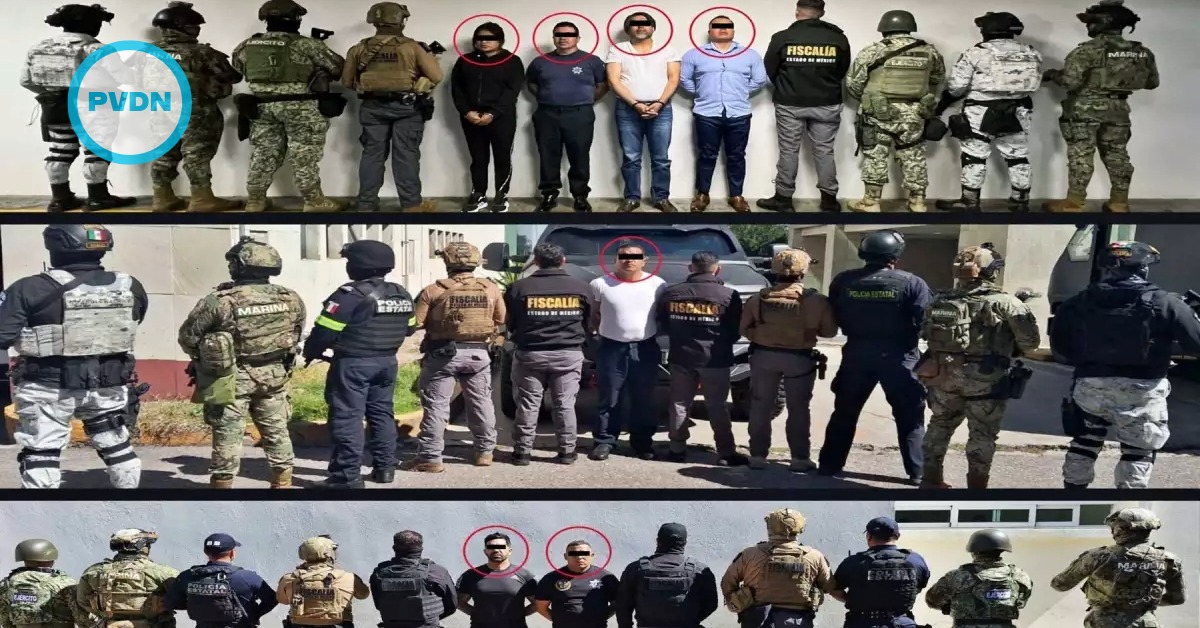
Before dawn on February 5, residents of Tequila — the Jalisco town famed for its namesake spirit — watched their mayor being led away in handcuffs. Diego Rivera, Tequila’s municipal president, was arrested alongside his police chief and other officials, all accused of running an extortion ring out of city hall. Their capture was the latest strike by Operación Enjambre, a federal security initiative dismantling alleged protection networks for organized crime at the municipal level.
The code name “Enjambre,” meaning “swarm” in Spanish, reflects how this operation works: with coordinated, simultaneous raids by multiple agencies, swarming targets so quickly that local power brokers have no time to escape or cover their tracks. Launched in late 2024, Operación Enjambre is led by Mexico’s civilian security ministry but brings together the army, navy, national guard, intelligence agency, and federal prosecutors in an unprecedented joint effort. Intelligence units quietly build cases for months. Then, on an appointed day, federal forces fan out to execute numerous arrest warrants simultaneously across multiple towns before word can spread. It’s a dramatic show of force designed to root out entrenched corruption in one decisive swoop.
Breaking the alliance between officials and cartels
Operación Enjambre’s first sting hit on November 22, 2024, just after President Claudia Sheinbaum took office. In a single day, federal and state teams swept through municipalities in the State of Mexico (Edomex), arresting seven local officials. Among those caught were a sitting mayor suspected of murder, several police chiefs, and even the head of a town social services agency. Their alleged crimes ranged from extortion and “express” kidnappings to orchestrating assassinations — all in collusion with notorious cartels like La Familia Michoacana. One town’s security director, cornered by agents reading out his charges, chose to shoot himself rather than surrender, underscoring the gravity of the accusations.
In small municipalities such as Amanalco, Tonatico, or Tejupilco, these officials had effectively flipped the script on law enforcement. The very people meant to protect citizens were, according to investigators, using their badges to protect criminals instead. Police vehicles, weapons, and authority were allegedly wielded to intimidate local businesses, collect illicit “taxes,” and tip off crime groups about any police presence. In return, officials took bribes or a cut of the profits. This cozy alliance between town hall and cartel often kept violent crime statistics deceptively low — criminal gangs didn’t need rampant murder when compliant officials quietly smoothed the way for their extortion rackets. For years, residents who reported threats found that their complaints went nowhere or, worse, led to retaliation, as some municipal police effectively worked for the other side.
The Tequila case brought these dirty dealings into the national spotlight. The mayor, Diego Rivera, is accused of shaking down the country’s most iconic tequila producer for tens of millions of pesos under the guise of “taxes,” even briefly shutting the distillery when it refused to pay. Jalisco’s governor decried the climate of “ingobernabilidad” (ungovernability) that had taken hold — a local government consumed by infighting, corruption, and intimidation of businesses. Multiple formal complaints of extortion and even gender-based political harassment against the mayor finally triggered federal intervention. With Operación Enjambre, investigators moved in to stop what local authorities couldn’t or wouldn’t. Rivera’s arrest not only freed a vital industry from local tyranny; it also signaled that no corrupt official was beyond the reach of this new strategy, not even a member of the ruling party in a distant state.
High-profile arrests from town halls to police barracks
In just over a year, Operación Enjambre has detained at least 67 municipal officials across several states, the bulk of them in the State of Mexico. The roster reads like a who’s-who of local power: mayors, former mayors, police commissioners, department directors, and city council members. Some arrests have been stunning. In Amanalco, a small mountain town, the sitting mayor was charged with ordering the assassination of her own town councilor — allegedly at the behest of a criminal boss who wanted internal dissent silenced. In another case, an ex-mayor and his brother were arrested for running a mafia-style protection racket that squeezed local merchants for cash with threats of violence.
Yet the pattern is not limited to elected politicians. Police chiefs and commanders have proven to be critical links, often serving as the hands-on enforcers for crime groups. For example, the police director of Ixtapaluca, a populous suburb of Mexico City, was caught on video brandishing a pistol to extort a market vendor. In Tejupilco and Naucalpan, security heads allegedly oversaw networks that committed kidnappings-for-ransom and systematic “floor charge” extortion under the cover of their badges. One Naucalpan police official, Omar Leyva, was convicted and hit with a 40-year prison sentence for his role in such schemes. These are not low-level bribes or victimless crimes; investigators describe deep-rooted conspiracies that turned public institutions into tools of organized crime.
Operación Enjambre has also netted a variety of municipal bureaucrats and political figures who played supporting roles in corruption networks. In one case, the husband of a town mayor — serving as head of the local family services agency — was arrested for allegedly extorting businesses on behalf of La Familia Michoacana, going so far as to have a shopkeeper abducted and beaten for not paying a cartel “fee.” In another, a town council trustee (síndico) and an ex-police director teamed up to terrorize local shop owners into handing over regular payments. The fact that even seemingly mundane offices (such as a land registry director or a public works chief) have been implicated in these busts shows how entire municipal administrations can be compromised. Cartels and splinter gangs were apparently able to embed operatives in multiple departments, ensuring their interests were protected at every turn — from construction permits to prison visitation logs.
Political shockwaves and a new message of accountability
The implications of Operación Enjambre are rattling Mexico’s political landscape. By sweeping up public servants of all political stripes — from members of the ruling Morena party to opposition figures — the operation is sending a blunt warning that “no one is untouchable.” President Sheinbaum underscored this point in a national address, stating that wherever authorities are found colluding with crime, “we have to act.” It was a clear break from a past in which local officials often enjoyed impunity, even amid obvious corruption. In response to the Tequila arrests, even Morena’s own leadership in Jalisco voiced support, emphasizing that justice must be served “without privileges or exceptions,” despite the embarrassment of one of their mayors being led away by federal agents.
This crackdown also arrives at a moment when public outrage over violence and corruption is high. In recent years, Mexico has seen mayors assassinated by cartels, car bombs in once-peaceful towns, and surging extortion that cripples local economies. Against that grim backdrop, Operación Enjambre has been described as the new government’s first decisive show of authority. Security analysts note that it combines two key elements long called for: serious investigative work and inter-agency coordination. Omar García Harfuch, the federal security secretary and former police chief known for his bold style, is orchestrating these raids with a media-savvy approach — personally announcing arrests and highlighting the haul of evidence, weapons, or ill-gotten cash seized. The spectacle of mayors in perp walks is both a public reassurance and a strategic message to other officials who might be in league with criminals.
Crucially, Operación Enjambre is not just about headlines; it’s testing whether Mexico’s justice system can follow through and convict powerful local actors. Early signs are encouraging: of the first 60 detainees under Enjambre, courts have already handed down 18 guilty verdicts, totaling over 800 years in prison. These include hefty terms for police chiefs and a former security commissioner who was convicted of murder. Such outcomes are significant in a country where past anti-corruption dragnets often collapsed in court for lack of solid evidence. A notorious example was the 2009 “Michoacanazo,” when dozens of officials in Michoacán were arrested amid great fanfare — only to be quietly released later due to weak cases. Sheinbaum’s government is determined not to repeat that failure. “What are we doing differently? We’re judicializing,” she declared, implying that thorough investigations and legally sound cases are the priority, not just mass arrests. Indeed, federal prosecutors (FGR) are deeply involved in Enjambre, signaling that these cases will be handled at the national level to prevent local influence or intimidation from derailing them.
Challenges ahead: cleaning house and sustaining momentum
Despite its early accomplishments, Operación Enjambre faces a long road ahead. The web of “narcopolitics” that has ensnared many Mexican towns did not form overnight, and dismantling it will require persistence beyond one-off raids. Investigators acknowledge that for every mayor or police chief taken down, entire networks of lower-level accomplices and even state-level patrons may remain. So far, Enjambre has focused on municipalities—the grassroots of government—where cartel influence is often likened to a cancer. Security experts argue that this approach must expand to address higher offices if evidence leads there, including possibly state officials or regional power brokers who allowed municipal corruption to fester. As one analyst put it, going after mayors is a start, but “narcopolitics doesn’t end at city hall.” The ultimate measure of success will be whether the federal strategy can institutionalize accountability, so that collusion with organized crime becomes a genuine liability for any public servant, not just those unlucky enough to be caught in a sting.
Early indications show a shift in attitude. In areas where Enjambre struck, local residents and honest officials have been emboldened to speak up. The operation relies partly on citizen tips and whistleblower reports, and its well-publicized results may encourage more people to come forward. There are also signs of reform trickling down: state governments are beefing up anti-extortion laws and purging compromised police ranks, inspired by the federal push. Still, sustaining momentum is key. The federal government has signaled that Operación Enjambre will continue “as long as necessary,” and hinted at plans to replicate it in other states facing similar problems. Each new phase of the operation will test the federal-local cooperation. For instance, the collaboration between Sheinbaum’s administration and an opposition-led state like Jalisco in arresting Tequila’s mayor showed that partisan lines can be overcome in the interest of public security. It’s a hopeful precedent, suggesting that tackling corruption might be one arena where consensus is possible.
Ultimately, Operación Enjambre has injected a rare sense of accountability into the local governance of Mexico, a level where impunity had long been the norm. By physically removing corrupt mayors and officers from their positions and hauling them before judges, the campaign offers a tangible answer to communities fed up with being caught between cartel threats and complicit authorities. It demonstrates a new model for combating organized crime: not just confronting gunmen on the street, but dismantling the hidden political scaffolding that enables them to operate. Whether this “swarm” of justice will truly clear out the entrenched hives of corruption remains to be seen. But for now, the message echoing from Mexico’s town halls is unmistakable: those who collude with the underworld can no longer count on City Hall as their safe haven.