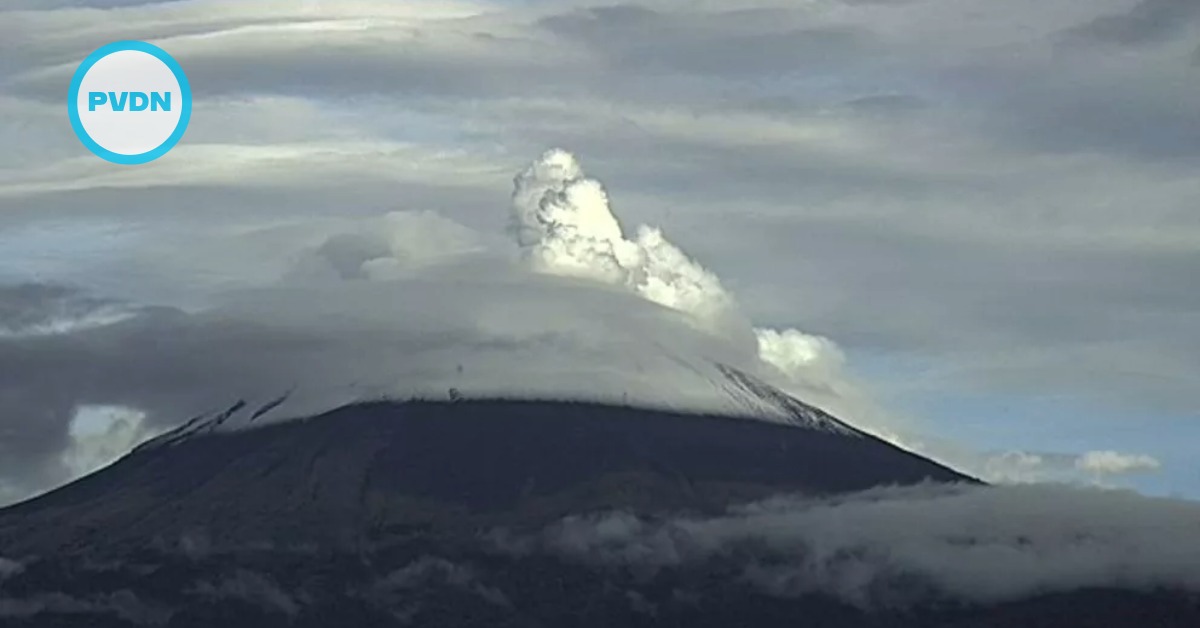
Low but steady Popocatepetl volcano activity brought tremor and gas plumes, keeping Yellow Phase 2 and a strict 12 km safety zone.
Residents across central Mexico woke up to familiar news on Friday. Popocatepetl volcano activity remained low but continuous. Monitoring systems detected short gas and ash emissions and several segments of volcanic tremor during the last 24 hours.
According to the National Center for Disaster Prevention (Cenapred), the volcano produced a series of low-intensity exhalations loaded mainly with water vapour and volcanic gases, with only light traces of ash. One persistent plume overnight rose to less than 500 metres above the crater before drifting toward the southeast. By morning, cameras showed a steady column blowing toward the north and northeast, hanging over the valleys below without major ash fall reports so far.
Cenapred kept the Volcanic Alert Traffic Light in Yellow Phase 2 and repeated a message that has become routine for the communities around the mountain. Authorities urged people not to attempt to climb the volcano and to respect the 12-kilometre exclusion radius around the crater. They also asked residents to stay away from the bottoms of ravines during heavy rain, when sudden mud and debris flows, known as lahars, can rush downhill with little warning.
Popocatepetl volcano activity stays low but steady
Yellow Phase 2 is the intermediate warning level in Mexico’s three-step volcanic alert system. At this stage, Popocatépetl is expected to show frequent small exhalations, occasional minor to moderate explosions and variable volcanic tremor. A constant plume of vapour and gases can carry fine ash to nearby towns. Glowing fragments can fall on the upper slopes, but evacuations are not planned as long as activity stays within this pattern.
The current behaviour fits that description. Instruments have recorded short segments of low-amplitude harmonic tremor. This rhythmic shaking reflects the movement of gas and magma within the conduit. These tremor bursts, combined with the soft exhalations observed overnight, point to a volcano that is restless but not in a rapid-escalation phase.
This week’s report also follows several days of mild unrest. Earlier in the week, Cenapred documented a series of small volcano-tectonic quakes beneath the crater and a handful of exhalations. The alert level remained in Yellow Phase 2. Together, the recent data show a volcano that remains active and closely watched, but without signs that would justify raising the alert level.
Communities stay alert as monitoring continues
For people living in Puebla, Morelos, the State of Mexico and Mexico City, the numbers on the daily Popocatépetl report translate into small practical choices. When the plume leans toward the north or northeast, as it did this morning, neighbourhoods on that side of the volcano prepare for the possibility of light ash on cars, rooftops and streets. Health officials recommend staying indoors as much as possible during ash episodes, keeping windows and doors closed, protecting water tanks and using masks or cloths to cover the nose and mouth when going outside.
Cenapred and civil protection agencies also stress the danger of ignoring the 12-kilometre exclusion zone. Even on a calm day like today, the volcano can launch incandescent blocks and larger fragments that fall without warning around the crater. The risk increases for hikers and climbers who step beyond authorised routes and into restricted high-altitude areas, where a single explosion could be deadly.
Heavy rain remains another concern. Ash and loose volcanic material on the slopes can mix with intense downpours to form fast-moving lahars that roar down canyons and river channels. Authorities ask residents and travellers to avoid the bottoms of ravines and to move to higher ground if they hear unusual rumbling or see water turning suddenly thick and dark.
For now, the message from scientists is steady vigilance rather than alarm. Popocatépetl continues to release gas, ash, and tremor in a way that matches its long-running Yellow Phase 2 pattern. As long as that does not change, daily life goes on under the watchful eye of Don Goyo, with communities balancing routine and preparedness in the shadow of one of Mexico’s most closely monitored volcanoes.