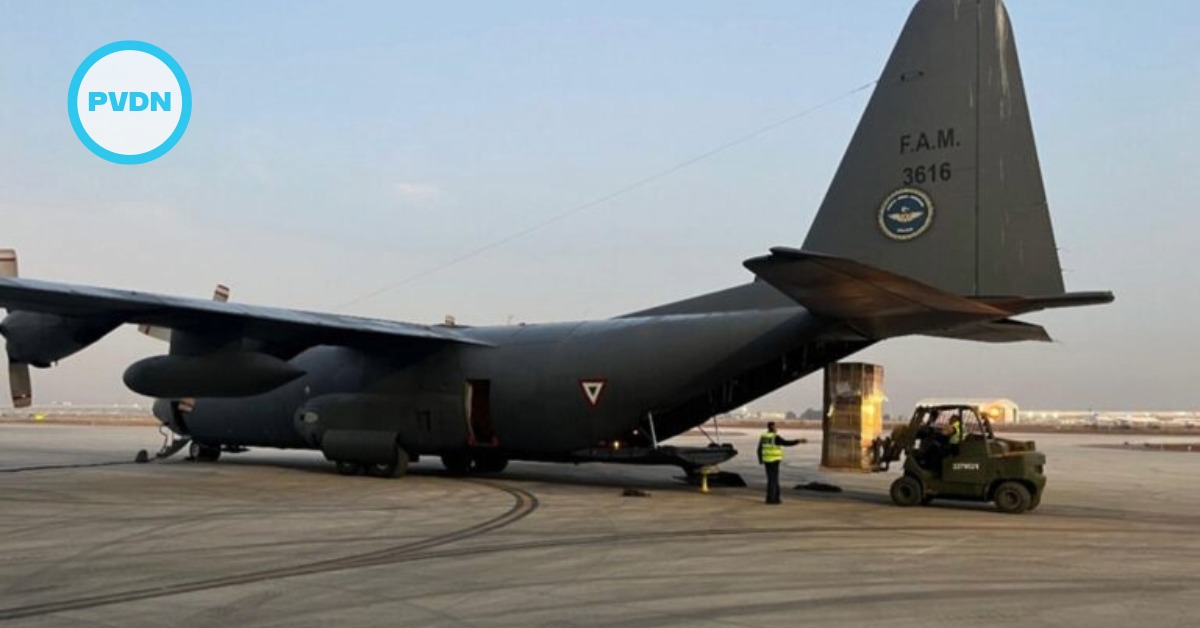
Images of an American military plane parked at Toluca International Airport, outside Mexico City, sparked a storm of questions last weekend. Was this a routine mission or a breach of Mexico’s cherished sovereignty? President Claudia Sheinbaum, caught in the fray, responded swiftly. A training flight meant to boost security cooperation had instead fueled political tension. Now Sheinbaum is quietly tweaking the rules for these cross-border exercises – a move aimed at calming fears while keeping crucial U.S.-Mexico security ties on track.
U.S. Plane’s Toluca Landing Sparks Uproar
It seemed like a routine military logistics mission. Over the past weekend, a U.S. Air Force C-130 Hercules transport plane landed at Toluca International Airport, just west of Mexico City. On board were Mexican security personnel heading to the United States for a training program. However, the sight of an American military aircraft on Mexican soil – especially at a civilian airport – quickly sparked public controversy. Images of the gray Hercules on the tarmac circulated on social media. The unusual sight prompted questions about Mexico’s sovereignty and why a Mexican aircraft or a military air base was not used for the mission.
Opposition lawmakers seized on the issue and demanded an explanation from the government. By law, Mexico’s Senate must authorize any deployment of Mexican troops abroad or the entry of foreign military units into the country. Critics argued that the U.S. plane’s arrival skirted this oversight.
In response, President Claudia Sheinbaum clarified that no special Senate approval was needed in this case. The Hercules carried no U.S. soldiers or weapons into Mexico – it simply picked up Mexican officials. “The United States plane landed, public servants got on that plane, and they went to the U.S. for training,” Sheinbaum explained, noting that Mexico’s Defense Ministry had authorized the flight months in advance. The operation, she stressed, was a logistical part of ongoing bilateral cooperation, not any form of foreign troop presence.
Sheinbaum, who took office after a campaign centered on national sovereignty, emphasized that the Toluca landing did not break any laws. The mission had been green-lit by the National Security Council and the Ministry of Defense back in October. It complied with established protocols under longstanding Mexico–U.S. training agreements. The only unusual aspect, she noted, was the choice of Toluca’s international airport instead of a military base, which drew public attention. Sheinbaum assured Mexicans that if the U.S. aircraft had entered the country without permission or carried armed troops, the government would have intervened immediately. That was not the case here, and the mission was coordinated and permitted under existing agreements.
Sheinbaum Shifts Training Flight Policy
Nonetheless, the uproar over the Hercules landing clearly resonated with the new administration. By mid-week, President Sheinbaum announced an adjustment to prevent such flare-ups in the future. Going forward, Mexican personnel traveling to the U.S. for training will do so on Mexican aircraft, not on U.S. military planes. Sheinbaum said it is “much better” to have a Mexican Air Force plane carry trainees to the United States “than for a U.S. plane to come” into Mexican territory. That decision has now been made at the highest levels. In practice, this means Mexico will strictly limit the entry of U.S. military planes even for joint training exercises. Mexican Air Force or government planes will transport any soldiers or officials bound for courses in the United States.
Sheinbaum underlined that this logistical change does not signal an end to security cooperation – only a change in how it’s carried out. Training exchanges between Mexico and the U.S. will continue, as they have for years. American military instructors and agents also regularly visit Mexico for joint training under carefully defined rules. Those programs will go on, but the optics will be handled differently. By using Mexican aircraft for transport, Sheinbaum aims to avoid stirring public sensitivities while still reaping the benefits of U.S.-Mexico collaboration against crime and security threats.
This episode highlights the delicate balance Mexico’s leader is trying to maintain. In recent weeks, Washington has ratcheted up pressure on Mexico to crack down on drug cartels. U.S. officials – including President Donald Trump – have even floated the idea of direct American intervention. Sheinbaum has firmly rejected any violation of Mexico’s sovereignty, even as she works with U.S. counterparts on shared security goals. The Hercules controversy was her first test.
By swiftly tweaking the protocol for training flights, Sheinbaum has shown she is willing to refine cooperation arrangements to uphold national pride and legal norms. The hope is that these new measures will let Mexico continue its security partnership with the U.S. on its own terms. Ideally, they will prevent any more unexpected scenes of foreign military planes on Mexican tarmac.