Cancún has spent decades growing outward from its beach hotels, pushing roads and housing deeper into the jungle and wetlands. That growth brought millions of visitors and thousands of jobs, but it also left behind irregular neighborhoods, endless traffic, and flooding that hits the poorest streets first. City hall now says it is ready to change course.
This week, the municipality of Benito Juárez signed a cooperation agreement with ONU-Habitat to rewrite Cancún’s master blueprint for growth. The deal puts the United Nations’ urban agency at the table as the city updates its Urban Development Program. This document determines where housing, hotels, industry, and green space can be located. Officials say the goal is to align the plan with international standards on sustainability, climate risk, and people-focused design.
The new partnership makes Cancún the first municipality in Quintana Roo to work directly with ONU-Habitat on a full review of its urban plan. State housing and development authorities are also deepening their own cooperation with the agency, framing the move as part of a broader effort to build more just, livable cities across the Caribbean coast. Behind the formal language is a simple promise that residents have heard many times before but rarely seen fulfilled: that planning should start with the people who actually use the city every day.
Cancun urban plan
City leaders say the agreement will open a months-long process that includes workshops with experts, neighborhood meetings, and technical studies on land use, water, public transport, and housing. The administration has already flagged more than 15,000 irregular lots that emerged during years of speculative growth. Many of those properties lack paved streets, drainage, or legal certainty, even as prices for formal housing climb out of reach for local families.
The updated plan is supposed to tackle that gap head-on. Officials talk about directing new development toward areas with services, stopping the sprawl of unplanned subdivisions, and tying housing to better bus routes and safe streets for walking and cycling. ONU Habitat’s team is expected to bring tools and training so local planners can weigh flood risk, access to jobs, and basic services, instead of just following where private projects appear first.
That shift would put Cancún closer to changes already underway in Mexico’s national housing policy. In recent years, federal housing lender INFONAVIT has moved away from financing far-flung subdivisions and started linking its loans to how close workers live to jobs, schools, and clinics. Urban specialists argue that cities that keep growing on the edge, without transit or services, lock low-income families into long, costly commutes and greater climate vulnerability. Cancún’s new planning process is an opportunity to break that pattern at the local level.
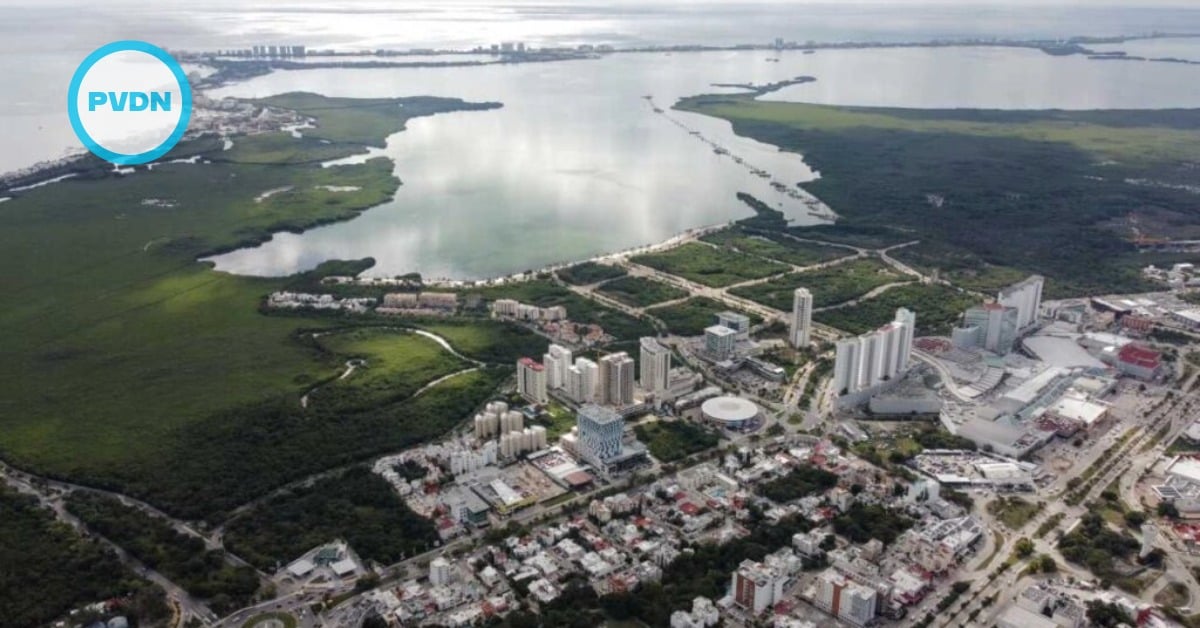
For long-term residents, the announcement also reopens a deeper conversation about what kind of city Cancún wants to be. Created in the 1970s as a state-backed resort, the town grew from a fishing village of barely one hundred people to more than seven hundred thousand inhabitants in just a few decades. Satellite images show how hotel towers, highways, and suburbs have replaced mangroves and coastal vegetation, while tourism now generates a large share of Mexico’s foreign currency. That success came with a heavy price: sewage spills, eroded beaches, and more frequent flooding in low-lying areas.
Scientists have warned that Quintana Roo’s flat, low-lying coastline makes it one of the Mexican states most exposed to sea-level rise. Studies of the region point to potential mangrove losses, greater economic damage from storm surges, and more than a million people at risk of flooding under worst-case scenarios toward the end of the century. For a city built between the sea and the lagoon, planning where and how new neighborhoods grow is no longer just a question of aesthetics or traffic. It is about protecting lives, homes, and the tourism economy that sustains them.
From pledge on paper to real change
The cooperation agreement with ONU Habitat is still a starting point, not a finished map. Much will depend on how openly city hall shares information, who gets to sit at the table, and how seriously it takes feedback from ordinary residents. A process that is dominated by hotel and real estate interests would risk repeating old mistakes. One that brings in workers from the hotel zone, street vendors, transport users, and families from irregular settlements could instead draw a much sharper picture of where the city is failing and what needs to change.
Residents in inland neighborhoods already have a wish list. Many want reliable drainage so heavy rains no longer turn their streets into canals. Others ask for shaded sidewalks, lighting, and bike lanes so their children can move safely between school, work, and home without depending on a car. For people who spend two or three hours a day on crowded buses, a serious plan for public transport and transit-oriented housing would feel like more than a planning buzzword. It would be a tangible gain in time, safety, and income.
The state government has framed its partnership with ONU Habitat as part of a “development with a human face” agenda, one that puts quality of life ahead of raw construction numbers. If Cancún’s new Urban Development Program manages to balance environmental protection, fair access to housing, and improved mobility, it could become a reference for other fast-growing coastal cities in Mexico. If it stalls or bends to short-term interests, it will be remembered as another missed chance to fix a town built at high speed for too long.
For now, the signature on the agreement signals that Cancún’s growth model is finally up for debate. The real test will come as draft maps and zoning rules are released and residents see whether their daily routes, flood-prone blocks, and overcrowded buses are reflected in the final document. A people-first plan will not erase decades of uneven growth, but it can begin to steer the city toward something many locals have been asking for quietly for years: order, fairness, and a chance to enjoy the place they keep working so hard to sustain.