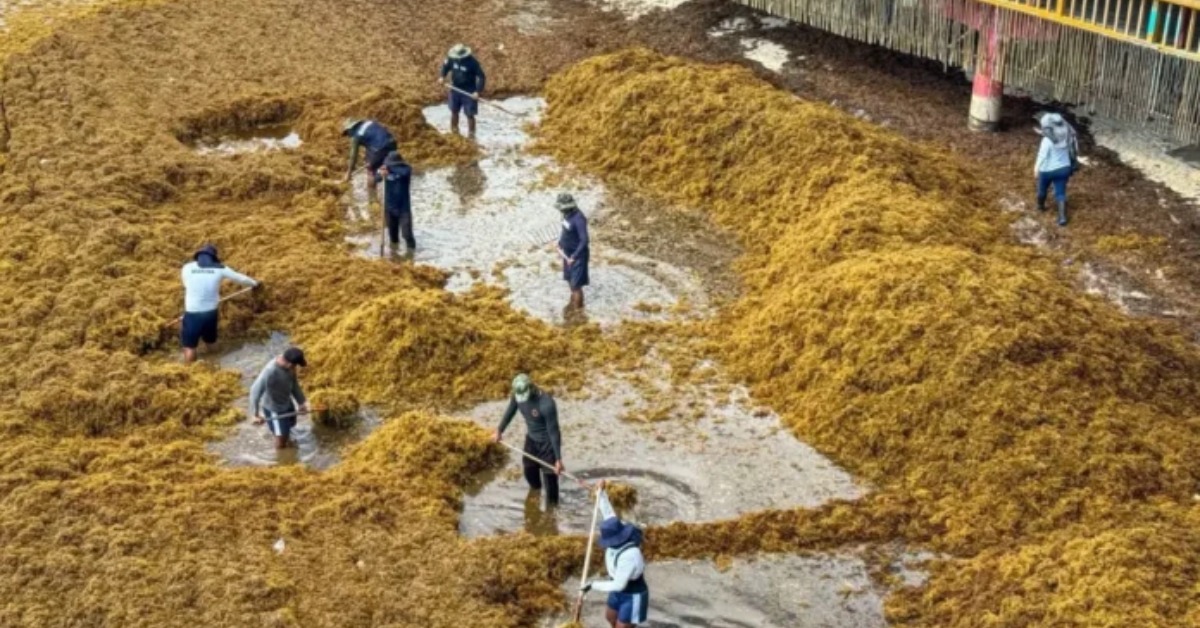
A legal change last year seemed to open the door to private offshore collection of sargassum in the Mexican Caribbean. But as Playa del Carmen heads into another early season, business leaders say that opening still has not become a workable system. The result is a familiar scramble on shore, a heavier dependence on public crews at sea, and a growing question for the Riviera Maya: who can move fast enough to stop the algae before it becomes a beach crisis?
Why this matters now
Playa del Carmen is entering another sargassum season, known locally as sargazo, with a familiar problem. Business leaders say private money is willing to help. But unclear rules still keep that investment on the sidelines. That matters because the 2026 season started early. Local officials activated their response in February after atypical recurrences in January. They also said the municipality had already removed 1,288 tons before March.
The municipality says it has 86 million pesos available for 2026 sargassum work. The money comes from the local environmental sanitation levy and a disaster fund. That should help finance shore cleanup. But it does not solve the bigger dispute offshore. Businesses say a legal opening exists on paper, yet there is still no clear operating path for private collection at sea.
The law changed but the system did not
In August 2025, the federal government updated the Carta Nacional Pesquera. It recognized Caribbean sargassum as a fishery resource with development potential. That was a major shift. It moved the algae out of a legal gray area. It also suggested permits could support collection at sea and later industrial use.
Yet the same federal document helps explain why frustration persists. It says important management tactics are still under development. It also calls for technical rulings, more research, and a management plan. That is the gap now drawing complaints in Playa del Carmen. The legal status changed first. The day-to-day rules for a functioning private market still appear incomplete.
Why offshore collection matters
That gap matters because offshore collection is very different from beach cleanup. Once sargassum reaches the sand, the problem changes. It becomes a daily removal issue. It becomes a disposal issue. It also becomes an environmental issue. UNAM researchers say the goal should be to intercept the algae before landfall. They warn that poor disposal can release leachate that filters into aquifers.
There is also a cost problem. When the algae reaches the beach, cleanup becomes labor-heavy and constant. It affects visitors, hotels, restaurants, and tour operators. It also drains public budgets. For Playa del Carmen, this is not just a seasonal nuisance. It is a question of infrastructure, environmental management, and how much damage can be reduced before the shoreline becomes the final collection point.
Public crews are carrying the load
Authorities are not standing still. In January, Semar said it had removed about 178 tons statewide in the first 20 days of 2026. It said the response already included an ocean-going sargassum vessel, coastal boats, amphibious units, support craft, and barriers. In Playa del Carmen, the local government later expanded its barrier plan to five kilometers. It also said Semar would reinforce the effort with boats and daily monitoring.
Official Marina bulletins in early March showed why officials moved early. They placed conditions at moderate and projected possible arrivals near Playa del Carmen within 24 to 48 hours. Business leaders say that is exactly the problem. Public agencies are carrying most of the offshore load even as the season builds. Their complaint is not that the government is absent. It is that public capacity alone is not enough for a problem this large.
What comes next
The next test is practical, not rhetorical. Can federal fishery and environmental rules be translated into clear permits, clear methods, and clear safeguards? Can the port and storage infrastructure support regular work at sea? Until those answers are settled, Playa del Carmen will continue to rely on municipal cleanup crews and federal containment efforts rather than on a broader response that includes private capital.
For residents and readers watching the beaches, the problem looks simple. Too much algae reaches the shore. But the dispute behind this season is more technical. It sits in permits, management rules, and investment timing. If those pieces do not move faster, Playa del Carmen may keep fighting sargassum in the most expensive place possible: on the beach.