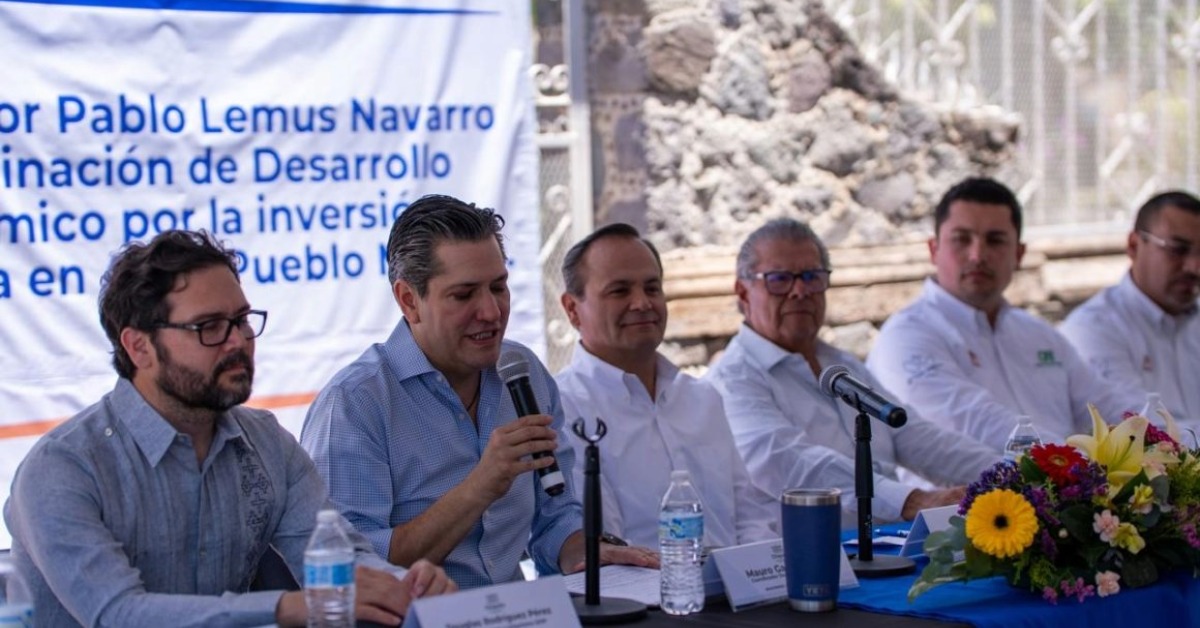
Ajijic is starting a project that many residents have wanted for years, but one that will also test patience in the town center. Authorities say the plan will remove overhead electric and telecom lines from 23 blocks and move them underground in phases. The promise is a safer, cleaner, and more orderly historic core. The unanswered part is how smoothly the work will move in a town where daily life, tourism, and small business all depend on those same streets.
Ajijic moves ahead with an underground utility overhaul
Ajijic is preparing to remake the look and function of its historic center by moving overhead electric and telecommunications lines underground. Authorities say the project will cover 23 central blocks and will replace a web of poles, transformers, wires, and public lighting infrastructure with buried systems designed to reduce visual clutter and improve safety.
The work is centered in the first square of town, within the area between Luis Donaldo Colosio and Lago de Chapala avenues, and Colón and Marcos Castellanos streets. For readers outside Jalisco, that puts the project in the heart of Ajijic, one of the most visited and best-known communities on the north shore of Lake Chapala. It is also one of Mexico’s best-known retirement destinations, which helps explain why a local public-works project has broader interest than it might elsewhere.
What the project will include
The announced scope is larger than a simple wire cleanup. Authorities say the project includes removing 149 concrete poles and 15 pole-mounted transformers, along with replacing more than 2.5 kilometers of medium-voltage lines and 6.4 kilometers of low-voltage lines. The plan also calls for more than 16,000 meters of underground ducting, new buried public lighting and telecom infrastructure, nine submersible transformers, and more than 1,200 household service connections.
That matters because the job is not just cosmetic. In towns like Ajijic, overhead lines often reflect years of layered expansion by electric, phone, cable, and internet providers. The result can be a dense, uneven network that affects the streetscape’s appearance and complicates maintenance. Officials and project backers have framed the Ajijic plan as both an urban-improvement effort and a public-safety measure, arguing that the work addresses long-standing risks posed by exposed, aging overhead infrastructure.
Why this matters more in Ajijic than in many towns
Ajijic is not just another neighborhood getting a public-works upgrade. It is a Pueblo Mágico with a built identity that depends heavily on its streets, facades, plazas, galleries, restaurants, and walkable center. It also has an unusually international profile for a town of its size. That means infrastructure decisions affect not only local residents and merchants, but also tourism, property markets, and the image the town projects to outsiders.
For many residents, the project speaks to a larger tension that has shaped Ajijic for years. The town has grown in visibility, real estate value, and visitor traffic, but much of its basic infrastructure still shows the patchwork pattern common across Mexico. Burying utilities will not solve every pressure facing Ajijic, but it does show that local officials are trying to match the town’s economic importance with more durable public investment. In that sense, this is as much about how Ajijic presents itself as it is about where cables physically go.
What residents and businesses should expect
Authorities say the work will be carried out in phases and by section, with each stretch opened, completed, and then closed before crews move to the next one. That approach is meant to limit disruption in an area where businesses rely on foot traffic and where road closures can quickly affect daily routines. Officials have also said they plan to hold information meetings with residents and merchants before the work intensifies, so people understand the timing and which blocks will be affected first.
The first phase is expected to be funded by the municipality of Chapala, while later stages will have support from the Jalisco state government. Local reporting has not been fully consistent on the final project total, placing it at roughly 30 million to 35 million pesos, but the structure appears clear: the intervention will be split into three stages, with CFE expected to execute the core electrical work, and telecom coordination will be handled alongside that process. Authorities have also said they want to avoid interruptions to basic services such as electricity, water, and internet during work.
The bigger test will come after the announcement
The announcement itself is the easy part. The harder part will be maintaining confidence once trenches open in central Ajijic and businesses begin measuring the real cost of construction delays, blocked access, and uncertainty. That is especially true in a town where many small businesses depend on daily customer flow and where a large share of residents are older adults who value reliable services and accessible streets.
Still, the project has the potential to leave a visible mark long after construction crews leave. If it stays on schedule and avoids major service failures, Ajijic could gain a cleaner town center with fewer overhead obstructions and a more coherent infrastructure base. If it stalls, runs long, or produces repeated disruptions, it may deepen local skepticism about whether high-profile urban projects are designed more for image than for daily life. That is why this project matters. It is not only about underground cables. It is about whether Ajijic can modernize its center without losing the calm, usable, human scale that made people care about the place in the first place.