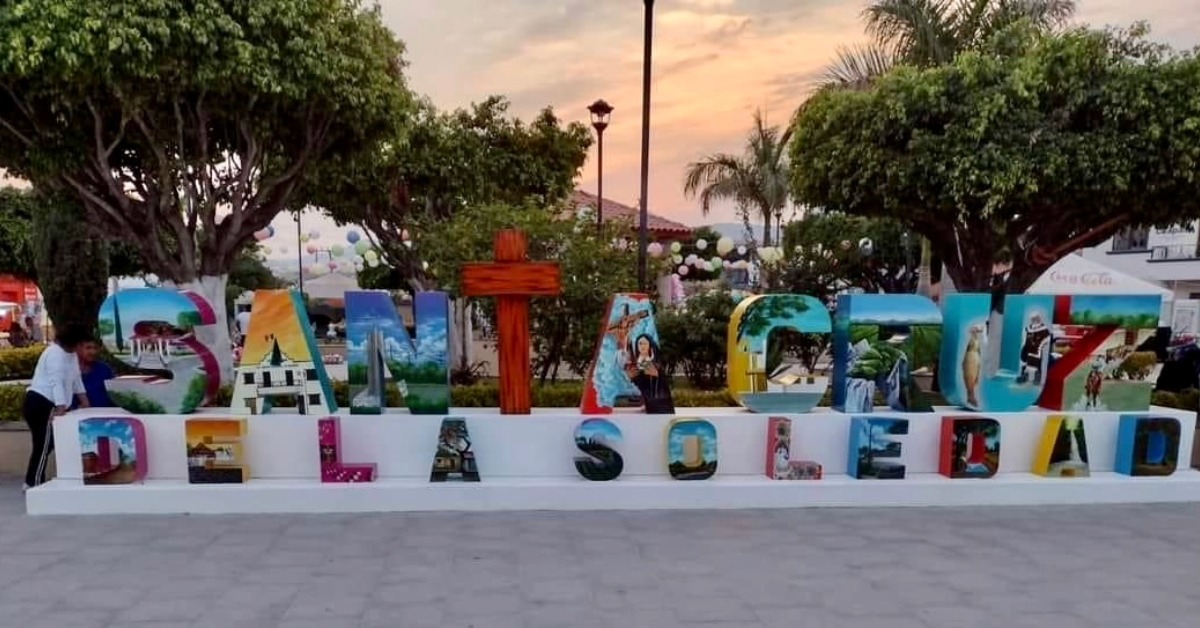
Chapala has begun an overhaul of the main entrance and bus stop in Santa Cruz de la Soledad, a delegation on the eastern side of the municipality. According to local officials, the work started on March 30 and is being carried out in stages to reduce traffic problems at the site. The project includes a 70-meter retaining wall, improvements to the bus stop area, and new landmark letters meant to strengthen the community’s visual identity.
At one level, this is a straightforward local public works story. A municipality is improving a key access point and trying to make a public transit stop safer and more presentable. But for smaller communities in Mexico, entrance projects often carry more weight than their budget might suggest. They are practical works, but they also convey political and social messages. They tell residents that their town is being seen, funded, and folded into the municipality’s broader development plans.
That matters in a place like Santa Cruz de la Soledad, which sits within the larger Chapala municipality but does not receive the same outside attention as Ajijic or Chapala proper. International readers often know the Lake Chapala area through its expat hubs, real estate market, or lakeside tourism. Smaller delegations can feel less visible in that picture. A project at the town entrance does not change that overnight, but it does show how local governments often try to improve day-to-day infrastructure while also reshaping how a community is perceived.
More than beautification
The most useful way to understand this project is not as a beautification effort alone. The retaining wall suggests a functional need tied to stability and site improvement. The bus stop work points to daily use by residents, workers, and visitors who rely on public transportation. The visual elements, including the planned letters, are the parts people notice first, but they sit alongside basic infrastructure that can affect comfort, safety, and traffic flow.
That combination is common across Mexico. Municipal governments often bundle small mobility fixes with image-making features. The logic is simple. If a town entrance looks neglected, the area can feel neglected too. If the bus stop is uncomfortable or poorly integrated into the road edge, it affects daily life more directly. When both are addressed together, officials can present the project as both useful and symbolic.
There is also a local continuity here. Santa Cruz de la Soledad already has landmark letters in its civic plaza, installed during earlier municipal efforts. The new work appears aimed at extending that visual identity to the entrance itself rather than limiting it to the town center. For residents, that kind of repetition matters. It creates a more defined sense of place. For visitors, it turns an otherwise ordinary roadside stop into a clearer civic gateway.
Why the May 3 target matters
The timing is not accidental. Local authorities say they want the entrance ready for May 3, the planned inauguration date. In Santa Cruz de la Soledad, that date aligns with Día de la Santa Cruz, the community’s most important annual religious and civic celebration. That gives the project a deadline, but it also gives it meaning.
In many Mexican towns, patron saint or patronal festival dates are when local governments try to deliver visible works. The reason is partly practical. Those are the days when the community gathers, public spaces fill up, and returning family members see the town at its liveliest. But the timing is also political. A completed project unveiled during a major celebration becomes part of the festival itself. It turns a construction job into a public statement about municipal presence and local pride.
For international readers, that context helps explain why a bus stop and entrance wall can become a headline. These are not just roadside features. They are part of how a town presents itself during its most important public moment of the year. In a community where tradition, religion, local identity, and municipal spending overlap, the entrance becomes both infrastructure and stage.
What residents should watch next
The immediate question is whether the municipality meets its own timeline. Staged construction can limit disruption, but it also means residents will be watching how quickly each section moves and whether the finished work matches the promise. In smaller communities, people tend to judge these projects less by the announcement and more by the details. Does the bus stop actually improve waiting conditions? Does the traffic flow remain manageable? Does the entrance feel more secure and better organized once the work is complete?
The broader question is whether this remains a one-off improvement or signals more attention to Santa Cruz de la Soledad. Entrance upgrades can serve as the visible front edge of broader public works, or they can remain isolated interventions with little follow-through. That distinction matters because residents do not live in a rendering or an inauguration photo. They live with drainage, sidewalks, transit access, and maintenance after the ribbon cutting.
For now, the project is best read as a small but telling sign of how Chapala is trying to balance service improvements with community image in one of its lesser-known delegations. It is not the biggest project in the region. It does not try to be. But for a town preparing for May 3, the condition of its entrance says a great deal about how it wants to be seen.