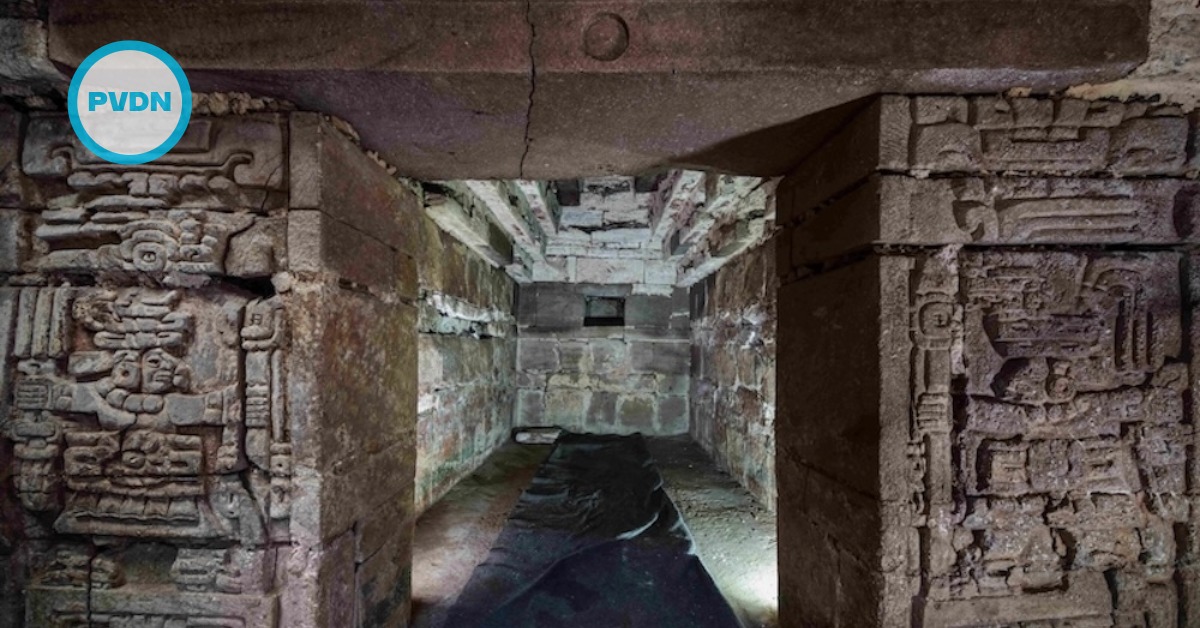
Beneath a quiet hill in Oaxaca, archaeologists have uncovered a spectacular secret: an ancient Zapotec tomb sealed for over a millennium. Inside this intact burial chamber, vibrant murals and intricate sculptures hint at the stories of a long-lost civilization. The discovery has experts excited, but leaves them with many questions. Who was buried with such honor? What do the symbols on the walls reveal about the world of the Zapotecs? This remarkable find is only beginning to unveil its mysteries.
Archaeologists in southern Mexico have uncovered a remarkably intact 1,400-year-old Zapotec tomb in Oaxaca’s central valleys. Mexico’s President Claudia Sheinbaum praised the tomb’s exceptional preservation and the wealth of information it holds, calling it “the most important archaeological discovery of the last decade.” The tomb boasts vivid murals and intricate carvings that reveal new insights into the life, death, and beliefs of the ancient Zapotec civilization.
The tomb lies beneath a rocky hill known as Cerro de la Cantera, near the town of San Pablo Huitzo. The Mexican government publicly announced the discovery in January 2026, highlighting its importance.
A Time Capsule of Zapotec Art and Ritual
Entering the tomb is like stepping into a time capsule from the Zapotec Classic period around AD 600. The burial complex consists of an antechamber and a main chamber, both adorned with symbolic art. Above the doorway, a sculpted owl spreads its wings — a creature that in Zapotec mythology represents night and death. The owl’s beak is carved to cover the face of a painted Zapotec figure at the doorway. Archaeologists believe this figure depicts the ancestor for whom the tomb was built.
The door jambs flanking the entrance are carved with the reliefs of a man and a woman in elaborate headdresses. Each figure holds ritual objects in their hands. Archaeologists interpret these figures as possible guardian spirits or protectors watching over the tomb.
Inside the inner burial chamber, fragments of vibrant mural paintings still cling to the walls despite the passage of fourteen centuries. The murals are painted in rich hues of ochre, white, green, red, and blue. They depict a procession of figures carrying bundles of copal incense—an aromatic resin used in sacred ceremonies. The painted characters appear to be walking toward the entrance, perhaps as part of a ritual homage to the tomb’s occupant. Stone panels above the doorway are engraved with Zapotec calendar glyphs, likely recording dates or names linked to the deceased. These details speak volumes about the elaborate symbolism the Zapotecs wove into their funerary spaces.
Clues to Zapotec Society and Beliefs
This extraordinary tomb offers a rare glimpse into the social structure and spiritual world of the Zapotec people. The elaborate architecture and artwork suggest the person buried here was an elite — a “Zapotec lord.” It’s possible his descendants venerated him as an ancestral protector. The presence of the owl and other symbols of death and power points to a deep pre-Hispanic belief system. In Zapotec cosmology, the afterlife was closely connected to the broader universe.
The owl motif at the threshold underscores the Zapotec view of night and death as intertwined, guiding the soul’s passage. Meanwhile, the male and female guardian figures hint at a dualistic aspect of Zapotec cosmology and social roles. It appears that both masculine and feminine forces were invoked to safeguard the journey of the dead.
The funerary rituals illustrated by the murals align with what historians know of Mesoamerican practices. Offerings of copal incense and other goods were commonly used to honor the deceased and petition the gods. Yet finding such well-preserved imagery in its original context is extremely uncommon. It allows archaeologists to study these rituals directly, rather than piecing together clues from scattered artifacts. Every element adds to our understanding of how Zapotec society was organized and how its people honored their dead. Scholars are now eagerly decoding the layers of meaning about hierarchy, religion, and ancestor worship encapsulated in this single tomb.
Preserving and Understanding a Lost Heritage
The discovery is not only a boon for historians but also a challenge for conservators. For centuries, the tomb’s fragile murals and carvings lay sealed underground. Now, a team from Mexico’s National Institute of Anthropology and History (INAH) is working to carefully stabilize them. Alongside this preservation effort, researchers are conducting meticulous analyses of ceramics, human remains, engravings, and pigments from the site. These interdisciplinary studies span archaeology, iconography, epigraphy, and physical anthropology. The aim is to extract every bit of information the tomb has to offer.
They hope to determine who was buried here and the person’s status in life. They also aim to understand the exact nature of the funerary rituals performed in that individual’s honor.
This Zapotec tomb’s significance also resonates beyond the academic sphere. It draws attention to the rich pre-Hispanic legacy of Oaxaca, a region famed for the Zapotec capital Monte Albán. The Zapotec civilization thrived in southern Mexico between roughly 500 BC and 900 AD. Its major center of power was Monte Albán — a city of tens of thousands that today is a UNESCO World Heritage site. At its height, Monte Albán’s nobles built elaborate tombs adorned with murals and sculptures. The newly found burial at Huitzo stands on a par with those grand funerary complexes. It confirms the sophistication and reach of Zapotec culture across the valleys of Oaxaca.
As experts slowly unlock its secrets, this ancient tomb is shedding new light on a civilization that still holds many mysteries.
With information from La Jornada, INAH Press Release, The Star (DPA), Heritage Daily