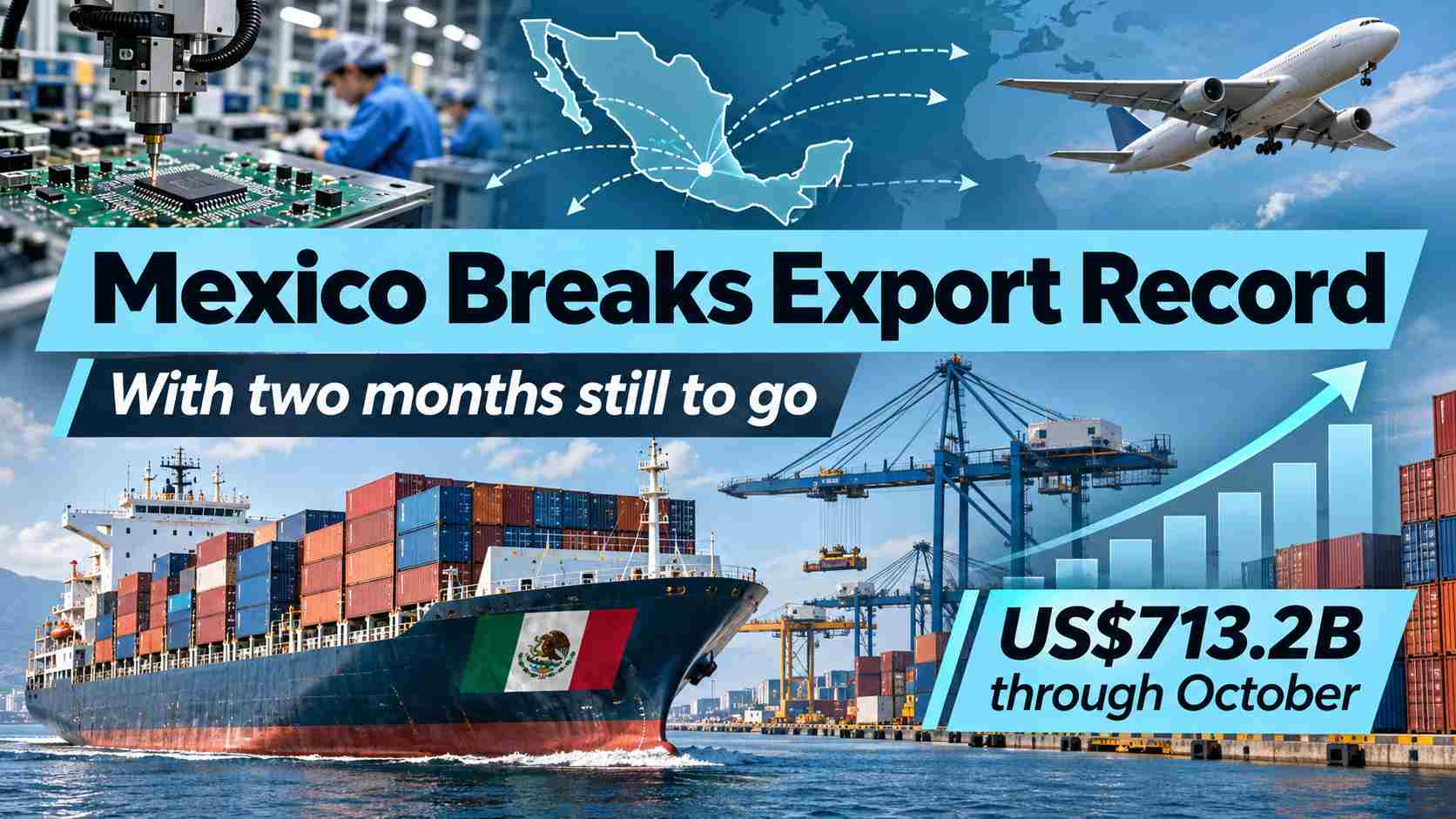
Mexico’s exports reached a record US$713.2 billion through October 2026, surpassing last year’s total as manufacturing drives international trade.
Mexico City, Mexico, November 27, 2026 – Mexico has already exported more goods in the first ten months of 2026 than it did during all of last year, setting a new annual record with November and December still to be counted.
According to figures released Friday by the National Institute of Statistics and Geography (INEGI), Mexican exports reached US$713.2 billion between January and October, an increase of 30.3% compared with the same period in 2025.
That puts Mexico nearly US$49 billion ahead of its previous annual record of US$664.3 billion, based on the latest revised figures.
October alone brought another milestone, with merchandise exports reaching approximately US$86 billion, up 30.2% from a year earlier.
The figures are particularly noteworthy given the uncertainty surrounding Mexico’s trade relationship with the United States, ongoing tariff disputes and questions about the future of the North American trade agreement.
But perhaps the most interesting part of Friday’s report is what Mexico is selling to the rest of the world and how that is changing.
Electronics are becoming a major export driver
Mexico has long been recognized as one of the world’s leading automobile manufacturing centers, but the automotive industry is not responsible for most of this year’s export growth.
Manufactured goods accounted for 92.5% of Mexican merchandise exports during the first ten months of 2026, generating approximately US$659.8 billion in sales.
According to an analysis of the latest trade figures, non-automotive manufacturing exports increased 45.4% during that period, compared with growth of just 1.8% in automotive exports.
In October, several manufacturing categories recorded significant year-over-year increases:
- Electrical and electronic equipment: 73.6%.
- Steel industry products: 13.2%.
- Specialized industrial machinery and equipment: 7.7%.
- Metallurgical products: 7.4%.
- Automotive products: 5.6%.
The growth in electronics is particularly interesting because Mexico appears to be benefiting from the enormous investments being made internationally in artificial intelligence, computing infrastructure and data processing.
A Banco de México analysis reported Thursday by El Economista found that computers, peripheral equipment and electronic components accounted for 82% of the increase in non-automotive manufacturing export values between January 2024 and September 2026.
That suggests Mexico is finding opportunities in the global technology industry at a time when its traditional automotive sector is navigating changes in consumer demand, manufacturing strategies and international trade policy.
The United States remains Mexico’s biggest customer
Despite efforts to expand commercial relationships with other countries, Mexico remains heavily dependent on American consumers and businesses.
The United States accounted for approximately 85% of Mexico’s non-oil exports during the first ten months of 2026.
Non-oil exports destined for the United States increased 33.4% during that period, while those headed to other countries grew 20.9%.
The difference became even more pronounced in October, when non-oil sales to the United States increased 36.8% from a year earlier, compared with growth of just 0.8% in shipments to the rest of the world.
The numbers help explain why negotiations surrounding the United States-Mexico-Canada Agreement, known as USMCA or T-MEC in Mexico, remain so important to the country’s economic future.
As Vallarta Daily reported Wednesday, Mexico avoided the latest round of proposed U.S. tariffs, although Washington’s investigation into Mexican manufacturing remains open.
Mexico’s growing export business demonstrates the importance of maintaining access to the American market. It also illustrates the risks associated with depending so heavily on a single trading partner.
Mexico is buying considerably more from abroad, too
While the export record is grabbing headlines, imports have also increased substantially.
Mexico purchased approximately US$703.7 billion in foreign goods between January and October, representing growth of 27.9% compared with the same period last year.
Much of that money was spent on materials, components and other products that businesses use to manufacture goods.
According to Mexico’s latest import figures, purchases of intermediate goods increased 34% during the first ten months of the year and accounted for approximately 80% of the country’s total merchandise imports.
This is an important part of understanding Mexico’s manufacturing economy.
A computer assembled in Mexico, for example, may contain processors, memory chips and other electronic components manufactured elsewhere. Mexico may export the finished product, but a substantial portion of its value originated outside the country.
Increasing the number of components manufactured domestically would allow Mexico to retain more of the economic benefits associated with its growing export industry.
Mexico turns its trade deficit into a surplus
Despite the increase in imports, Mexico has sold more merchandise abroad than it has purchased from other countries so far this year.
Figures from Banco de México’s international trade statistics and Friday’s INEGI release show a significant improvement in the country’s merchandise trade balance.
During the first ten months of 2025, Mexico recorded a trade deficit of approximately US$2.87 billion.
During the same period this year, it recorded a surplus of US$9.55 billion.
A trade surplus simply means that the value of goods sold abroad exceeded the value of goods purchased from other countries.
It does not represent government revenue or corporate profits, but it provides a useful indication of the country’s international trading position.
Mexico finished October with a monthly surplus of US$298.2 million, reversing the deficit recorded in September.
Oil is no longer the export powerhouse it once was
For decades, petroleum played a central role in Mexico’s international trade.
Today’s figures paint a very different picture.
Oil-related products accounted for just 2.5% of Mexico’s merchandise export earnings through October, and their value declined slightly compared with the same period last year.
October was particularly challenging for crude oil exports.
Mexico exported approximately 408,000 barrels of crude per day during the month, compared with 717,000 barrels per day in October 2025.
Even though international prices for Mexican crude were considerably higher than a year earlier, the decline in export volumes contributed to lower overall petroleum export earnings.
Meanwhile, Mexico continued to import substantial quantities of petroleum products.
The country’s success in manufacturing has more than compensated for its petroleum trade deficit this year, further illustrating how much the Mexican economy has changed over recent decades.
Agricultural exporters see mixed results
Mexico’s agricultural sector has not enjoyed the same broad success as manufacturing.
Although agricultural and fishing exports increased 7.4% in October, their accumulated value during the first ten months of 2026 was 1.6% lower than during the corresponding period last year.
The performance also varied considerably depending on the product.
October’s agricultural trade figures show particularly strong growth in the value of unroasted coffee exports, followed by onions, garlic, cucumbers and citrus fruits.
Other producers experienced substantial declines, including exporters of seafood and certain tropical fruits.
For Mexico’s agricultural communities, the country’s overall export record does not necessarily reflect what farmers are experiencing in their own businesses.
Why record exports don’t mean the economy grew 30%
This is where the numbers require a little perspective.
If Mexico’s exports are growing by more than 30%, why isn’t the entire economy growing at anything close to that rate?
Export figures measure the monetary value of goods sold internationally. Gross domestic product measures the value added through economic activity within the country.
The two are related, but they measure very different things.
Banco de México’s recent manufacturing analysis found that while the dollar value of non-automotive manufacturing exports nearly doubled between January 2024 and September 2026, manufacturing production excluding transportation equipment increased just 2.2%.
The difference partly reflects the types of products being exported, their prices and the substantial use of imported components.
Earlier this week, Vallarta Daily reported that Mexico’s economy grew 3.3% during the third quarter, with the services sector playing a significant role.
The export record is encouraging, but it should not be mistaken for an equally dramatic improvement in domestic economic activity, employment or household purchasing power.
What this means for people living in Mexico
A strong export industry can support employment, attract investment and generate demand for transportation, logistics and professional services.
It can also support the Mexican peso by generating foreign currency earnings, although exchange rates are influenced by numerous other factors, including interest rates, international investment and political developments.
For foreign residents living on income earned in dollars, a stronger peso could make everyday expenses in Mexico more expensive when converted into their home currency.
However, the export figures alone are not sufficient to predict where the peso will move in the coming months.
For Mexican households, the more important question is whether the country’s export success translates into better-paying jobs and improved purchasing power.
As our recent coverage of rising inflation and food prices in Mexico demonstrated, positive national economic indicators do not always mean families are finding it easier to pay their monthly bills.
Mexico heads toward another record year
INEGI is scheduled to release its November merchandise trade figures on December 23, providing another indication of how Mexico will finish 2026. The latest figures remain preliminary and may be revised.
The country has already established a new annual export record, and the final two months should extend that achievement.
The longer-term challenge is making sure Mexico captures more of the value associated with the products it exports, develops stronger domestic supply chains and creates opportunities beyond its established manufacturing centers.
Selling more goods to the rest of the world is an achievement worth recognizing. Turning those sales into lasting economic improvements for people living in Mexico is the next challenge.