
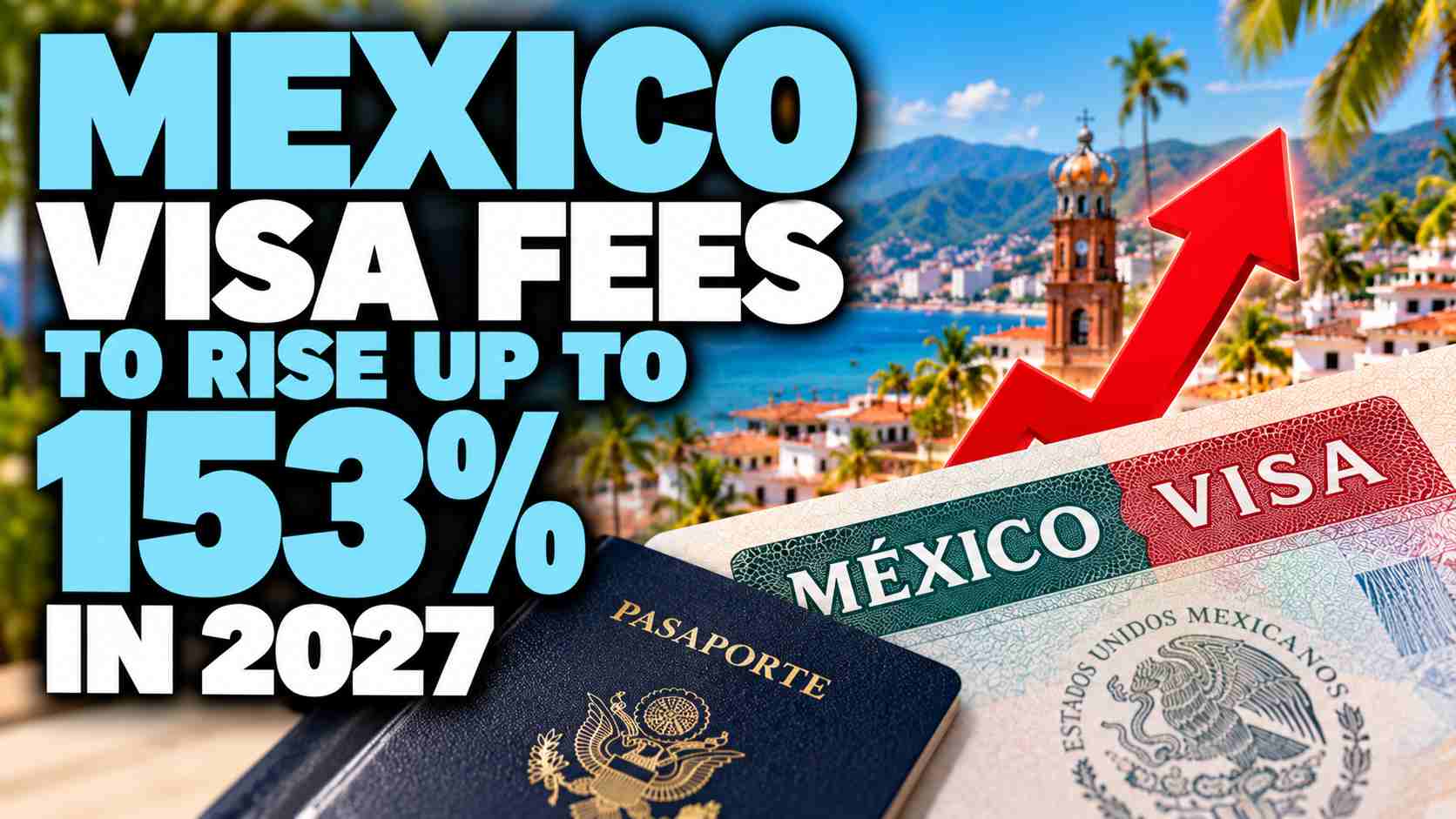
Puerto Vallarta, Jalisco, October 28, 2026 – Mexico’s Senate approved higher visa fees on October 27, with increases reaching 153% for certain categories beginning in 2027, as part of a broader federal revenue package.
The changes will raise the cost of ordinary visas issued through Mexican consulates and long-duration visitor visas, while also increasing the federal fee charged to many international tourists entering the country.
For foreigners considering a move to Puerto Vallarta, the increases raise an immediate question: Will getting a visa to live in Mexico become significantly more expensive next year?
The answer depends on the type of visa being requested. The largest increases approved by lawmakers apply to specific consular visa categories, not automatically to every temporary or permanent residency application.
Some Mexican visa fees will increase by more than 150%
Under the legislation approved by the Senate, Mexico will establish a standardized fee of 1,639.80 pesos for two visa categories issued through Mexican consulates abroad.
The changes affect ordinary visas issued in foreign passports and long-duration visitor visas that do not authorize paid work.
According to an analysis of the legislation by Mexican legal and tax publication IDC, the increases break down as follows:
- Ordinary visas: The fee rises from 990.79 pesos to 1,639.80 pesos, an increase of approximately 66%.
- Long-duration visitor visas: The fee rises from 647.96 pesos to 1,639.80 pesos, an increase of approximately 153%.
The changes are part of amendments to Mexico’s Ley Federal de Derechos, or Federal Rights Law, which establishes charges for services provided by the federal government.
The Senate approved the amendments without modifying the version previously passed by the Chamber of Deputies. The legislation now moves to the federal executive for publication.
The increase means that applicants seeking certain Mexican visas through consulates in the United States, Canada, or other countries will face higher government charges in 2027.
However, the distinction between a visitor visa and a residency visa matters especially for foreigners planning to make Mexico their home.
Will temporary and permanent residency visas cost more?
Mexico’s immigration system separates visas issued abroad from the residency documents issued after someone arrives in Mexico.
For example, an American or Canadian planning to retire in Puerto Vallarta may begin by applying for temporary or permanent residency at a Mexican consulate.
If the consulate approves the application, it generally issues a visa that allows the applicant to enter Mexico and complete the residency process through the National Migration Institute, known as the INM.
Once in Mexico, an applicant following this process normally has 30 calendar days after entry to begin exchanging the consular visa for a residency card.
That process involves separate government charges.
The newly approved 1,639.80-peso fees specifically concern ordinary visas and certain long-duration visitor visas under Article 22 of the Federal Rights Law. They should not be interpreted as the new universal price for every residency visa or residency card.
The legislation also updates other immigration-related charges, but the widely reported 66% and 153% increases do not apply equally across all residency categories.
For someone already holding temporary or permanent residency in Puerto Vallarta, the distinction is significant.
Permanent residents are not required to obtain a new consular visa every year simply to maintain permanent residency. A temporary resident renewing an existing card in Mexico also follows a different procedure than a first-time applicant requesting a visa abroad.
Therefore, existing residents should not assume that their next renewal will automatically increase by 153%.
Understanding the difference between visa and residency fees
For foreigners considering retirement or relocation to Puerto Vallarta, the process generally involves two distinct expenses.
The first is the visa application at a Mexican consulate abroad. The second is the residency card issued by the INM after entering Mexico.
The Mexican government’s current temporary residency guidance lists a consular visa charge of US$56 for 2026. That fee is separate from the amount charged for the residency card itself.
Once a person receives a temporary or permanent residency visa and enters Mexico, the INM requires the applicant to exchange that visa for a residency document within 30 calendar days.
For example, a Canadian couple planning to retire in Puerto Vallarta in 2027 might first obtain residency visas through a Mexican consulate in Canada. After moving, they would need to complete their residency documentation at the appropriate INM office in Mexico.
They should budget separately for the consular applications and the residency cards. The new legislation does not mean that the entire residency process will cost only 1,639.80 pesos per person.
Likewise, the reported percentage increases for ordinary visas and long-duration visitor visas should not apply to every step of that couple’s residency process.
The actual 2027 charges for their applications will depend on the fee schedule in force when they apply.
Foreign visitors will also pay more to enter Mexico
The legislation includes another increase affecting people who visit Mexico without permission to work for pay.
Under the Senate-approved provisions, the federal charge for this immigration category will rise to 1,158 pesos in 2027.
That represents a 17.8% increase over the 2026 fee, according to the Chamber of Deputies’ official reporting on the legislation.
The visitor charge is frequently called the Derecho de No Residente, or DNR.
For many international travelers arriving by air, the charge is incorporated into the price of their airline ticket rather than collected separately at immigration.
Someone flying from Los Angeles, Vancouver, or Toronto to Puerto Vallarta next year may therefore see the increased charge included in the government fees associated with the ticket.
For a traveler who visits Puerto Vallarta several times a year, the effect will depend on how the charge applies to each trip and the ticket purchased.
This increase is separate from the consular visa charges. American and Canadian passport holders generally do not need to obtain an ordinary visitor visa before taking a standard tourist trip to Mexico, provided they meet the applicable entry requirements.
The legislation also does not create a new municipal entry tax specifically for Puerto Vallarta.
Where will the additional immigration revenue go?
The Federal Rights Law changes include a new distribution formula for revenue collected through the affected immigration provisions.
Under the approved legislation, 57% of the revenue will be allocated to the Secretariat of National Defense, 15% to the National Migration Institute, and the remaining 28% to the Federal Treasury.
The INM’s share is designated for technological infrastructure associated with border security and immigration control.
That distinction matters for foreign residents who may assume higher fees will directly improve services at their local immigration office.
Although the government has identified technology and immigration control as funding priorities, the legislation does not guarantee additional staffing, shorter appointments, or faster residency processing in Puerto Vallarta.
The funding split is part of the broader federal approach to immigration administration, not a program specifically designed for foreign residents renewing documents.
Why Mexico is increasing immigration charges
The changes were approved as part of Mexico’s 2027 federal fiscal package, which updates charges across several government services.
During the Senate debate, Miguel Ángel Yunes Márquez, president of the Finance and Public Credit Committee, defended the revisions as a way to align government charges more closely with the costs of providing services.
“The Federal Rights Law proposal has as its main objectives updating, on the one hand, the fees for certain services provided by the state and, on the other, those corresponding to the use or enjoyment of public property,” Yunes explained.
Opposition lawmakers questioned whether the higher fees were justified.
Movimiento Ciudadano Senator Alejandra Barrales argued that the package would place additional financial pressure on taxpayers, while PAN Senator José Máximo García López criticized the government’s borrowing plans and economic assumptions.
The visa increases were approved alongside a wider revenue package authorizing up to 1.7 trillion pesos in net domestic federal borrowing.
According to Aristegui Noticias’ October 28 report, the legislation also includes adjustments to government charges involving aviation, environmental services and federal regulatory activities.
The Federal Rights Law amendments passed 79 to 34 in the general Senate vote. The contested provisions subsequently passed by 75 votes to 34.
The Senate rejected proposed modifications, leaving the legislation unchanged from the version approved by the Chamber of Deputies.
When will the new visa fees take effect?
The revised federal fees are scheduled to take effect on January 1, 2027, after the formal publication process is completed in Mexico’s Diario Oficial de la Federación.
Until then, the current fee schedule remains in effect.
For foreigners who already hold valid residency cards, the Senate’s decision does not require them to obtain a new visa or restart their immigration process.
For those planning to apply for residency next year, the immediate consideration is more specific: confirm the government charge for the particular visa and residency document involved.
The largest percentage increase, 153%, applies to the designated long-duration visitor visa category. This is not a blanket increase in the cost of living in Mexico for temporary or permanent residents.
Applicants preparing to move to Puerto Vallarta should also remember that visa eligibility requirements, including financial solvency where applicable, are separate from government charges. The fee amendments do not themselves establish new income or savings thresholds for residency approval.
In practice, beginning January 1, 2027, certain consular visa applications will carry a standardized fee of 1,639.80 pesos, while many international visitors will face a federal entry charge of 1,158 pesos.
For someone preparing to make Puerto Vallarta their home, the first figure to verify is the consular fee for their specific residency visa, followed by the separate INM charge for the residency card they will need after arriving in Mexico.