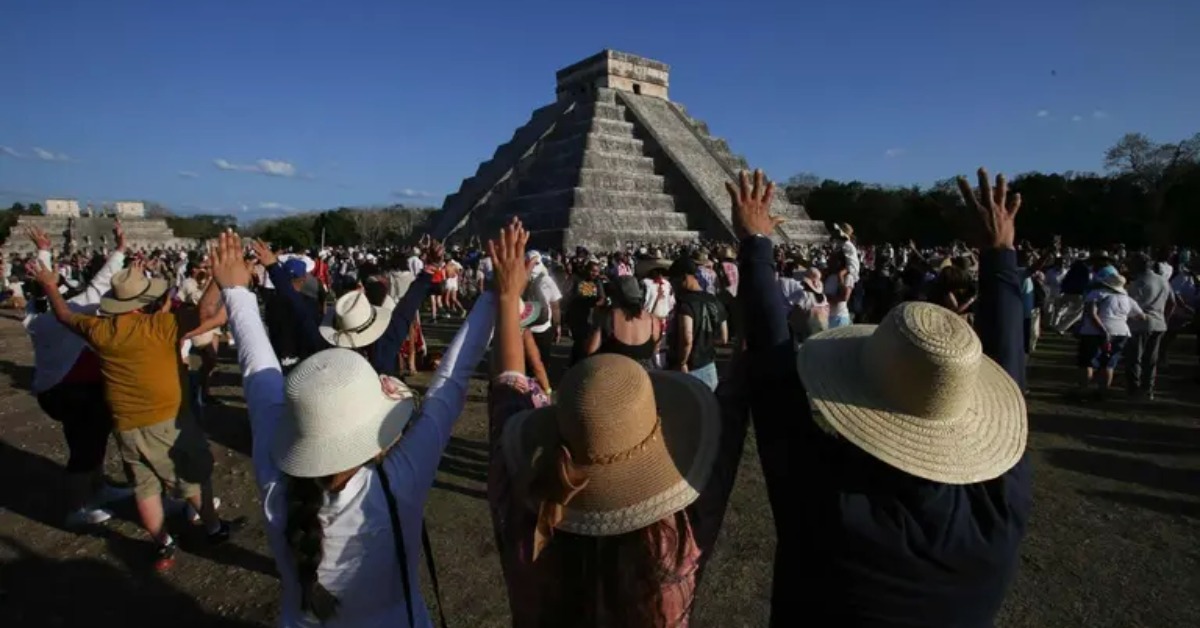
Before sunrise, people in white were already moving toward Teotihuacán and Chichén Itzá. Some came for tradition. Some came for spirituality. Others came because the spring equinox remains one of Mexico’s most visible public rituals. This year’s crowds arrived under tighter site controls and strong reminders about heat, hydration, and heritage protection. For international readers, the scene can look ancient and timeless. In reality, it is a mix of archaeology, tourism, public belief, and crowd management that says as much about present-day Mexico as it does about the past.
Mexico greets spring at two ancient landmarks
On Friday morning, thousands of people gathered at Teotihuacán in the State of Mexico and Chichén Itzá in Yucatán to welcome spring. The astronomical season began at 8:46 a.m. Central Mexico time, but visitors had started arriving much earlier. At Teotihuacán, many wore white clothing, a familiar custom tied to ideas of renewal and positive energy. Authorities urged people to stay hydrated and use hats or umbrellas. At Chichén Itzá, officials also activated security and medical support as crowds moved into one of Mexico’s busiest archaeological zones.
The annual equinox gathering shows how an ancient place can function in the present. It is part public ritual, part tourism event, and part national tradition. For many visitors, the date carries spiritual meaning. For others, it is simply a chance to be at a famous site on a symbolic day. Either way, the crowds are real, the logistics are complex, and the state must balance access with conservation each year.
Why these sites matter
Teotihuacán and Chichén Itzá are not interchangeable backdrops. Each site holds a distinct place in Mexican history. Teotihuacán, northeast of Mexico City, was one of the largest cities in ancient Mexico and is recognized by UNESCO as a World Heritage. Chichén Itzá, also on UNESCO’s list, was a major Maya-Toltec city in Yucatán and remains one of the country’s biggest tourist draws. That status helps explain why spring crowds concentrate there. They are famous, easy to recognize, and already embedded in Mexico’s national image.
That visibility also shapes how the equinox is experienced. At Teotihuacán, visitors often treat the day as a moment to seek renewed energy, raise their arms to the sun, and take part in ceremonies along the Avenue of the Dead. At Chichén Itzá, the main attraction is more specific. People come to see the light-and-shadow effect on the Pyramid of Kukulcán, where a serpent-like form appears along the staircase as the afternoon sun shifts. For international readers, that is the key difference. One site is centered on a broad public ritual. The other is tied to a highly specific visual phenomenon.
What the equinox actually marks
The spring equinox is an astronomical event, not a holiday fixed to a single calendar tradition. It marks the moment the sun crosses the equator, which is why day and night are roughly equal in length. In 2026, that moment fell on March 20, not March 21. That point matters because popular celebrations often blur the difference between the exact astronomical event and the broader cultural season around it.
It also helps explain why people at Chichén Itzá did not all come for the same thing at the same time. The change of season happened in the morning, but the best-known Kukulcán effect is seen in the days around the equinox and later in the afternoon. In other words, the symbolic welcome to spring and the most photographed visual phenomenon do not fully overlap. That is part of why crowds often stretch across several days, not just the exact minute spring begins.
A modern ritual at ancient ruins
The image most outsiders notice first is the clothing. Many visitors wear white, which has become a visible part of equinox gatherings in Mexico. Some people link it to purification, balance, or renewed energy. Others wear it because it has become part of the day’s public ritual. At Teotihuacán, especially, the crowd’s visual identity is now part of the event itself.
This is one reason the equinox keeps drawing attention beyond Mexico. It is not only an archaeological story. It is also a story about how people use historic places in the present. Ancient cities become settings for contemporary beliefs, family outings, tourism, and personal rituals. That mix can be hard to separate into neat categories. It also helps explain why the equinox continues to attract large crowds year after year.
Crowds, heat and conservation
The celebration also brings clear risks. The National Institute of Anthropology and History set a broader spring equinox operation for March 20 to 22 across 45 archaeological zones. Site rules were tightened around access, restricted areas, and items visitors could bring inside. At Chichén Itzá, authorities coordinated with security, civil protection, and migration officers, as well as Red Cross teams. At Teotihuacán, officials repeatedly warned visitors about sun exposure and hydration. These measures are not ceremonial. They reflect the pressure that large crowds put on protected sites and on people standing for hours under the sun.
Last year’s figures show why officials plan so aggressively. Over the 2025 equinox period, Teotihuacán received more than 36,000 visitors and Chichén Itzá nearly 33,000. Those totals were recorded over several days, not one single morning, but they still show the scale of demand. UNESCO’s own site profile for Chichén Itzá notes that visitor pressure is an ongoing concern. The same is true at Teotihuacán, where conservation and surrounding development have long shaped management decisions. The modern equinox celebration depends on access, but it survives only if the monuments do.
Why it resonates beyond archaeology
For readers living in Mexico or visiting from abroad, the equinox crowds offer a useful window into the country’s relationship with its past. These sites are not frozen museum pieces. They are living public spaces managed by modern institutions, surrounded by tourism economies, and loaded with symbolic meaning. The annual return of people in white makes that tension visible. So do the barricades, the hydration warnings, the security lines, and the restricted areas.
That is what this year’s scene at Teotihuacán and Chichén Itzá really showed. Mexico did not just mark the start of spring at two ancient sites. It repeated a national ritual in which archaeology, identity, tourism, belief, and state protection met in the same place. The photographs tell part of the story. The larger story is how Mexico keeps using its best-known past to speak to the present.
With information from Instituto Nacional de Astrofísica, Instituto Nacional de Antropología e Historia, INAH Equinoccio de Primavera