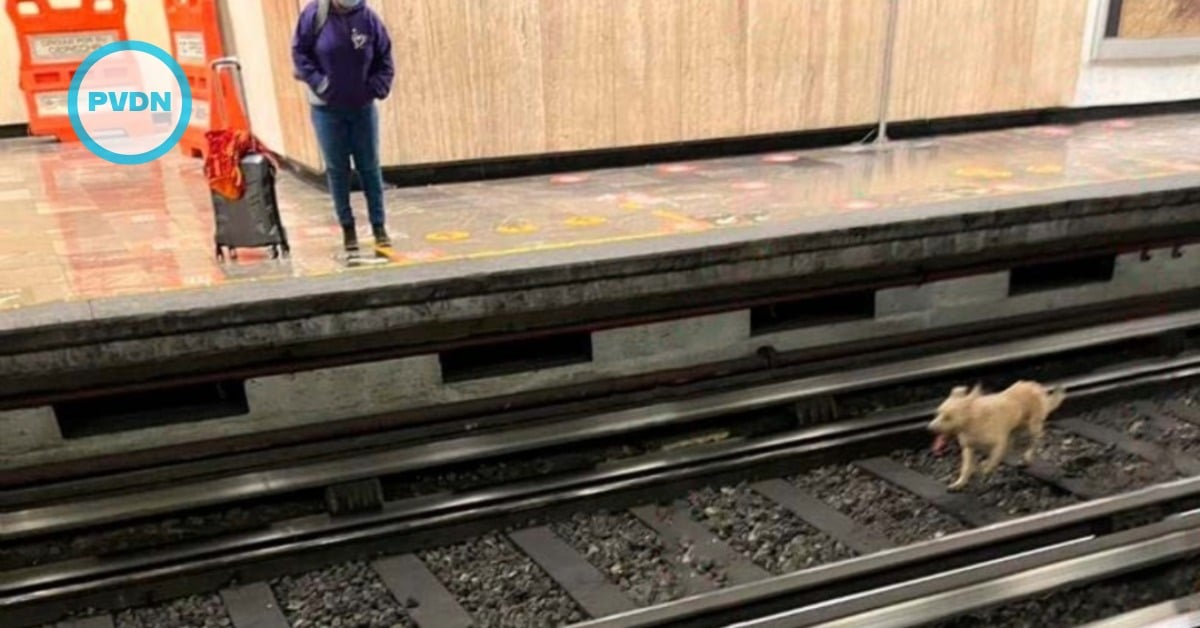
Service on Metro Line 2 slowed for nearly two hours after a stray dog ran along the tracks before staff rescued it unharmed.
The Friday morning rush on Mexico City’s Metro Line 2 turned into an unexpected test of patience when a stray dog slipped onto the tracks and refused to leave. Around 6:00 a.m., the animal was seen in the Chabacano station area, forcing control staff to cut power in sections and order trains to move at a crawl. What is usually one of the system’s busiest lines suddenly became a long, slow queue of stalled trains and packed platforms.
As users posted videos of the dog trotting ahead of a train, Metro control extended safety measures along the northbound route toward Cuatro Caminos. Crews were told to keep doors closed between stations and to wait for instructions, which meant passengers sat in dark tunnels or at platforms for long stretches. Radio updates and station loudspeakers repeated that rescue maneuvers were underway for an animal on the tracks, but for thousands of commuters already running late, the explanation did little to ease the frustration.
Reports from riders described intervals of 20 to 40 minutes between trains at some points of the line, far beyond the usual morning headways. The delays rippled through connecting lines, especially at transfer hubs such as Hidalgo and Bellas Artes, where platforms soon became shoulder-to-shoulder. Station staff tried to keep people moving and close off the edge of the platforms while the dog continued its improvised journey under the trains.
Metro Line 2 dog turns rush hour upside down
According to Metro information shared later in the morning, the dog covered roughly 11 kilometers between Chabacano and the Cuatro Caminos terminal, passing through more than a dozen intermediate stations. Along the way, it was spotted at points like Zócalo-Tenochtitlán, Bellas Artes, and Revolución, each sighting triggering new power cuts and another round of slow-motion departures as crews tried, and failed, to corner it safely inside a station.
Workers from the system’s security and civil protection teams positioned themselves along the route, looking for a chance to contain the animal without sending anyone directly onto the live tracks. In at least one attempt, a staff member approached the dog only for it to bolt again down the tunnel, forcing operations control to extend the slow-running zone further north. Officials later emphasized that at no point were rescue maneuvers allowed to put personnel or passengers at risk.
The chase ended near the maneuvering area at Cuatro Caminos, where staff finally secured the dog a little after 7:00 a.m. By that time, Metro authorities acknowledged, the incident had disrupted service for close to two hours. Service gradually normalized as power was restored along the line and trains were spaced back into their usual pattern, but the residual crowding at major stations took longer to clear.
Metro’s director, Adrián Rubalcava, publicly thanked the teams involved in the rescue and underlined that protecting life is the first priority, even when that means delaying thousands of people trying to get to work or school. The dog, confirmed to be uninjured, was handed over for medical evaluation and basic care once it was removed from the tracks.
Growing pressure from animal rescues in the Metro
The dog’s destination after leaving Cuatro Caminos is the Metro’s Centro de Transferencia Canina, or CTC, the shelter facility the system uses for animals found in tunnels, stations and depots. There, veterinarians check rescued dogs for injuries or disease, vaccinate them and prepare them either to be reunited with an owner or to enter an adoption program. In recent years, the CTC has gone from a little-known experiment to a permanent part of the network’s safety infrastructure, reflecting the frequency with which animals now appear in the system.
Requests for public information obtained earlier this year show a steady rise in the number of dogs rescued from Metro facilities. Between 2021 and 2024, more than 250 animals were taken off the tracks or out of other risk areas and transferred to the CTC, with annual totals climbing from just over 40 to nearly 80 per year. Those figures underline that what happened on Line 2 this Friday is not an isolated curiosity but part of a broader pattern.
Metro authorities also point out that most of the dogs arriving at the CTC never had any business being near the trains in the first place. Many are street dogs driven into stations in search of food or shelter. Others slip their collars in nearby streets and follow their owners through turnstiles before anyone notices. The official rules only allow guide dogs for people with disabilities to travel in the network, but staff must now regularly deal with loose animals that can trigger full power cuts and widespread delays.
For riders, the Line 2 disruption lands on top of chronic concerns about crowding, maintenance and the impact of any incident, however small, on a system that already runs close to capacity. Line 2 alone moves hundreds of thousands of passengers on a typical day, with its terminal stations among the busiest in the capital. A single stray dog, on this morning, was enough to demonstrate how fragile that flow can be when something unexpected happens on the tracks.
Still, the way the story ended matters. The dog left the tunnels alive, the trains eventually moved again, and a commuter video that could have shown a tragedy instead shows an animal nervously trotting along a rail bed before being led away by workers. Metro officials closed the episode with a familiar reminder: keep pets out of stations, secure them on the street near entrances, and report any animal seen on the tracks immediately to staff.
What happens next is more hopeful than the start of the morning suggested. After its checkup at the Centro de Transferencia Canina, the Metro says the dog could be made available for adoption, like many others rescued from the system each year. For one small passenger who never meant to board a train, the chaotic commute may end not in a tunnel, but in a new home.