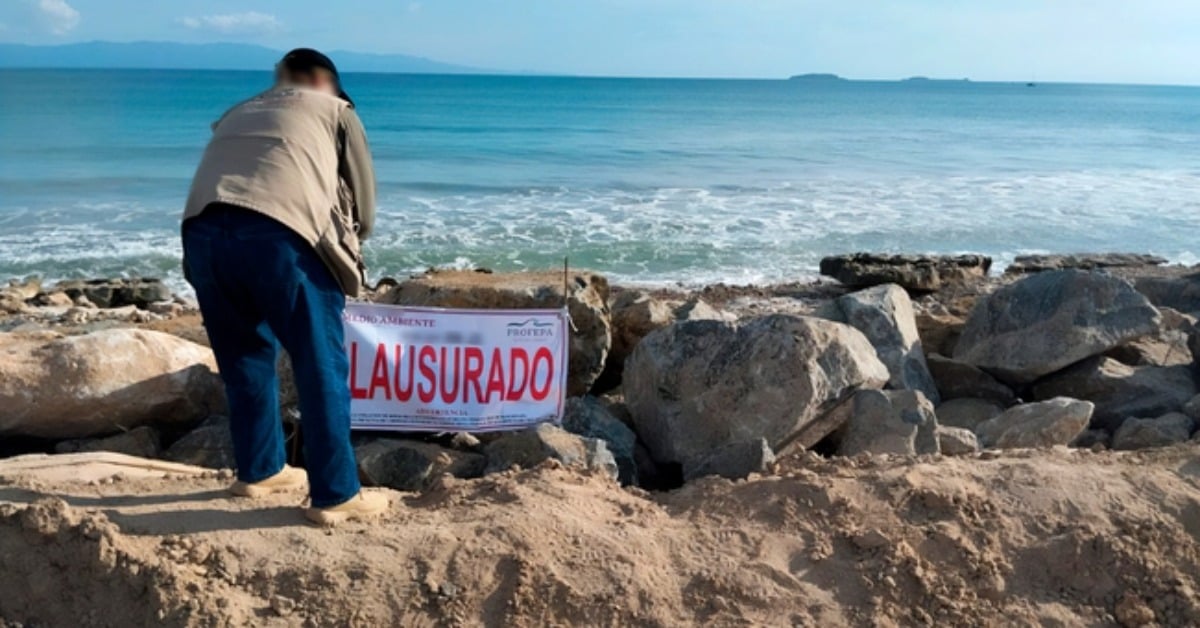
Federal inspectors moved in on Playa La Cocina in Punta Mita and shut a coastal construction front that had advanced without the required environmental authorization, according to agency records and local reporting. Residents say the works damaged the shore and squeezed public access. The company behind the project had asked for permission to relocate trees and shore up rock defenses but was told to stop pending more information. Days later, inspectors returned and sealed the site. What exactly was happening on that beach—and what happens next?
Federal environmental inspectors imposed a temporary total closure on activities carried out on Playa La Cocina in Punta Mita, Bahía de Banderas, after the developer failed to produce the required authorization in environmental impact. The action targets work within the Zona Federal Marítimo Terrestre (Zofemat), the 20-meter public strip that runs along Mexico’s coastline.
The closure followed weeks of complaints from the neighborhood about shoreline damage and restrictions on access. Residents had documented crews moving material and altering the beach while the dispute escalated both on the ground and online.
What inspectors found and when they acted
Records describe a project that included an anti-scour mat, the relocation of 87 trees, and the replacement of gabion protections with armor rock. The company, Cantiles de Mita, S.A. de C.V., had filed for an “emergency works” authorization but was ordered by Semarnat on August 19 to suspend any intervention on the Zofemat and to submit additional information.
Inspectors from Profepa visited on August 22. When the company was unable to present an environmental-impact authorization, agents sealed the Zofemat work site with a closure banner, a standard security measure in such cases. Authorities emphasized that the measure applies to activities in the federal strip, not the entire private development beyond it.
Why the Zofemat matters on a beach like La Cocina
In Mexico, the Zofemat is in the public domain. By law, any special use in that strip requires federal authorization, and beach access cannot be inhibited or conditioned except under established rules. Environmental-impact authorizations are separate and are mandatory for high-impact works that alter dunes, vegetation, hydrology, or coastal structures.
Profepa closures are grounded in the environmental law’s security-measure provisions, which allow temporary total closures when there’s a risk of ecological harm or when required authorizations are missing. The measure freezes activity while administrative proceedings are in progress.
Who is behind the project
Cantiles de Mita is tied to the larger Punta Mita resort and real-estate complex on the peninsula, which includes luxury lodging, clubs, and golf courses. Corporate materials list Cantiles de Mita among related entities that develop and operate amenities in the area. The company sought to frame the works as urgent stabilization and vegetation rescue, but those actions on the Zofemat still require a federal green light before shovels hit the sand.
The closure arrives amid a more extended regional debate about coastal development and the character of public beaches around Bahía de Banderas. Residents have pushed back against fences, gatehouses, and shoreline hardening, which they say erode access and reshape beaches.
What happens next
The immediate next step is administrative. Profepa’s file remains open while the company presents information or corrective measures. The outcome can range from lifting the seal after compliance to sanctions if violations are confirmed. Any plan to resume work within the Zofemat will need an explicit, published authorization from Semarnat that addresses impacts on dunes, vegetation, and nearshore dynamics at La Cocina.
For locals, the closure is a pause, not an ending. It gives regulators time to determine whether coastal protections and public access rules were followed and what, if any, repairs the shoreline now requires. For the developer, it’s a reminder that “emergency” coastal engineering is still engineering—and still regulated—when it touches Mexico’s public beach zone.