Puebla marks its 38th anniversary as a UNESCO World Heritage site, balancing its tiled Baroque streets with the pressures of a fast-growing city.
On 11 December 2025, Puebla quietly reaches a milestone that reshaped the way the city sees itself. Thirty-eight years have passed since the historic centre was inscribed on the World Heritage List, a recognition that turned its streets of cantera stone, red brick and glazed tile into a benchmark for colonial cities across Latin America.
The designation covers a dense core laid out in the sixteenth century on the floor of the Cuetlaxcoapan Valley, at the foot of the Popocatépetl volcano. Puebla was founded in 1531 as a planned Spanish city between the existing Indigenous powers of Tlaxcala, Cholula and Cuauhtinchan, on the main route linking Mexico City with the port of Veracruz. That strategic position helped it grow quickly into one of New Spain’s most important urban centres.
World Heritage status arrived on 11 December 1987, after Mexico had already protected the area as a federal Historic Monuments Zone. Official inventories describe nearly seven square kilometres of historic fabric in the centre, with around 2,600 catalogued monuments spread across just under four hundred city blocks. Many of those buildings date from the sixteenth to nineteenth centuries and include houses, convents, palaces and churches built in styles ranging from Renaissance to Mexican Baroque.
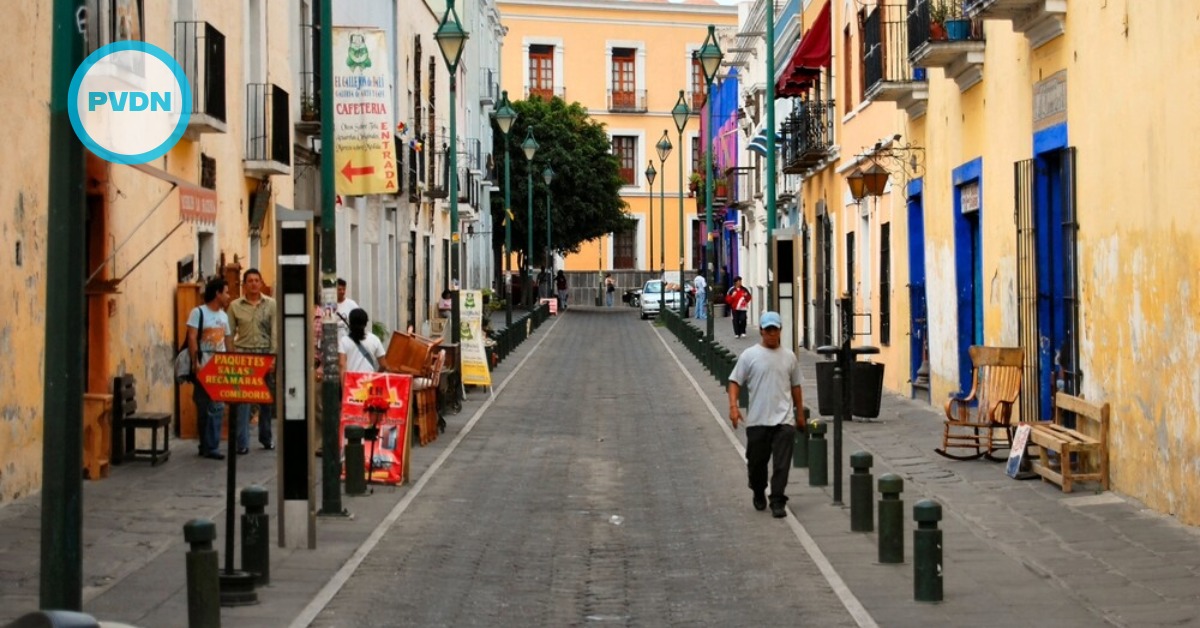
UNESCO’s own description of the site highlights the same elements that still draw visitors today. The cathedral, whose construction began in the late 1500s, dominates the main square with two slender bell towers and a façade that blends European and local influences. Nearby stand the former archbishop’s palace and the Palafox Library, founded in the seventeenth century and often cited as one of the first public libraries in the Americas. Across the centre, whole streets of townhouses are wrapped in patterned azulejo tiles and white stucco relief, creating an almost continuous skin of colour and texture on the upper floors.
This mix of religious monuments, civil buildings and ordinary homes laid out on a Renaissance-inspired grid is what convinced the World Heritage Committee that Puebla offered “outstanding universal value.” In technical terms, the site met criteria that recognise both the influence of its urban design and the quality of its preserved architecture. In plain language, Puebla showed how a New World city could take European planning ideas, merge them with local materials and crafts, and still feel distinctly American.
From planned city to living historic centre
The World Heritage title did not arrive in a vacuum. Mexico had already declared Puebla’s centre a protected zone in the 1970s, and large-scale restoration efforts were underway by the 1960s and 1970s in major churches, civic buildings and markets. Those early works meant that, by the time UNESCO made its decision, the core of the city already looked like a textbook of colonial and early republican architecture.
Protection has not been a straight line. Earthquakes in 1999 and 2017 damaged some of the oldest structures, forcing emergency shoring, partial closures and long reconstruction projects. Surveys carried out after those events documented cracked domes, fallen cornices and weakened façades across the historic zone. Many buildings have since been stabilised or repaired, but the quakes served as reminders that heritage in Puebla is as vulnerable to natural forces as to human neglect.
Even so, the centre remains the cultural and political heart of the modern city. The zócalo, framed by the cathedral and municipal palace, still functions as a plaza mayor in the classic sense: a place where protests, festivals, religious processions and family strolls unfold on the same paving stones. Behind the arcades, cafés and small shops share space with government offices and long-established businesses. While Puebla has expanded with malls and new neighbourhoods on all sides, daily life in the historic core still sets much of the city’s rhythm.
Local authorities have increasingly tied that identity to long-term management. In June 2025, the National Institute of Anthropology and History and the municipal government signed a cooperation agreement focused on the historic centre and other heritage areas of the city. The agreement includes a dedicated permit window for works in protected zones and seeks to coordinate everything from small façade repairs to major infrastructure projects. The goal is simple: make it harder for unapproved alterations to slip through and easier for owners to legally and safely maintain old buildings.
Puebla UNESCO World Heritage
The World Heritage label has also helped Puebla connect its historic core to broader cultural policies. On 11 December 2015, exactly twenty-eight years after the original inscription, the city joined the UNESCO Creative Cities Network as a City of Design. That recognition focused less on colonial monuments and more on contemporary design, education and industry, but it built on the same idea that Puebla’s urban fabric and creative economy are tightly linked.
Another piece of that puzzle came in 2019, when the artisanal process for making talavera ceramics in Puebla and Tlaxcala was added to the Representative List of the Intangible Cultural Heritage of Humanity. The craft is visible everywhere in the historic centre, from tiled church domes to patterned house façades and shop displays. Recognising the technique as living heritage underlines that the city’s tile-clad streets are not just museum pieces; they remain part of an active production and design ecosystem.
For residents and officials, the 38th anniversary arrives with mixed responsibilities. On one hand, the inscription continues to attract tourism and international attention, bolstering the local economy and giving weight to demands for conservation funding. On the other, it obliges the city and the federal government to monitor threats such as real-estate pressure, traffic, visual pollution and the risk of poorly planned redevelopment in surrounding neighbourhoods.
UNESCO regularly warns that uncontrolled urban growth and mass tourism can undermine the very qualities that earned cities their place on the World Heritage List. Puebla is not immune to those pressures. New high-rise buildings just outside the core, heavier daily traffic and the constant demand for parking all pose challenges to the historic urban landscape. The cooperation agreements signed in recent years, and the emphasis on heritage in local planning documents, suggest that authorities are trying to use the World Heritage framework as a tool rather than just a badge.
As Puebla enters its thirty-ninth year on the list, the tiled houses, baroque churches and shaded plazas that convinced UNESCO in 1987 are still doing quiet work. They shape how people move, where they gather and how they imagine their city. The anniversary is less about looking back at a decision taken in Paris and more about the choices made every day in Puebla itself. Whether to repair a cracked cornice, keep a traditional storefront, or thread a new tram line without slicing through a centuries-old streetscape.
If those choices continue to favour long-term care over quick fixes, Puebla’s historic centre stands a good chance of reaching future anniversaries with its character intact. The title of Puebla as a UNESCO World Heritage site will then mean not only that the city once met a set of criteria, but that it has kept meeting them, one restored tile and one safeguarded street corner at a time.