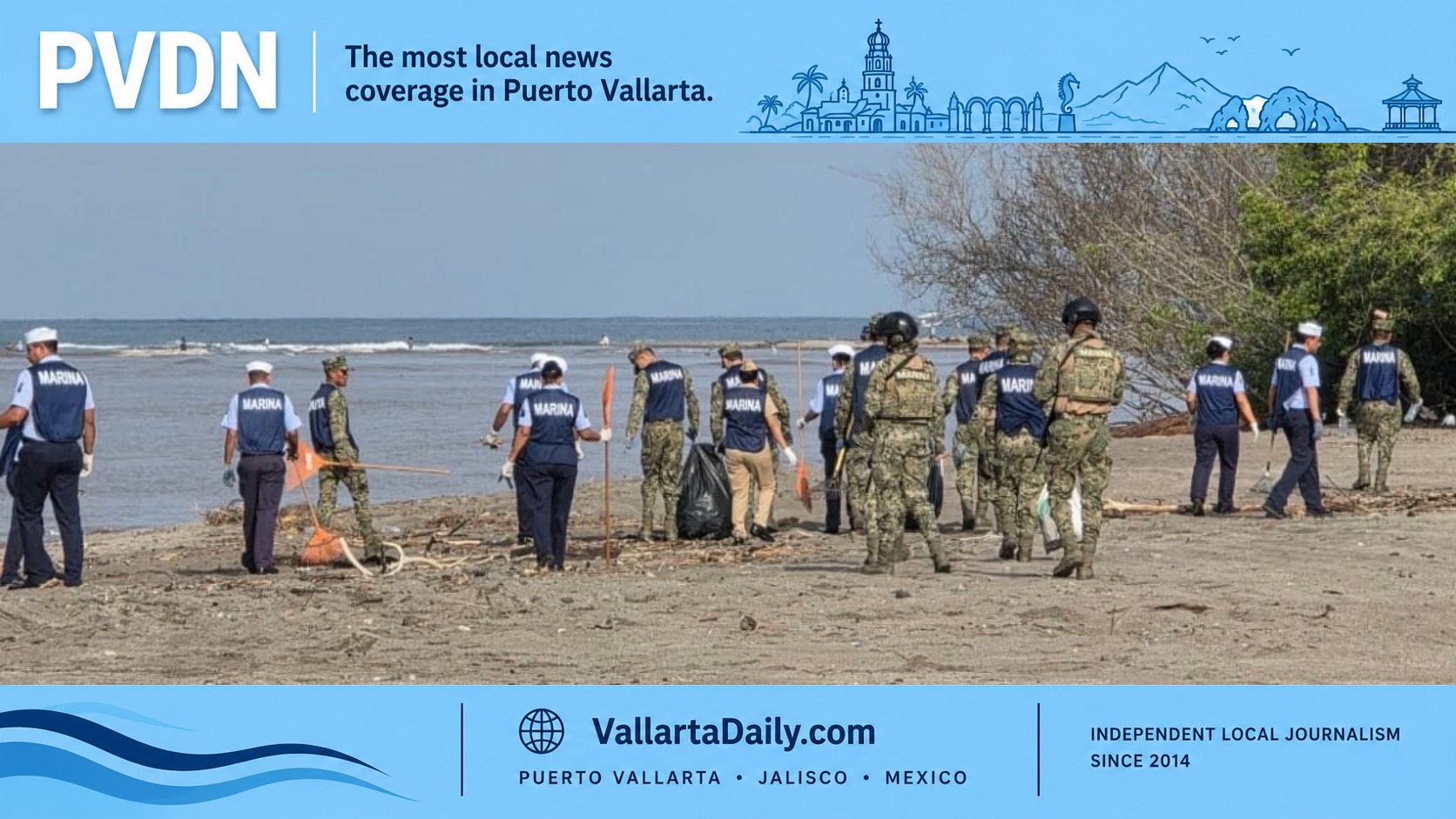
Puerto Vallarta, Jalisco, June 26, 2026 – More than 35 Navy personnel cleaned Boca de Tomates this week, returning to a north Puerto Vallarta beach where trash, runoff, and wildlife protection keep colliding at the edge of the Ameca River.
The cleanup was carried out by SEMAR’s 18th Naval Zone as part of the Navy’s national beach and coast conservation campaign, a program the agency says will continue through 2030. The work focused on collecting solid waste from the beach and reinforcing conservation around one of Vallarta’s most sensitive coastal areas.
The Navy’s marine environment staff identified the most common debris as PET plastics, plastic bags, and cigarette butts. Lt. Liliana Vianey Padilla García, a biologist with SEMAR’s marine environment service, said the goal is simple: keep garbage from reaching the water and reduce the use of disposable plastics.
Boca de Tomates is not a normal beach cleanup
Boca de Tomates sits near the mouth of the Ameca River and the Estero Boca Negra area, behind the airport corridor and north of Marina Vallarta.
That geography makes the beach a natural trap for debris after storms. Trash dropped in streets, canals, and waterways can move toward the river system and end up on the coast, especially during rainy-season runoff.
It also places the beach inside a larger ecological corridor. University of Guadalajara researchers have pushed for the Boca de Tomates and Estero Boca Negra area to receive stronger protection, citing 164 hectares around the Ameca River delta with mangrove remnants, coastal dunes, river crocodiles, sea turtles, and other species.
Removing plastic and fishing debris here can protect nesting areas, mangrove habitat, and wildlife corridors that still survive in one of the city’s most developed coastal zones.
Repeated cleanups point to a recurring problem
This was not the first major cleanup at Boca de Tomates this year.
In February, Navy personnel collected about one ton of inorganic waste from the same beach, including roughly 500 kilograms of plastic containers, 300 kilograms of glass and aluminum, and 198 kilograms of fishing gear. The waste was taken to Puerto Vallarta’s municipal dump for final disposal.
In April, another cleanup tied to Earth Day removed more than 300 kilograms of waste along 1.5 kilometers of coast, with participation from SEMADET, the Puerto Vallarta government, SEMARNAT, the Boca de Tomates turtle camp, WWF México, WRI México, and volunteers.
A separate 2025 cleanup removed two tons of trash after heavy rains washed waste onto the beach. That earlier effort also warned that garbage thrown into arroyos, canals, and rivers can end up in the sea.
A beach with wildlife, restaurants and real limits
Boca de Tomates remains known for its ramadas, seafood, sunsets, and quieter setting at the edge of the city. It is also one of the places most associated with crocodile presence in Puerto Vallarta because of its proximity to the Ameca River and nearby wetlands.
Visitors go for food and views, while the surrounding habitat supports crocodiles, birds, turtles, and mangroves. PVDN has previously covered the area’s turtle nesting pressure and wider crocodile activity around bay beaches during the rainy season.
The cleanup does not change normal safety precautions at Boca de Tomates. People should respect posted warnings, avoid entering crocodile habitat, keep a distance from wildlife, and never feed animals.
Less plastic before it reaches the sand
The Navy said communities can request coordination for future cleanup activities through SEMAR. Padilla García said the local work is part of an ongoing monthly effort in Puerto Vallarta, not a one-day operation.
Plastic bottles, bags, cigarette butts, and fishing waste are easier to stop at the source than to remove after storms scatter them across a nesting beach. That means the next visible cleanup may begin far from the sand — in neighborhood trash habits, restaurant waste handling, canal maintenance, and the everyday choices that decide what reaches the Ameca River.
More local coverage of beach conditions, wildlife, and conservation can be found in PVDN’s Puerto Vallarta environmental news hub.