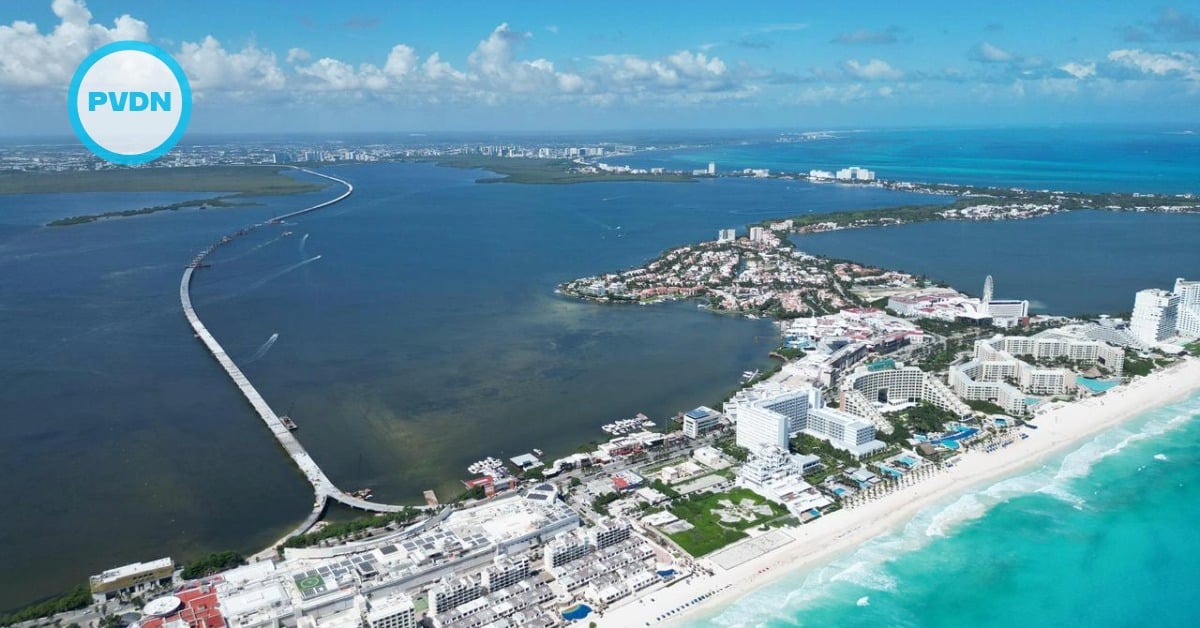
On November 10, 2025, Quintana Roo Governor Mara Lezama said the Nichupté bridge project is 90.2% complete, keeping one of Mexico’s most-watched road works on a glide path to opening after years of fits and starts. The 11.2-kilometer corridor is billed as a second spine for Cancún, easing the strain between downtown and the Hotel Zone. The latest update repeats a promise that this won’t be a car-only fix: space for cyclists and pedestrians is built into the design.
The core span rises over the Nichupté Lagoon for 8.8 kilometers, with three lanes—one in each direction and a reversible lane to match commuter flows—plus emergency bays and modern lighting. ICA, one of Mexico’s most prominent builders, holds the contract. Those details match earlier technical briefs and today’s state communiqué.
Officials continue to frame the bridge as both a daily relief valve and a safety asset. In storm country, redundancy matters: the corridor is designed to double as an evacuation route. In normal conditions, the state says travel times between Kukulkán Boulevard and the city center could drop by as much as 45 minutes once the bridge opens.
The government’s national projects dashboard still lists December 2025 as the intended start of operation. That page also captures the engineering profile—an 11.2-kilometer project with an 8.8-kilometer lagoon crossing, reversible lane, shared-use path, and an eye-catching steel arch segment.
Nichupte Bridge Cancun
Beyond the finish-line rhetoric, the money story matters. ICA originally won the job in mid-2022 at 5.58 billion pesos. Since then, official estimates have climbed; by mid-2025, the federal projects site showed 8.586 billion pesos, and separate reporting has cited a higher ceiling registered with Mexico’s Finance Ministry of 9.57 billion pesos. The split reflects the difference between an investment estimate and a registry’s budget cap, but either way, the project is significantly more expensive than first advertised.
What won’t rise at the toll booth is the price to cross. Authorities have repeatedly said the bridge will be free to use, addressing long-standing concerns that a new link would shift congestion to pay plazas or price out local workers. Earlier coverage made that clear: no toll for drivers.
The design continues to answer environmental criticisms that dogged the project from inception. During an April site tour, officials highlighted a “top-down” construction method to limit disturbance in mangrove habitat, along with the inclusion of a steel arch segment. The federal projects dossier references the approved environmental filing (MIA 23QR2022V0008) and outlines mitigation commitments associated with the work. Those measures won’t end the debate, but they set the compliance baseline against which builders will be judged in the coming weeks.
If the schedule holds, the bridge opens just as high season crests. That timing matters for workers who spend too many paid hours in traffic and for visitors who depend on a single, fragile corridor to the Hotel Zone. It also matters to emergency planners who have warned for years about the risks of relying on a single arterial during hurricane evacuations.
What remains before opening
The final push is straightforward but unforgiving: complete paving across the main deck, finish the lighting and ITS systems, stripe and sign the lanes, and tie in the approaches at Colosio and Kukulkán so the new link actually works with the old network. State outlets say those are the last-mile tasks still in motion. Each is routine in isolation; together they determine whether December is a ribbon-cut or another moving target.
One more question lingers after the ceremonial photos: real-world performance. Reversible lanes help only if operations are disciplined. A shared path only changes behavior if it feels safe and connected on both ends. And a free crossing will generate new demand and shift existing trips. Cancún is betting that combining capacity, redundancy, and design is better than the status quo. In a few weeks, daily commuters—and the next big storm—will deliver the verdict.