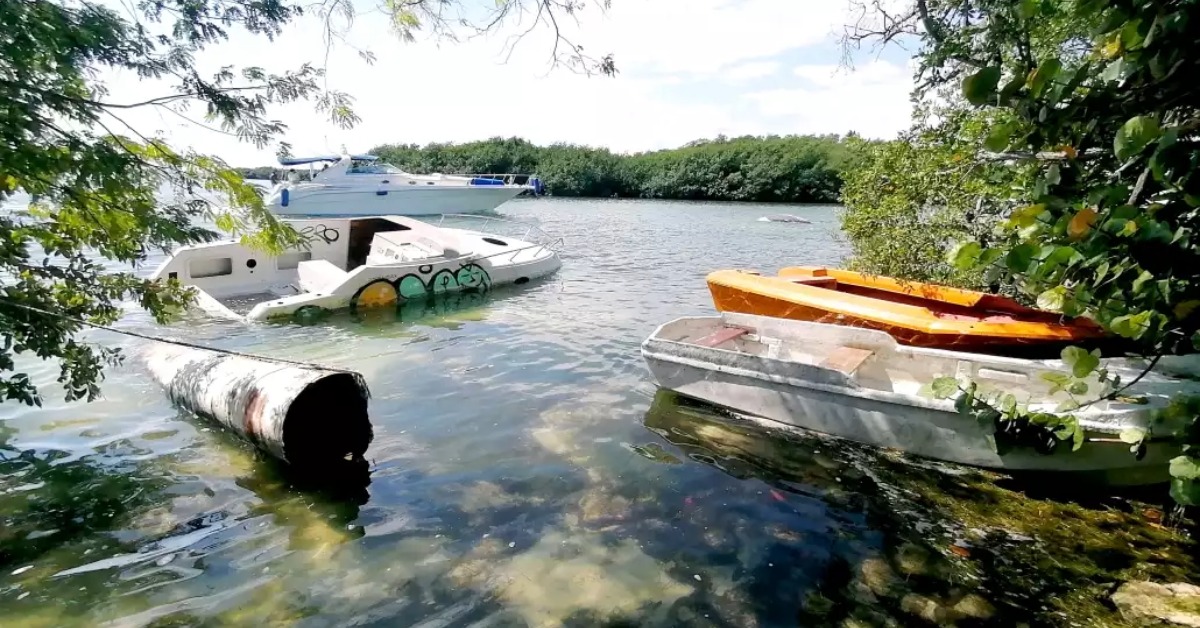
Nichupté lagoon abandoned boats
The Nichupté lagoon abandoned boats problem is no longer a footnote. It is a hazard hiding in plain sight. The Quintana Roo Boating Association estimates 60 to 80 vessels sit sunk or derelict in the lagoon. Many have already cleared the required legal steps for disposal. Yet they remain in the water.
Association director Ricardo Muleiro López explains the core issue. The Harbor Master began legal actions because each hull is private property. Crews cannot tow or dismantle them without due process. “They cannot be moved without authorization, even if they are abandoned,” he said. Most vessels now have legal release. The next move should be physical removal, coordinated by the state and the municipality. That hand-off has not happened.
Legal green light, stalled follow-through
Paperwork is no longer the excuse. The legal part is largely done, according to the Association’s latest report. The plan is clear. Authorities would remove the boats by land and send them to an appropriate disposal site. On the ground, though, there is no scheduled operation. The case has gone quiet during the holiday rush.
Muleiro López says timing matters. Heavy machinery is tied up while the Nichupté Bridge work advances. Lifting and transport capacity remains focused there. Once that work wraps, removal becomes easier. Until then, derelict hulls stay put. The lagoon bears the risk during peak storm months.
Public ramp gap slows response
A second problem hampers day-to-day navigation and any future cleanup: no public launch ramps. The Association notes no progress on a promised Puerto Juárez public ramp. And Tajamar’s ramp area will need major repairs once the bridge project ends. The maneuvering yard is damaged and cannot safely handle regular traffic.
“It is not a complicated problem,” Muleiro López says. “It needs maintenance.” In the meantime, boaters lean on a patchwork of private ramps. Some are free, others charge a fixed fee. They all empty toward the Hotel Zone. Trailers funnel into one corridor, and traffic bogs down. What should be a simple launch becomes a bottleneck.
After the holidays, what happens next
The Association expects movement after the vacation period. With legal release in hand, a coordinated removal should follow. The job is straightforward but not light. Teams must locate each hull, lift it, and haul it by road to a certified site. That takes cranes, flatbeds, and time windows that do not clash with bridge logistics.
The plan relies on basic sequencing. Finish the priority civil works. Shift the machinery. Execute a lagoon-wide sweep. Each delay extends risk through hurricane season. Every week counts when storms can churn up debris and fuel sheens.
Environmental stakes, kept simple
The environmental case for removal is basic. Leave a fiberglass hull in a shallow lagoon, and it degrades. Add trapped oils, diesel, or residue, and the problem grows. The Association will not endorse reefing these boats for that reason. The only viable route is controlled dismantling and final disposal on land. That requires planning, not improvisation.
Cleanup is also about safety. Submerged hulls threaten propellers and hull bottoms. Hidden debris complicates rescue work if a storm turns serious. With hurricane season active, the window for careful removal is narrow. The longer the wait, the harder the job.
A practical path forward
The pieces are on the table. Legal clearance exists for most hulls. The Association has signaled the scope: 60 to 80 boats. The state and municipality must set a calendar and lock in equipment. That calendar should dovetail with the end of bridge works. It should also include a plan to restore Tajamar and deliver a Puerto Juárez public ramp.
Boaters need clarity on access while cleanup proceeds. Private ramps will not fix traffic loads in the Hotel Zone. A public alternative can ease the pressure. It can also support the removal operation itself. Good logistics save days on the water and hours on the road.
What success looks like
Success would be visible and measurable. Fewer hazard markers. Clearer channels. A working ramp network that spreads trailer traffic. Fewer delays for tourism operators and workers. And a lagoon that is safer when storms threaten. None of this requires a new theory. It needs coordination and follow-through.
Muleiro López sums up the moment with a practical view. The problem is not complex, he says. It requires maintenance and a plan. The lagoon does not need another concept. It needs trucks, cranes, and a start date.