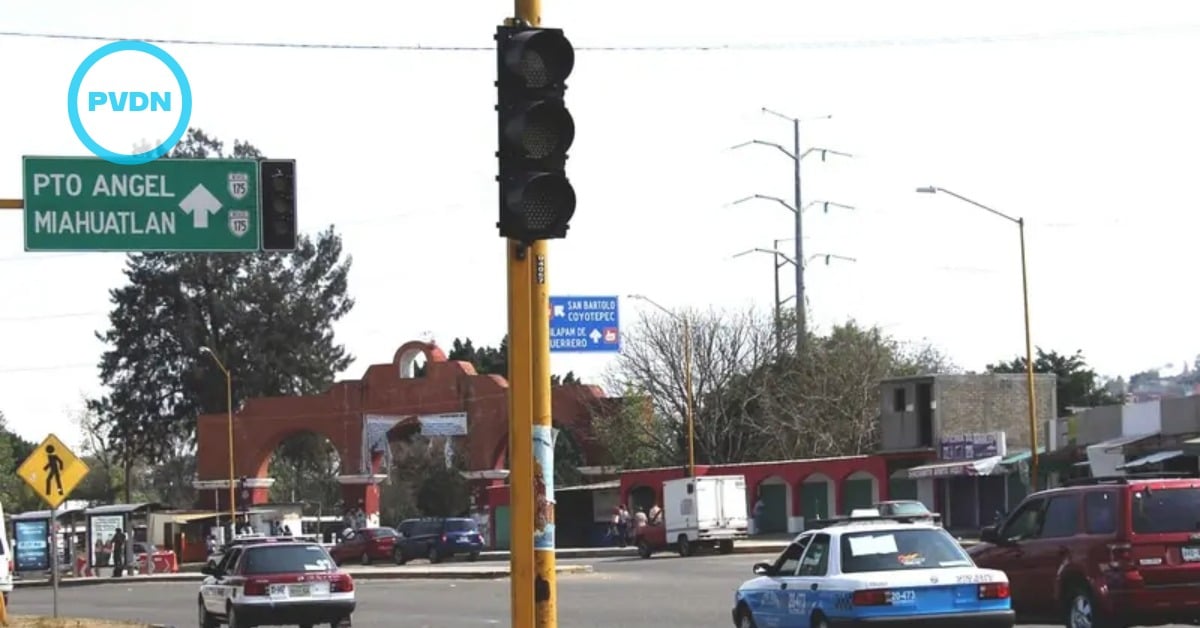
The Oaxaca capital says it will get serious about broken traffic signals—and it wants the public’s help. Mayor Ray Chagoya asked residents to report dark or mistimed lights so crews can tackle repairs quickly. He also said the city is studying a modernization plan that could bring AI-based synchronization to key corridors, including a stretch that alone could cost close to 100 million pesos.
Oaxaca traffic lights
Anyone who has tried to cross near busy schools or along the Periférico knows how one dead signal can spill chaos across several blocks. Buses brake late. Pedestrians gamble on gaps—delivery riders thread between cars. City Hall’s pitch is simple: report it, and they’ll fix it—even when the mast or cabinet sits on a state-managed road inside municipal limits. That pledge matters in Oaxaca de Juárez, where jurisdiction can be messy and the public usually wants the light to turn green.
Why push now? Road safety in Oaxaca still needs work. Statewide, police and municipal records logged 5,203 roadway incidents in 2023—slightly fewer than in 2022, but still thousands of crashes that snarl traffic and put people in hospitals. Better timing, brighter LED heads, and faster maintenance won’t solve everything, but they’re low-hanging fruit compared with big, slow-moving transit overhauls.
The city’s promise arrives with a warning about costs. Replacing old controllers and heads isn’t cheap, and the mayor was blunt about it. Still, Oaxaca has already seen pieces of a smarter network. In 2020–2021, the state began installing “semaforización inteligente” along the CityBus corridor, adding hundreds of vehicular and pedestrian signals, audible push-buttons, and centralized control to tame the most chaotic crossings. It wasn’t a silver bullet, but it proved the region can run modern signal tech when funding and follow-through line up.
Residents want to know what they can do today. For now, the city asks people to send reports through municipal channels or directly to traffic authorities so crews can log the intersection, check power and controllers, and swap failed LEDs. That step—basic maintenance—often delivers the biggest immediate safety gain, especially near schools, hospitals, and markets where foot traffic is heavy.
What AI timing could change
AI-assisted synchronization is the next rung up the ladder. Done right, adaptive timing can smooth platoons of cars on arterials, cut idling, and shorten pedestrian waits without forcing dangerous sprints. Oaxaca’s gridded core, with narrow streets and frequent crossings, isn’t an easy laboratory. But adaptive systems can still help at trouble spots—think Central de Abasto, Parque del Amor, and the long north–south runs where a single late bus can knock a corridor out of rhythm. The catch is integration: old cabinets and controllers don’t always speak the same language, and many poles hide years of improvised fixes.
Funding is the other hitch. The mayor flagged a nine-figure peso estimate for a single stretch. That number reflects more than software; it’s trenching, conduit, controllers, cabinets, backup power, fiber or radios, pedestrian heads, and ADA-style audible signals. It also means a maintenance contract, so the network doesn’t rot after the ribbon-cutting.
Accountability will make or break this push. Oaxaca has announced ambitious mobility projects before, and some have been delivered only halfway. This time, the promise is narrower: fix what’s broken fast, and design a realistic upgrade path. If the city pairs public reporting with transparent work orders—what was reported, when it was fixed, what it cost—trust grows. If it pilots adaptive timing on one corridor, publishes travel-time and crash data before and after, and expands only when results hold, trust hardens.
For people on foot, the stakes are human. A working pedestrian head, with audible cues and a sane countdown, can be the difference between a calm crossing and a dash through honking traffic. For cyclists, a green wave at 18–20 km/h on a couple of east–west streets would be a small revolution. For drivers and bus riders, fewer “every light is red” commutes mean less frustration and fewer dangerous gambles at yellow lights.
Oaxaca’s promise isn’t a fix-all, and it won’t be cheap. But a city that can refill potholes and repaint crosswalks can also keep its signals alive and in sync. Start with the reports. Prove the repairs. Pilot the smart timing. Publish the data. Then scale what works—and only what works. That’s how you turn a pledge into safer streets, one intersection at a time.