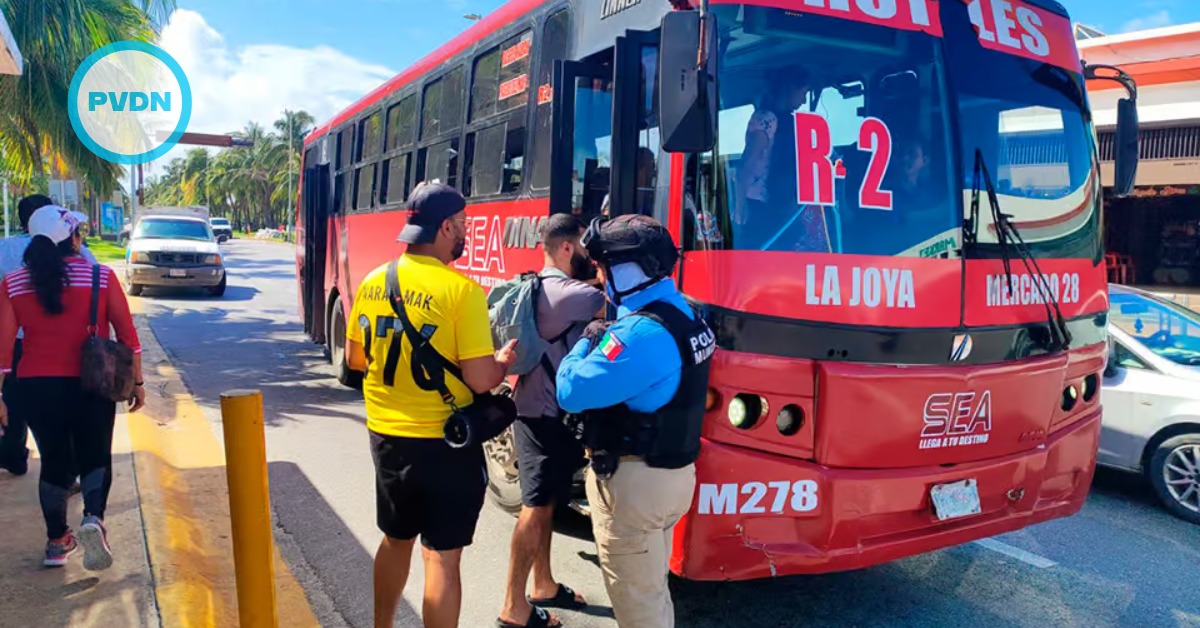
Cancún’s new Paradero Seguro operation posts police and National Guard at busy bus stops to deter crime and protect daily commuters.
The first buses of the day in Cancún now pull into stops watched not only by commuters but by armed officers. The city’s Secretaría Municipal de Seguridad Ciudadana y Tránsito, backed by the National Guard, has rolled out the Paradero Seguro operation at some of the busiest bus stops in the municipality of Benito Juárez. The plan is to place uniformed officers where riders actually stand and wait, rather than keeping patrols far from the rush of people.
Authorities launched the scheme on 8 December, with officers deployed from five in the morning to meet early shifts and school runs. Patrols and foot officers rotate through paraderos in supermanzanas such as 105, 107, 201, 227, 247, 248, 249, 251, 259 and 260, areas flagged for heavy daily movement and recurring reports of theft and harassment. The focus, police say, is on the people who depend most on public transport: workers, students, women and adolescents who often travel in the dark or in crowded conditions.
Paradero Seguro shifts security to the curb
Paradero Seguro is part of a broader push to move security operations closer to everyday spaces like bus stops and informal terminals, rather than concentrating resources solely on roadblocks or distant checkpoints. The operation places officers on the curb, in direct view of passengers and drivers, with the stated aim of preventing robberies, assaults and harassment before they happen. Police units also patrol nearby streets to respond quickly if a situation escalates.
This is not the first time Cancún has tried to tighten safety around public transport. In recent years, authorities have tested operations such as Pasajero Seguro, which included random inspections of buses, checks on drivers and verification of permits and tariffs. Those efforts showed that targeted deployments can uncover irregularities and discourage some crimes. Still, they also revealed how fragile safety can feel when enforcement is sporadic or tied to specific crackdowns. Paradero Seguro draws on that experience by focusing on fixed points where people congregate and offenses often begin.
The initial phase concentrates on corridors where thousands of people board buses and vans each day to reach industrial zones, commercial areas and the hotel district. Residents have cited these same stops as places where pickpocketing, harassment and fights occasionally flare up, especially in the early morning and late evening. By keeping officers visible at those times, city officials hope to send a message to both potential offenders and commuters that the paradero is no longer a blind spot in the security map.
What riders can expect at bus stops now
For regular users of the system, the most immediate change is the presence of uniformed officers standing near shelters, walking along queues and sometimes boarding buses to speak with drivers. According to the municipal security department, officers are instructed to maintain a preventive posture, observe interactions, and intervene only when they detect clear risk situations or when citizens request help. The idea is to keep the flow of transport moving while making it easier for passengers to report threats or suspicious behavior without leaving the paradero.
Authorities have also encouraged residents to see the operation as a shared effort rather than a one-way show of force. Public messages around Paradero Seguro stress the role of citizen complaints and real-time alerts in deciding where patrols should concentrate. That feedback is crucial in a city where routes stretch from dense housing areas to the hotel zone, and where paraderos can quickly change from quiet to crowded as shifts change. The commitment, officials say, is to adjust deployments as patterns of mobility and risk evolve, keeping protection aligned with how people actually move through Cancún.
The long-term impact of Paradero Seguro will depend on consistency. Commuters have seen highly publicized operations arrive with cameras and then fade as attention shifts elsewhere. If officers remain on the ground at key bus stops, at the right hours, the program could gradually rebuild trust in public transport spaces that many passengers currently see as vulnerable. For now, the early-morning sight of police and National Guard standing at the curb is a clear signal that the city is trying to close one of the most visible gaps in its security strategy.