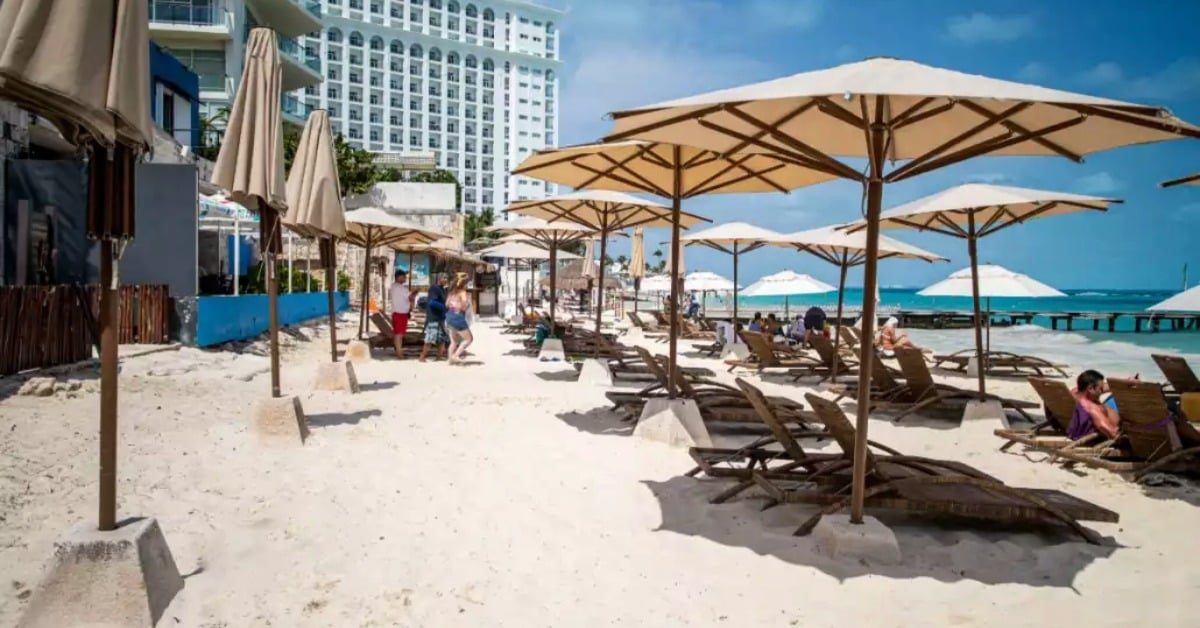
Rows of pay-to-use umbrellas at Playa Caracol have narrowed the sand that everyday beachgoers can use. Locals say the public entry is easy to miss, and the free area feels smaller every month. Mexico’s law is clear: beach access cannot be restricted. Yet practice often lags behind policy, and Cancún has a history of equipment creeping into the federal maritime zone. Whether this is a permitting gap, weak oversight, or both, residents want action—and they want it now—before another “public beach” becomes public only on paper.
Playa Caracol public access
At Playa Caracol, the picture many residents paint is one of simplicity and frustration. As more private umbrellas and loungers occupy the sand, public access to Playa Caracol is being squeezed to the margins. The complaint is not new in Cancún, but it has grown more visible at this small, family-friendly cove near Km 9 of Kukulcán Boulevard. People arriving by bus or on foot find the entrance subtle, the signage uneven, and the free space reduced by rentable shade.
Mexico’s rules are not ambiguous. There are no private beaches. Access to the shoreline and the federal maritime-terrestrial zone (ZOFEMAT) must remain open. Blocking, conditioning, or restricting access to the sea can trigger fines and even the loss of concessions. On paper, the law is supposed to protect Playa Caracol. On the sand, residents say the experience tells a different story.
What the law requires on this beach
ZOFEMAT is the 20-meter strip of public domain land, measured from the highest tide line, that runs along the coast. Anyone can transit and use it. Concessions can authorize specific, limited uses—like placing furniture or operating services—but they don’t convert the area into a private club. Concessionaires must respect open access and stay within their permits. Enforcement falls to federal and municipal authorities, including PROFEPA and local ZOFEMAT offices.
In 2020, a reform toughened penalties for those who block beach access. Sanctions range up to 12,000 UMAs, a ceiling that’s currently in the seven-figure-peso range. Lawmakers also emphasized that, where public entries are scarce, adjacent landowners have duties to facilitate passage under environmental authority oversight. The intent was to curb exactly the type of creeping exclusion people now report at Playa Caracol.
Cancún’s recent record on umbrellas and loungers
Authorities have acted before. PROFEPA has removed unauthorized umbrellas and loungers from Cancún beaches when vendors lacked permits or exceeded the allowed footprints in ZOFEMAT. During high seasons, coordinated sweeps target irregular setups. Local outlets have documented new attempts to expand furniture zones under environmental filings, and civic pressure has prompted repeat inspections when the issue resurfaces.
That history matters. It demonstrates that enforcement tools are available and that irregular occupiers can be effectively pushed back. It also shows why residents at Playa Caracol are calling for fresh inspections now, before the narrow cove becomes functionally exclusive to paying customers.
The lived experience at Playa Caracol
Playa Caracol is small. That’s part of its charm—calm water, shallow entry, a cove shielded from heavy surf. But small beaches are especially vulnerable to “furniture creep.” A few rows of umbrellas can transform the feel of a public space. Visitors describe the entrance as easy to miss, located near Plaza Caracol and the convention center, and say the scene sometimes appears private even when it isn’t. When the free towel-on-sand space shrinks, people either pay, push into the tide line, or leave.
What residents say should happen next
Residents want three quick moves. First, conduct an inspection: verify permits, measure footprints, and order the immediate removal of anything outside concession limits or in violation of access rules. Second, clear the entry: make the public access obvious with visible signage and keep commercial furniture off the path. Third, follow-through: repeat checks during peak hours and weekends, when equipment tends to be at its most demanding.
The principle is simple. The Caribbean is for everyone. Cancún thrives when locals and visitors feel welcome on its shores—not only as customers, but as members of the public with rights that the law already recognizes.
[vd_follow_combo category_slug=”cancun” tag_slug=”beaches” label_follow=”Follow Cancún Beaches”]