On a warm November evening in Playa del Carmen, the Caribbean breeze carried more than music and sea salt. Under the towering Portal Maya in Parque Fundadores, neighbors, schoolchildren, elders, and city officials gathered to mark the city’s 123rd anniversary by looking back to the people who were here long before resorts and beach clubs.
At the center of the civic ceremony stood Mayor Estefanía Mercado, flanked by founding families and community groups who have long pushed to anchor the city’s official story in its Maya roots. She reminded the crowd that the city was not born the day the first hotel opened, but on a coastline that already had spirit, memory, and a name in Maya long before the tourism boom.
Mercado spoke of a land “founded with dignity,” built by workers, fishers, and migrants from across the peninsula who settled on what used to be a modest port. Behind her, the white Capilla de la Virgen del Carmen and the bronze Portal Maya framed the Caribbean horizon, turning the square into a stage where past and present shared the same view.
As the band played and the honor guard raised the flag, representatives of the Quiam, Dzib, Puc, Aguilar, and other early families watched from the front rows. For decades, many of them have told and retold the story of a town that once had only a few wooden houses and sandy streets, long before Playa del Carmen became a brand on travel posters.
Playa del Carmen Mayan roots honored in public square
The anniversary ceremony placed those families and their Maya ancestry in the spotlight. Mercado highlighted that the municipality now officially bears the name Playa del Carmen, a symbolic change that she described as an act of historic justice driven by residents who insisted that the city’s legal identity should match the name people already carried in their hearts.
After her remarks, the mayor stepped down from the stage to lay a floral wreath in honor of the founding families. The gesture was simple, but the message was clear: in a town where new towers rise every season, the people who poured the first foundations and built the earliest docks still matter. For many in attendance, seeing their surnames spoken from the podium was as crucial as any fireworks display.
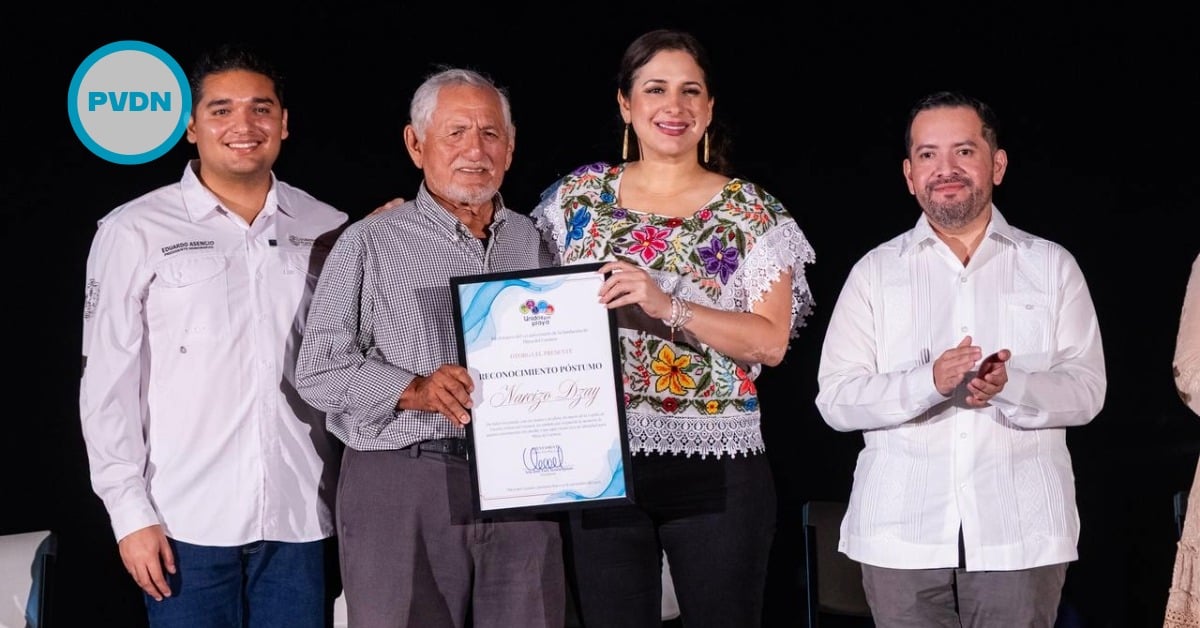
One of the most emotional moments of the night came with the posthumous recognition of community leader Narciso Dzay. His relatives received the distinction on his behalf, as the crowd applauded the man remembered for helping build the first church on this stretch of coast. That modest structure would grow into today’s Capilla de la Virgen del Carmen, the small seaside chapel whose white silhouette now defines the skyline of Parque Fundadores.
The chapel’s story mirrors that of the city around it. In the 1960s, when Playa del Carmen was still a village of fishers and chicleros who tapped sap from the surrounding forests, local families donated land near the beach to create a place of worship visible from the sea. They raised the walls with their own hands, dedicated it to the patron saint of sailors, and turned it into a landmark that welcomed arriving boats.
Over time, the building was remodeled, but its role as a gathering place has only grown. Weddings, baptisms, night masses during storm seasons, and quiet morning prayers have all unfolded beneath its simple arch. For many playenses, having a commemorative plaque unveiled on the walls during the anniversary felt like a way to inscribe family memories into stone.
Beyond the square, the celebration also included stands with art, science, and cultural exhibits curated by local groups. Children painted images of the old town and the sea, and elders told stories of early fishing trips and music from the region mixed with the sound of waves crashing a few meters away. The mood was festive, but threaded with a quiet insistence: this is still a Maya coastline, even if the skyline has changed.
From Xaman Há to a city with two birthdays
City historians used the anniversary to explain how Playa del Carmen went from a pre-Hispanic port to a modern municipality with two official celebration dates. Long before the name “Playa del Carmen” appeared on paper, the Maya knew this place as Xaman Há, “water of the north,” a key stop on trading routes that connected the Caribbean with inland communities. It was a place of canoes, coastal temples, and crossings toward Cozumel, where pilgrims honored the goddess Ixchel.
The written record arrived later. During the chicle boom at the start of the twentieth century, companies cut paths through the jungle to move latex from forest camps to the coast. In a letter dated 14 November 1902, now preserved in the national archives, the manager of a colonizing company informed the governor of Yucatán that workers were shipping their cargo from “the beach we have named Del Carmen.” That brief line, almost an aside, became the earliest known document to use the name that millions of tourists now recognize.
More than a century passed before local researchers tracked down the letter and pushed for its recognition. Their work helped the state congress declare 14 November 1902 as the official foundation date of the city and to establish a civic celebration every year on that day. At the same time, residents still mark 28 July, the date in 1993 when the municipality of Solidaridad was created and Playa del Carmen became its seat.
That dual calendar reflects the layers of identity woven into this coastal city. One date belongs to the paper trail of governments and decrees. The other belongs to a community that lived here as a fishing village, then as a work site for forest laborers, and later as a beach town that drew backpackers, divers, and eventually mass tourism.
The municipal chronicle also reminds residents that the city did not spring up overnight when the first all-inclusive resort broke ground. Families arrived fleeing the violence of the Caste War, settled along the coast, switched from chicle to fishing when the market shifted, and slowly built a town that, by the 1970s and 1980s, began to feel the pull of nearby Cancún’s tourist boom. By the time the municipality was created in the 1990s, the little port once called Xaman Há had already lived several lives.
Today, Parque Fundadores sits at the symbolic intersection of those histories. The Portal Maya sculpture rises above the sand as an artistic homage to Maya cosmology and the passage of time. Around it, vendors sell snacks, kids play in the shade, Papantla flyers perform, and cruise passengers stream through on their way to the ferry. On the anniversary night, the same space became a classroom without walls, where elders explained to younger generations why the names on the benches and plaques deserve to be remembered.
Residents who attended the ceremony spoke of pride, but also of responsibility. Honoring the past, they said, is not just about speeches or official documents; it is about everyday choices, from protecting archaeological remains and cenotes to treating service workers with respect in a city built on their labor. In a place where land prices keep rising and construction rarely pauses, keeping that conversation alive may be as crucial as any decree.
As the event ended and the crowd slowly dispersed along the waterfront, the chapel lights glowed against the dark sea, and the sound of the waves returned to the foreground. For a moment, Playa del Carmen looked less like an international destination and more like what it has always been at heart: a coastal Maya community trying to balance memory and growth.
For the people who pushed to put Playa del Carmen Mayan roots at the center of this 123rd anniversary, that image may be the real celebration. Not the fireworks or the photo opportunities, but a shared understanding that this place has a story far older and deeper than any travel brochure — and that writing its next chapter should begin by saying its name out loud, with all the history those words now carry.