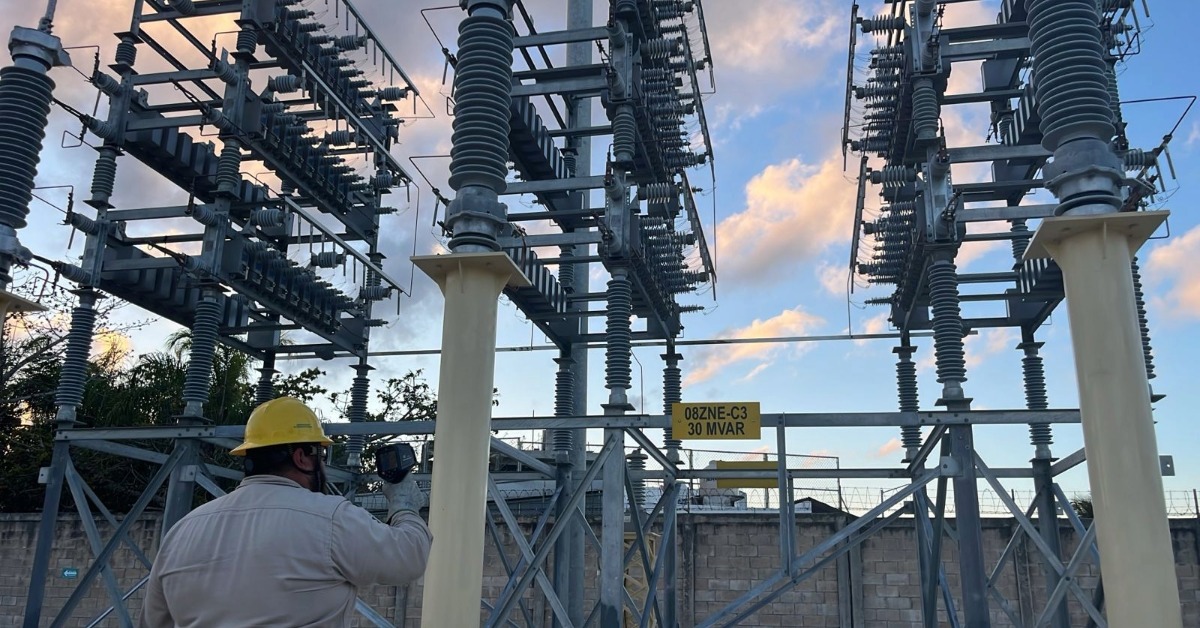
CFE, Mexico’s state power utility, said it put new infrastructure into service in Playa del Carmen after energizing power equipment at the Zac Nicté substation. The company said the work expands the Red Nacional de Transmisión, Mexico’s national transmission grid. It said the goal is to improve power quality for 708,788 service connections across the peninsula. CFE presented the move as part of a wider effort to keep electricity service continuous, reliable, and able to meet higher demand in the southeast.
A substation does not generate electricity. It receives and routes it through the grid. When capacity is added at that point, the usual goal is to reduce strain, improve voltage stability, and give operators more room during peak demand. That matters in Playa del Carmen, where homes, hotels, shops, and public services all depend heavily on electric power.
Why the work matters now
The timing matters. The Yucatán Peninsula has dealt with repeated service problems during periods of heavy demand. In March 2025, a major blackout affected Quintana Roo and other southeastern states after a fuel supply problem disrupted generation. Playa del Carmen has also seen local outages that affected neighborhoods, businesses, and visitors. That recent history helps explain why a technical upgrade at one substation can become a wider public story.
Growth is part of the picture. Playa del Carmen’s municipal government says the municipality has 333,800 residents and an annual growth rate of 6.8%. Tourism adds another layer of pressure. So do new housing projects, restaurants, retail corridors, and short-term rentals. As temperatures rise, air-conditioning pushes electricity use even higher. In that setting, even a targeted grid upgrade can carry outsized importance.
The Zac Nicté work also fits a broader push in Quintana Roo. Earlier this month, CFE announced a new capacitor bank at the Balam substation and a new Bonampak substation in Cancún. Taken together, those steps suggest the utility is reinforcing the peninsula’s network before the hottest part of the year.
What residents should expect
The announcement should not be read as a promise that outages are over. A transmission upgrade can improve stability and give dispatchers more flexibility, but it cannot remove every source of failure. Storms, damaged local lines, generation problems, and construction accidents can still interrupt service. In the public materials reviewed for this story, CFE also did not spell out any immediate visible change for residents beyond a stronger system margin.
Even so, the upgrade is significant for daily life. Reliable electricity affects water pumping, traffic lights, internet service, refrigeration, home cooling, and hotel operations. For foreign residents, it is also a reminder that utility stories in Quintana Roo are often about more than convenience. They point to whether fast-growing cities can keep basic infrastructure aligned with population growth, tourism demand, and the summer heat.
With information from La Comisión Federal de Electricidad (CFE)