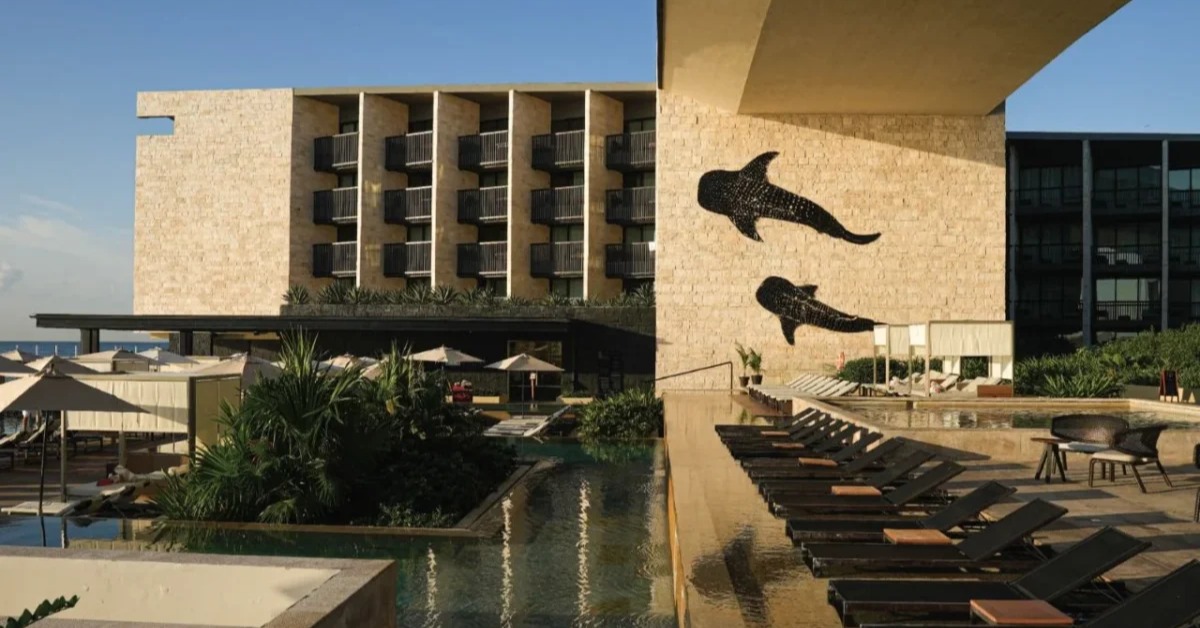
Grupo Posadas is moving ahead with one of its largest Riviera Cancún projects, a dual hotel complex planned under its Grand Fiesta Americana and Live Aqua brands. The 1,000-room development comes as Cancún and the Riviera Maya continue to absorb large resort investment, even as the region faces questions over growth, infrastructure, occupancy swings, and pressure on coastal communities.
Grand Fiesta Americana and Live Aqua
Grupo Posadas is preparing a 1,000-room hotel complex in Riviera Cancún, adding another large resort project to the busy Cancún and Riviera Maya tourism corridor.
The project is planned as a dual complex with two of the company’s higher-end brands. One section would operate as Grand Fiesta Americana Riviera Cancún, with about 600 rooms. The other would operate under Live Aqua, with about 400 rooms.
The hotels are expected to share major amenities, including a convention center of more than 4,000 square meters, more than 24 food and beverage spaces, and a spa of more than 2,500 square meters. The Grand Fiesta Americana opening has been described as planned for November 2026.
A large project in an already crowded hotel market
The Riviera Cancún project is part of a broader expansion by Grupo Posadas, one of Mexico’s largest hotel operators. The company has been shifting more attention toward beach destinations and premium travel, while still operating a wide portfolio of urban business hotels.
The new complex also fits a larger pattern in Quintana Roo. Cancún, Puerto Morelos, Costa Mujeres, Isla Mujeres, Playa del Carmen, and the Riviera Maya have all seen steady hotel growth in recent years. The region remains Mexico’s largest tourism engine, but it is also one of the most debated areas for new development.
For residents and frequent visitors, the announcement is not just about another hotel. A 1,000-room complex brings jobs, convention business, and visitor spending. It also adds pressure on roads, water, beaches, staffing, housing, and local services.
That balance is becoming more important as the Mexican Caribbean matures. Cancún is no longer a young resort city with unlimited room to grow. The region now faces the realities of a large tourism economy that must continue to attract travelers while managing the costs of its own success.
What Grupo Posadas is adding
Grupo Posadas’ latest plans include five new hotels and resorts in Mexico, with projects in Isla Mujeres, Mexico City, Mazatlán, and Riviera Cancún.
The Riviera Cancún complex is the largest of the group’s announced openings. The Grand Fiesta Americana side is aimed at family and leisure travel. The Live Aqua side is positioned toward adults and upscale travelers.
The shared convention center is important. It suggests the project is not only chasing vacationers, but also meetings, weddings, events, and group travel. That market can help hotels fill rooms outside peak vacation periods.
The company has also been promoting more “experience” focused travel. That means selling more than rooms, meals, and beach access. It points to wellness, dining, cultural activities, spa services, and personalized guest packages.
This approach reflects a wider trend in Mexico’s hotel industry. Major brands are trying to increase room rates and guest spending by adding more personalized services. In resort markets, that can mean more restaurants, branded spa concepts, private event spaces, and adult-only areas.
Why Riviera Cancún keeps drawing investment
Riviera Cancún sits in one of Mexico’s strongest tourism corridors. The area benefits from proximity to Cancún International Airport, the established Riviera Maya market, and strong name recognition with travelers from the United States and Canada.
For hotel companies, the appeal is clear. The region has global visibility, established air connections, and a long record of filling all-inclusive and luxury resorts. It also has a large labor market tied to hospitality, transportation, food service, and construction.
Quintana Roo’s hotel infrastructure is already large. State tourism data from 2025 listed more than 135,000 hotel rooms across the state. Cancún and the Riviera Maya accounted for a major share of that total.
This scale creates both opportunity and risk. Large operators want to be in the market because demand remains strong over the long term. At the same time, each new development enters a more competitive environment, where occupancy can be affected by air service, exchange rates, safety concerns, sargassum, and the broader U.S. and Canadian travel economies.
Growth comes with pressure
The Mexican Caribbean’s hotel boom has brought jobs and investment, but it has also created familiar complaints. Residents and smaller businesses often point to traffic, rising rents, beach access disputes, environmental strain, and the loss of local character.
Large resorts can also change how nearby communities function. They need workers, suppliers, transportation, laundry services, food distribution, and maintenance crews. That activity supports jobs, but it can also increase demand for housing and public services.
Environmental questions are also part of nearly every major coastal project in Quintana Roo. Developers must navigate federal and state rules, while communities continue to watch how new resorts affect mangroves, dunes, wastewater systems, and beach access.
The pressure is not limited to new construction. Existing destinations also face the recurring problem of sargassum, which can affect beach quality and visitor satisfaction during heavy seasons. Larger resorts often have the resources to manage cleanup, but smaller operators and public beaches can struggle more.
The hotel race is changing
Cancún and the Riviera Maya are not only adding rooms. They are also changing the type of rooms being built.
More projects are aimed at premium, luxury, wellness, and all-inclusive travelers. These segments can bring higher spending per guest. They can also reduce dependence on low-margin mass tourism, which is often more price-sensitive.
Grupo Posadas’ plan fits that shift. The combination of Grand Fiesta Americana and Live Aqua places the project in the higher end of the company’s portfolio. The convention center also gives the complex another revenue path beyond vacation stays.
Still, the timing matters. The region has seen strong tourism demand, but not without soft spots. Air capacity can change quickly. U.S. demand has shown signs of pressure at times. Some markets in the Caribbean are competing more aggressively for the same travelers.
That means new resorts will need more than size. They will need strong branding, reliable service, competitive pricing, and a clear reason for travelers to choose them over many similar options.
What to watch next
The next important details will be the project’s final opening timeline, permits, construction progress, hiring plans, and any environmental updates tied to the site.
For Cancún and the Riviera Maya, the project is another sign that major hotel groups still see the Mexican Caribbean as a long-term bet. For local residents, it also raises the same question that now follows most large resort announcements: how much more growth can the region absorb without weakening what made it successful?
Grupo Posadas is betting that demand for premium resort travel will continue to expand. The Riviera Cancún project shows how that bet is being built, not as a single hotel, but as a large mixed resort complex designed for families, adults, events, and higher-spending travelers.