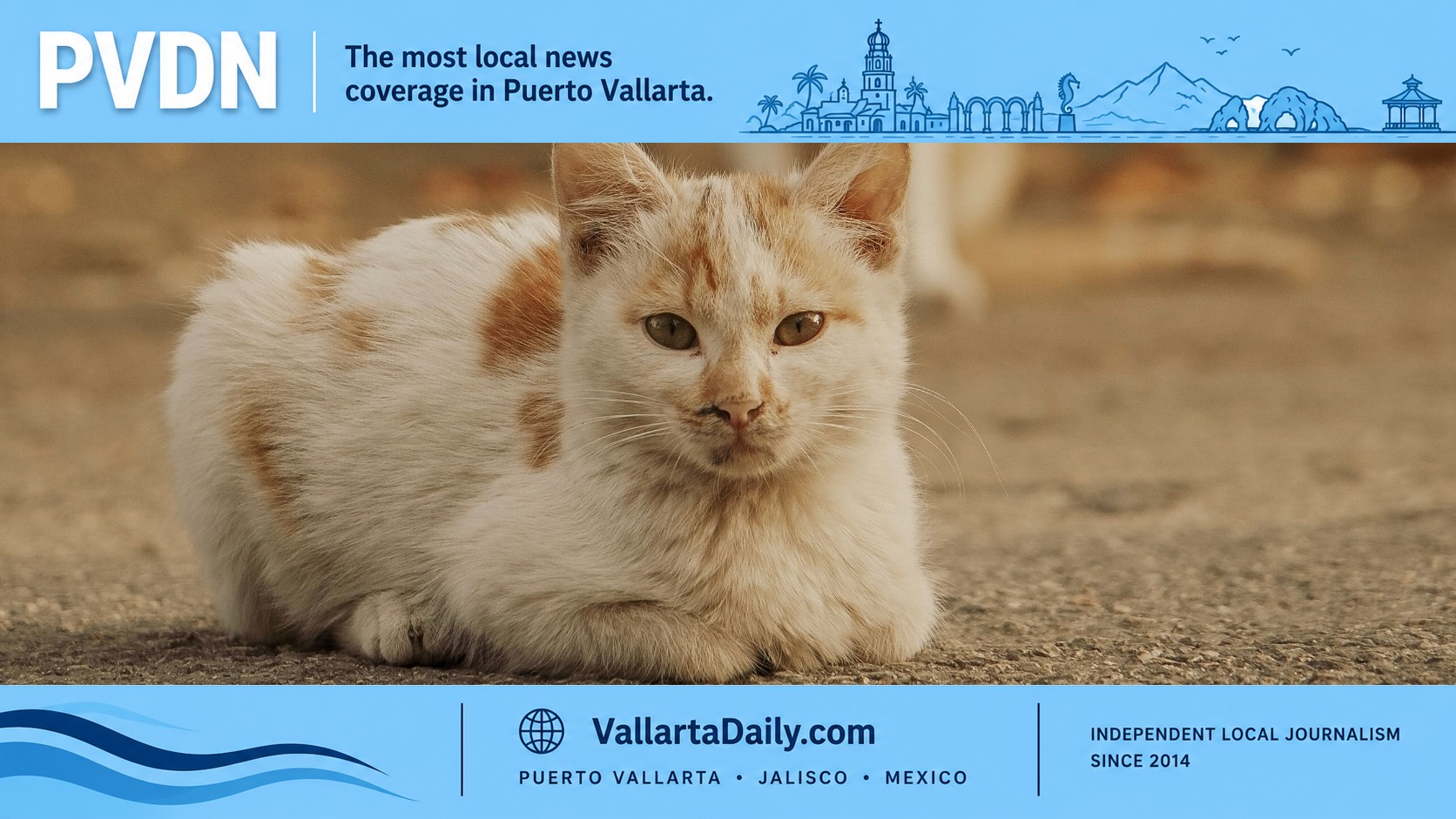
Puerto Vallarta, Jalisco, July 30, 2026 – A proposal submitted to Puerto Vallarta officials calls on the city to gradually remove cats from Cuale Island and replace isolated rescue efforts with a long-term wildlife and animal-welfare program.
Alejandro Leonardo Juárez Sánchez directed the appeal to the City Council, municipal environmental and animal-welfare officials, rescue organizations and specialists at the University of Guadalajara’s CUCosta campus. He is requesting a site-specific management plan built around capture, sterilization, shelter placement and adoption.
The proposal is a public request rather than an announced municipal program.
It follows repeated reports of people leaving cats and kittens on the island. PVDN reported earlier this month that new arrivals were outpacing sterilization and adoption work undertaken by local rescuers.
Municipal officials later identified a woman accused of abandoning a litter after witnesses photographed her. A municipal judge was expected to determine her penalty, which could include community service.
Juárez Sánchez argues that enforcement against individual dumping cases will not address the existing colony or its interaction with iguanas, lizards, birds and other wildlife along the river.
“I’m not asking that cats be killed. I’m asking that they be removed from the river,” he said.
His proposal would place captured cats in an enclosed shelter or adoption program rather than return them to the island. It also requests stronger restrictions on feeding and abandoning domestic animals within the federal river zone.
Sterilization prevents reproduction but does not eliminate hunting behavior. A peer-reviewed review of domestic-cat predation found that sterilization can limit population growth but does not prevent cats from pursuing wildlife.
A successful nonlethal program would require more than periodic sterilization campaigns. A 2024 study of a 157-cat colony recorded a 47.8 percent population reduction after intensive sterilization, adoption, monitoring, and public education. Researchers still documented new abandonment and immigration into the colony.
That experience points to several elements missing from the current Cuale response. A local plan would need an initial population count, identification of sterilized animals, veterinary assessments, adoption or shelter capacity, monitoring of new arrivals and continued enforcement at known dumping points.
Puerto Vallarta already has much of the legal authority needed. The city’s responsible ownership and domestic-animal protection regulation prioritizes sterilization and adoption over other population controls. It also authorizes municipal animal-welfare personnel to rescue and shelter animals, operate permanent sterilization programs and collaborate with universities and animal-protection groups.
The appeal adds a site-specific ecological component to those existing responsibilities.
It names the neotropical river otter as a priority species in the Cuale corridor. Mexico lists the neotropical otter, Lontra longicaudis annectens, as threatened under NOM-059, and the federal conservation program calls on local governments, universities, and community organizations to monitor populations and protect river habitat.
However, the 2014 paper frequently cited as scientific confirmation of otters in the Cuale was subsequently retracted by Acta Zoológica Mexicana. It cannot independently confirm the species’ current presence or population in the river.
A credible Cuale management plan would therefore need two baseline studies. One would document the island’s cat population and the other would establish which native species currently use the river corridor. That would allow sterilization, removal, and adoption work to proceed using verified local conditions while protecting the cats from further abandonment.