
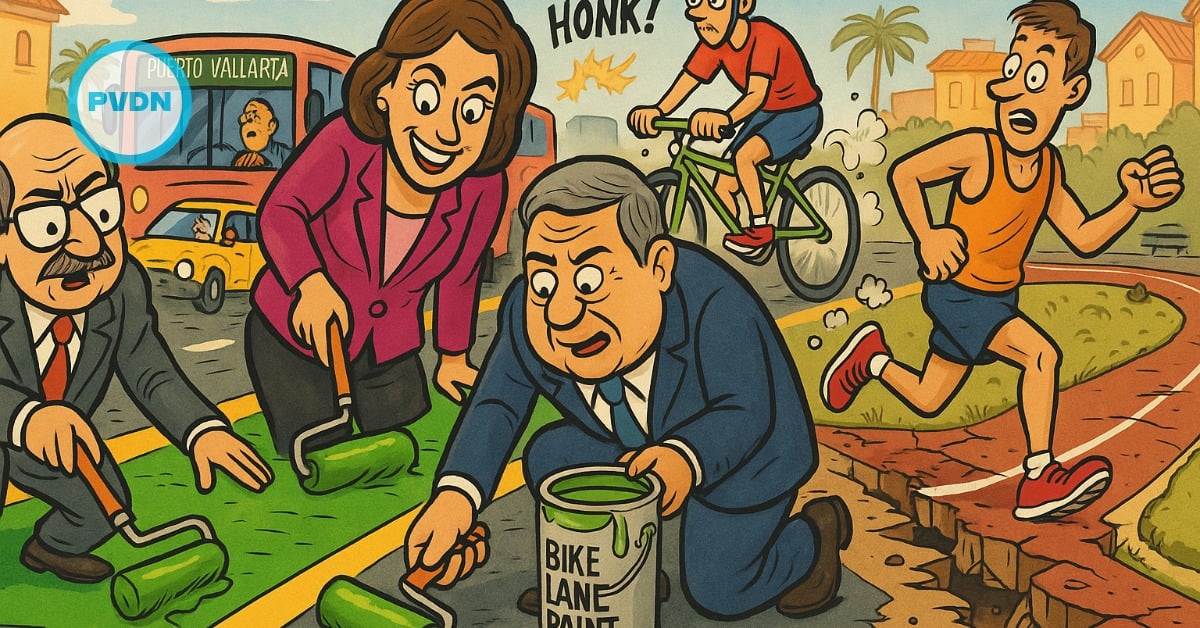
Puerto Vallarta’s city council has finally had enough of the chaos gripping this resort town: bike lane paint that is, in some places, up to three shades less vibrant than originally intended.
In a move described by officials as “the most ambitious infrastructure plan since someone invented the speed bump,” the council has approved a permanent program to maintain and repair the city’s bike lanes. Not for a week. Not for a year. Permanent. Until the sun burns out or the next administration forgets where they filed the paperwork.
The initiative, introduced by councilwoman Erika Yesenia García Rubio, aims to keep bike lanes in “optimal, safe and functional conditions,” which in government language means they might repaint them before the asphalt fully returns to its natural, feral state.
García, now unofficially known in City Hall as “La Reina de la Ciclovía,” presented the proposal alongside a second initiative to rehabilitate the city’s athletic tracks, especially the ones in the Agustín Flores Contreras Sports Unit. The idea is to create “dignified and safe spaces” for sports, so locals no longer have to run on surfaces that look like they were last maintained during the Vicente Fox administration.
Both ideas are part of what officials call a push to “improve quality of life” for Vallarta residents, and what cynics describe as “an aggressive strategy to win over cyclists and joggers, the two groups still willing to attend public hearings.”
The bike lanes that time forgot
The new permanent maintenance program for bike lanes will be coordinated by no fewer than five commissions: Recreation and Sports; City Planning, Public Works and Territorial Planning; Public Safety and Municipal Transit; and Quality of Life and Social Development.
Why so many commissions? Simple. Every time a bollard is replaced, it must be philosophically debated, emotionally processed and spiritually blessed.
Under the plan, city staff will regularly inspect bike lanes for cracks, potholes, faded lines, missing separators and mysterious piles of sand that appear overnight and linger for three administrations. Problem areas will be registered in a cutting-edge system known as “a spreadsheet someone may or may not save correctly.”
The program will especially target high-risk stretches, such as:
- The section where the bike lane suddenly turns into a parking lot.
- The legendary “vanishing lane,” which begins confidently and then evaporates into four lanes of confused traffic and one terrified cyclist.
- The spot where the green paint stops and a taco stand begins because the vendor “swears the city measured wrong.”
Cyclists in Vallarta, long used to playing a daily game of “Is this a bike lane or a suggestion?” greeted the news with cautious optimism.
“I’m excited,” said one local rider, adjusting a helmet that has seen things. “If they actually repaint the lines, drivers might finally remember we exist. Or they’ll just see it as a new challenge. Hard to say.”
To guarantee continuity, councilors declared the maintenance program “permanent,” a word that in municipal politics traditionally means “until the next budget cut, scandal, or change of party.”
The rise of the athletic track industrial complex
While the bike lanes prepare for their glow-up, García’s second initiative targets another long-neglected species: the municipal running track.
The city’s athletic tracks, particularly at the Agustín Flores Contreras Sports Unit, are set to undergo what officials delicately call “comprehensive rehabilitation” and athletes describe as “please, for the love of God, fix the holes before someone disappears.”
Over the years, the tracks have developed a complex personality. Some sections are too hard, others too soft, and one suspicious patch is believed to be a portal to another dimension where budgets are approved on time.
The proposal, now sent off to committees for deep analysis, envisions resurfaced lanes, proper lighting, working bathrooms and maybe even functioning bleachers. This would allow residents to run, walk and gossip in an environment that does not actively try to twist their ankles.
Witnesses say that when the idea was presented, several council members asked the same serious question: “Wait, people still use those tracks?”
If approved and funded sometime before the next solar eclipse, the plan could transform the Agustín Flores Contreras complex into a modern sports hub where children can train, adults can exercise, and retired joggers can complain that “it was better before they fixed it.”
Sustainable mobility, but make it dramatic
Throughout the session, García insisted the twin initiatives are about more than fresh paint and new rubber. They are supposed to promote sustainable mobility, reduce car use and encourage residents to move their bodies for something other than lining up at Oxxo.
City officials now talk proudly about a future where:
Cyclists glide along immaculate green corridors, protected from traffic by solid separators and, when necessary, by passive-aggressive stares from municipal transit officers.
Joggers run on smooth, even surfaces where the only obstacles are the occasional stray dog and that one guy who insists on stretching in the middle of the lane like a human traffic cone.
Families choose to bike to the park instead of driving, not just because it is better for the environment, but because it is the only way to see the mythical “city worker repainting a bike lane” with their own eyes.
Environmental advocates support the plan, arguing that any measure that gets more people out of cars helps reduce pollution. A local activist summarized it this way: “If we can get residents to trade a ten-minute drive for a fifteen-minute ride that feels like a video game on hard mode, the planet wins.”
The committees where initiatives go to nap
While the bike lane program has the green light, the track rehabilitation plan is headed to what insiders call “The Corridor of Eternal Study,” also known as city council committees.
There, the project will undergo a rigorous process that includes:
- Being printed in triplicate and placed in a folder labeled “Urgent.”
- Being read aloud in at least two meetings, usually right before lunch.
- Being postponed at least once because someone had a more pressing issue about the correct font size for street name signs.
Despite this, García remains hopeful. She insists both initiatives are linked and that you cannot talk about public health if you maintain bike lanes but leave runners bouncing across geological formations.
“The idea,” she reportedly told colleagues, “is to have a city where people can actually use the infrastructure we post about on Facebook.”
Her colleagues nodded, impressed by this radical notion.
The city of almost sports
If everything goes according to plan, future tourists might arrive in Puerto Vallarta and see more than beaches, bars and massive condo towers. They might see locals commuting by bike on freshly painted lanes and running at night on a track where the only hazard is the local gossip moving faster than anyone’s split time.
Skeptics, hardened by years of watching public works start strong and end as permanent caution tape sculpture parks, are already betting on how long the enthusiasm will last.
Optimists believe the maintenance program will become a quiet success story, with regular crews, clear signage and fewer near misses at rush hour. Pessimists predict a heroic first wave of repainting followed by a mysterious disappearance of funds, three broken cones and a sign that reads “Under Maintenance” for the next decade.
But for one brief moment, in a council chamber lit by fluorescent hope, the city officially acknowledged that bike lanes and running tracks are not decorative accessories. They are part of how people live, move and try to stay healthy in a town that sells leisure to the world.
If Puerto Vallarta follows through, residents may look back on this vote as the day the city decided its cyclists deserved more than faded paint and improvised shortcuts, and its runners deserved a track that behaves less like a trap.
If not, at least we will always have the press release.