A new diver-led committee just went to work in Bahía de Banderas, and its first mission wasn’t small. Trained by Profepa with support from WWF, the group removed a massive plastic mesh near Garza Blanca—one of Puerto Vallarta’s busiest stretches of water. The operation, carried out underwater and completed onshore, points to a larger strategy: locals, the government, and NGOs teaming up to hunt down the ghost nets that keep ensnaring wildlife. It’s early days for Buzmar, but the blueprint is clear—and already delivering.
A trained dive team is now on the front line against ghost gear in Puerto Vallarta’s bay. Mexico’s environmental watchdog, Profepa, accredited a new Participatory Environmental Monitoring Committee made up of specialist divers, created in collaboration with WWF México. The unit, named Buzmar, is based in Bahía de Puerto Vallarta and focuses on finding and removing abandoned fishing gear and other hazardous debris that continue to trap marine life. Profepa formalized the committee and described its scope in an official announcement.
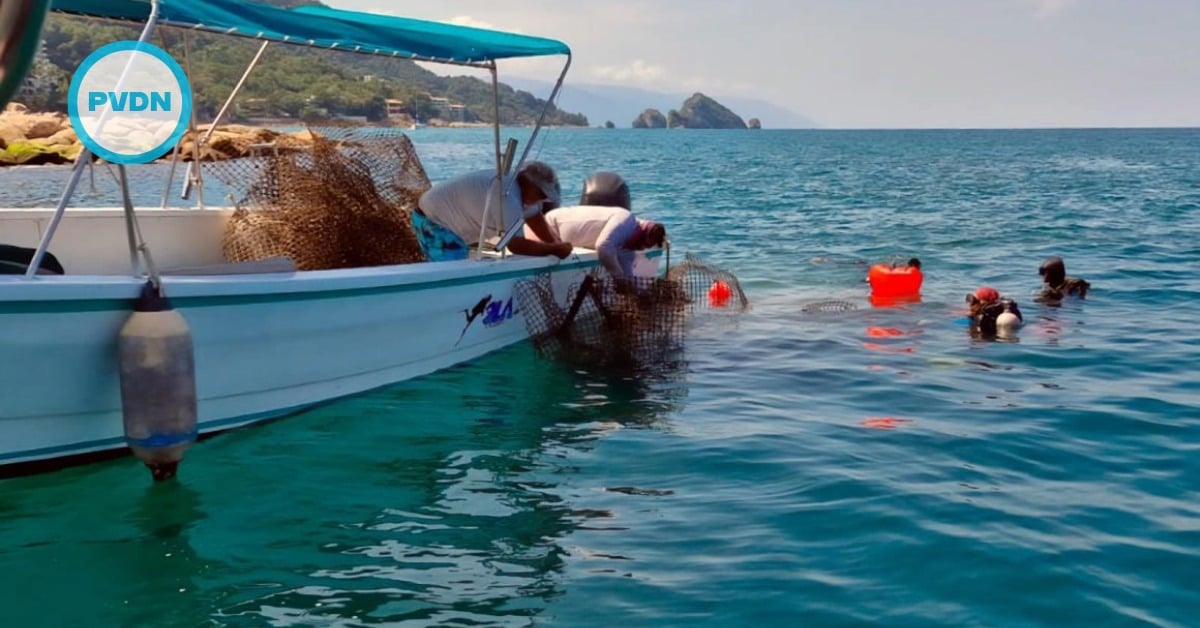
Buzmar’s first significant action happened on October 23, when divers located a large plastic mesh near Garza Blanca beach. The team worked underwater to cut it free, brought it to the surface, and then fragmented and removed it from the sea for final disposal. Independent coverage matched the government account on the date and location, underscoring that this effort went beyond a training dive and into real, messy fieldwork.
Puerto Vallarta ghost nets
Ghost nets are not abstract. Abandoned or lost fishing gear keeps fishing—snaring turtles, rays, dolphins, and fish—long after it’s been forgotten. WWF has been working in Bahía de Banderas for years on this specific problem, training local stakeholders and documenting removals around the Marietas and neighboring sites. That context matters because it shows Buzmar did not appear from thin air; it’s the latest step in a sustained, bay-wide push to clear lethal debris.
Profepa framed the committee as an extension of its citizen-based oversight network: people rooted in the community who can act as early sentinels, document violations, and file complaints when needed. That citizen angle is key here. Divers know the reef lines and rocky shelves where nets snag. They also know when a “lost” net is really an illegal set. A trained, accredited group gives that knowledge structure and legal pathways to escalate what they find. The point is simple: faster identification, safer removals, and better evidence when enforcement is required.
From the water to the truck, and where it goes next
After Buzmar hauled up the plastic mesh, city crews and a contracted waste operator handled collection and disposal. Local waste firm Red Ambiental has an active footprint in Puerto Vallarta, including a municipal “Ruta Ambiental” that deploys electric trucks for recyclables—evidence that infrastructure exists to move recovered debris through an appropriate chain of custody. That matters because ghost-gear operations fail if the gear is left to rot onshore. The loop has to close —from the seabed to certified disposal or recycling —and this operation shows that the hand-off can work here.
Expect more of these dives. In the same week, Profepa and the Navy reported disabling illegal traps in local turtle nesting zones—another sign of coordinated coastal enforcement in Jalisco’s stretch of Bahía de Banderas. With Buzmar now accredited and trained, there’s a professional pipeline for tips from tour operators, fishers, and beachgoers to reach a team that can actually pull dangerous gear out, safely and fast. The work is laborious. It’s also the kind of slow, steady intervention that keeps a bay alive.