Puerto Vallarta’s mayor has drawn a hard line on the city’s best-known boardwalk. Luis Ernesto Munguía confirmed this week that the semi-fixed stalls that long occupied the second section of the malecón will not return once renovation work is complete, saying the city is simply enforcing rules that already exist.
Under those rules, most street commerce on the seafront is banned. The regulation that governs the malecón, the Marina malecón, and Plaza de Armas prohibits fixed, semi-fixed, and roaming stalls along the walkway, with narrow exceptions for traditional vendors such as tuberos, balloon sellers, and cotton candy stands.
Munguía has framed the decision as a matter of law and fairness. In an interview, he said the municipality faces legal conditions tied to its federal concession over the coastal zone and must protect both the city and vendors’ legal rights, while also defending businesses that pay rent and taxes along the strip.
Malecón rules meet street livelihoods
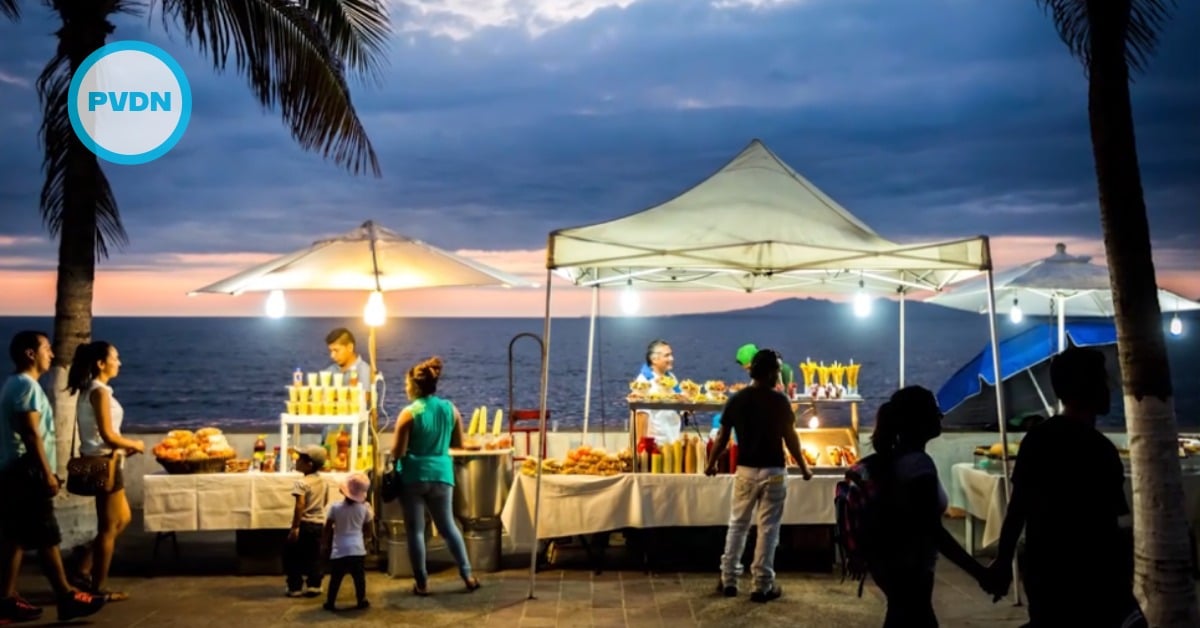
For years, Puerto Vallarta malecón vendors have been part of the everyday scene between Los Arcos and the river. They sold jewelry, toys, snacks, and souvenirs to tourists and locals, often working long evenings under heavy sun and salt air. Their stalls were technically temporary, but many families occupied the same spots for years, building up regular customers and a sense of ownership over a few square meters of concrete.
The renovation of the second section of the malecón pushed those stalls out months ago. While formal shops received promises of financial support for losses during construction, semi-fixed stallholders were left to work side streets, beach access points, or other busy corners of the Centro. Many hoped the disruption would be temporary and that they would be invited back once the new paving stones and lighting were in place.
That hope has now been closed off. Local coverage in Meridiano and business-focused outlet PVR Online confirms that the city plans to keep the renovated malecón “exclusive” to formal commerce, clearing out informal stalls and street sellers as soon as the work is finished.
City officials stress that vendors are not being “left on the street,” at least on paper. The mayor has said stallholders will be reallocated, but any move will depend on finding spaces that meet legal and safety requirements. No specific new locations have been announced publicly. For families whose income came almost entirely from that stretch of sea wall, the delay turns every week into another gamble.
At the same time, business groups along the malecón have pressed for stricter enforcement. The Association of Shops, Bars and Restaurants on the malecón has backed the decision, arguing that informal stalls undercut the rents and payroll costs that formal businesses must cover. One local businessman told PVR Online that unlicensed sellers hurt established shops because they do not pay taxes or create formal jobs, capturing the frustration many storefront owners feel when the promenade is crowded with carts and racks.
Puerto Vallarta malecón vendors
Behind the political language are city rules that, until now, have often been applied with a light touch. The Reglamento para el Uso del Malecón, the Malecón de la Marina and Plaza de Armas, published on Jalisco’s official legal portal, bans extending shop fronts into the walkway and forbids ambulant, fixed, and semi-fixed stalls along the seafront, except for a few regulated activities.
In practice, the city tolerated semi-fixed stalls for years, especially as tourism boomed and the demand for low-cost souvenirs grew. That informal tolerance sits awkwardly beside a boardwalk that international travel guides describe as a mile-long showcase of sculptures, restaurants, and boutiques, marketed as a polished, walkable attraction in the heart of Centro and the Romantic Zone.
The current administration is choosing to close that gap. By tying its decision directly to the malecón regulation and to the federal concession over the coastal zone, the city hall signals that the issue is no longer negotiable, at least for this stretch of waterfront. Once the new promenade opens, any stall that appears without express authorization will be removed.
For vendors, the key questions now are where they will be allowed to work and on what terms. Earlier this year, during the first phase of works, semi-fixed stallholders asked the city to designate temporary selling points. At the same time, the malecón was dug up, warning that months without income would be impossible to absorb.
Those concerns have not gone away. Relocating vendors to less visible streets or interior plazas would sharply cut the tourist foot traffic they rely on. Some may try to adapt by shifting to beach routes, residential neighborhoods, or local tianguis, but none of those spaces match the constant flow of people on the main seafront promenade. Others may leave informal trade altogether and look for wage jobs, even if pay is lower than a good high season on the boardwalk.
For residents, the change will be felt in different ways. Many people welcome a clearer, less cluttered malecón where strollers, wheelchairs, and families with children can move without weaving around stands. Others will miss the mix of formal storefronts and casual stalls that made the walk feel more like a street market than a mall, especially in a city whose identity has long rested on a blend of polished tourism and informal hustle.
Tourists will likely keep coming either way. The rebuilt malecón, a 12-block waterfront esplanade lined with public art and ocean views, remains one of Puerto Vallarta’s main calling cards, regardless of who is selling ice cream or bracelets along the rail.
What is less clear is how long the new line will hold. Once the ribbon is cut and the campaign season shifts, pressure may return from both vendors and visitors who enjoy grabbing a snack or trinket from a cart. For now, though, city hall has sent a strong signal: on the remodeled seafront, the era of the semi-fixed stall is over, and the people who lived from that trade must now search for space somewhere else.