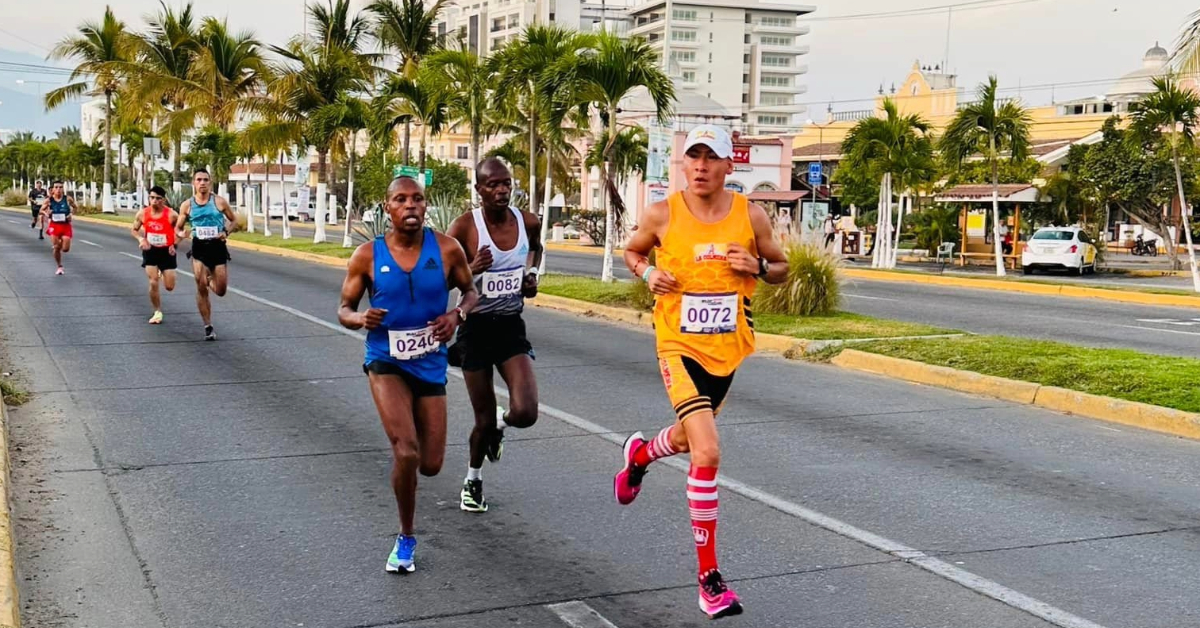
Puerto Vallarta authorities have announced an early-morning traffic plan for the Puerto Vallarta Marathon on Sunday, April 19, with road closures beginning at 2:00 a.m. and lasting in stages through the morning. The race is expected to bring more than 3,000 runners to the city, including athletes from abroad, and officials are asking residents to plan ahead if they need to drive across town, reach the airport, or head toward Bahía de Banderas.
The event is part of the city’s growing sports calendar, but for many residents, the immediate issue is practical. A marathon affects traffic differently than a concert or festival. Streets do not close all at once and reopen all at once. Instead, they are shut down in sections and released gradually as runners move through the course. That means drivers who normally rely on the same routes every Sunday morning may face delays even if they are not near the start line.
What will close and when
Organizers said the first restrictions will begin around 2:00 a.m. Sunday, mainly in the area from Avenida México, near the Sheraton zone, toward the Malecón. The race route will then extend through central lanes of Avenida Francisco Medina Ascencio toward the La Corona intersection, with effects also reaching parts of Fluvial Vallarta, Avenida Rodríguez Barba, the airport area, and the Marina corridor.
The earliest races, the marathon and half-marathon, are scheduled to start at 5:30 a.m. The 10K and 5K races are set to begin at 5:45 a.m. That early start is standard in coastal races because it reduces heat exposure for participants and allows authorities to begin reopening roads sooner. Even so, anyone with a morning airport trip, hotel transfer, medical appointment, or cross-bay drive should expect slower-than-usual traffic.
Authorities have recommended Calle Perú and the Libramiento Luis Donaldo Colosio as alternate routes for some trips. That will not solve every movement problem, but it gives drivers a way to bypass parts of the downtown corridor while the race is active.
Why this matters beyond a sports event
For international readers and newer residents, this kind of closure can seem larger than expected because Puerto Vallarta’s road network narrows quickly in key areas. A single event on the Malecón or the main entrance corridor can affect hotel zones, airport access, and travel toward Nuevo Nayarit or other parts of the bay.
That is why organizers and local officials are stressing timing as much as route choice. A person leaving at the usual hour may still run into trouble if they are trying to cross the city during the busiest part of the race. The better approach is to leave earlier than normal, especially if the destination has a fixed arrival time.
Some sections, including parts of Fluvial Vallarta and the airport zone, could begin reopening around 9:00 a.m. Organizers said traffic should return to normal more broadly by midday, though exact reopening times will depend on the race’s progress and public safety conditions.
A bigger event than many drivers may realize
This is the seventh edition of the Puerto Vallarta Marathon, and organizers have framed it as an international event rather than only a local race. The 2026 edition includes a 42K marathon, 21K half marathon, 10K, and 5K, with a new route starting and finishing near Los Arcos del Malecón. Officials and organizers have said runners will arrive from 24 countries and all 32 Mexican states.
That scale helps explain the city’s heavy operational planning. A field of several thousand runners means medical support, hydration stations, police coordination, traffic control, and route security across multiple neighborhoods. It also means road impacts are not limited to the waterfront. Once the course extends toward the airport and Marina areas, closures begin affecting residents, workers, ride-share users, hotel guests, and service providers well beyond downtown.
Organizers have also said the event should generate an economic lift for Puerto Vallarta, especially for hotels, restaurants, transportation providers, and other tourism-linked businesses. That benefit is real, but it comes with a tradeoff that residents see immediately in the form of temporary access problems on race morning.
What residents and visitors should do Sunday morning
The most useful advice is simple. Anyone who does not need to drive during the early hours should avoid the main race corridor until later in the morning. Anyone who must travel should leave earlier than usual and assume that even open roads may move more slowly than normal.
Visitors staying near the Malecón, the Hotel Zone, the Marina, or the airport should check their route before heading out. Residents with Sunday routines that involve grocery runs, church, employee shifts, or airport pickups should also build in extra time. Even where closures are temporary, traffic often remains uneven as vehicles are redirected from one corridor into another.
For many people, the disruption will last only a few hours. But those hours will likely fall right when the city begins its Sunday movement. That is why the notice matters. Puerto Vallarta is not simply hosting a race. It is temporarily reorganizing how people move through some of its most important roads.