A governor’s visit to Puerto Vallarta would not usually carry much weight on its own. This one does because it centers on the long-promised Mismaloya pier, a project tied to tourism, local mobility, and the future of the city’s south shore. The ceremony was scheduled for Wednesday afternoon, but the real story is what this new infrastructure is meant to change, who it is supposed to serve, and why officials have kept framing it as more than a simple public works ribbon-cutting.
A high-profile visit centered on a long-awaited project
Jalisco Governor Pablo Lemus was scheduled to arrive in Puerto Vallarta on Wednesday, April 8, for the inauguration of the new Mismaloya pier, with the ceremony set for 3:30 p.m. The visit puts state attention on a project that has been presented for months as one of the most important infrastructure upgrades for the city’s southern coastal zone.
For many readers, the key point is simple. This is not being treated as a routine local improvement. State officials and local authorities have framed the pier as part of a wider effort to improve how residents and visitors move through the coast south of Vallarta, while also giving one of the area’s best-known beaches a more formal and updated public access point.
That matters because Mismaloya is not just another beach stop. It sits in one of the most visited stretches south of the city and serves as both a tourist landmark and a departure point for smaller maritime routes. When officials talk about strengthening the southern tourism zone, they are referring to a place that already holds a high profile in Vallarta’s visitor economy.
More than a dock on the beach
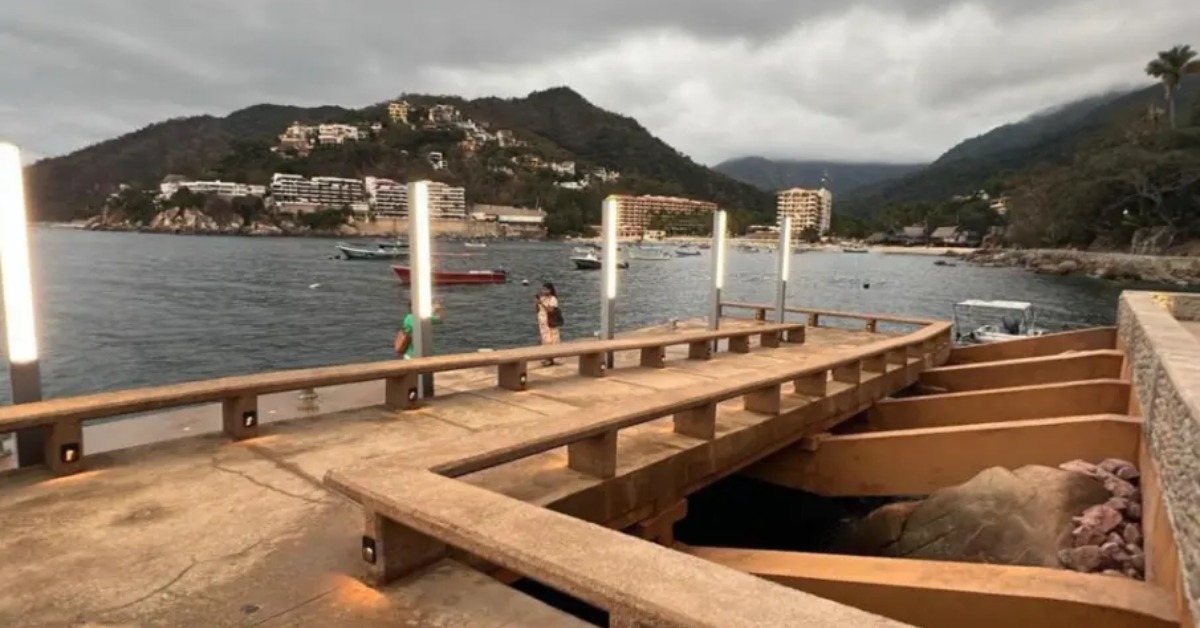
Recent reports on the project show that the work goes beyond the pier itself. The package includes a pedestrian walkway, lighting, urban furniture, rest areas, environmental and visual improvements, and rehabilitation work around the protective wall and surrounding public space.
That broader scope helps explain why officials have consistently used the language of maritime connectivity and public space renewal, rather than describing the project solely as a new boarding point. The intervention has been presented as a way to improve both function and appearance. In practical terms, that means better conditions for boarding and disembarking, as well as a more orderly and usable waterfront for the people who live in the area and for the visitors who pass through it.
Earlier local reporting described the investment at around 55 million pesos. One February progress report said the work covered close to 300 linear meters of pedestrian space and included a pier of about 168 square meters. By early March, officials were already saying the project was essentially ready and awaiting inauguration.
Why Mismaloya matters to the south side
For international readers, the significance of Mismaloya is partly geographic and partly economic. The beach sits on the route toward several smaller coastal destinations and boat-access areas south of Puerto Vallarta. In past explanations of the project, officials linked the pier to improved access for local maritime traffic and for routes to beaches and communities farther down the coast.
That does not mean the pier will transform the region overnight. But it does help explain why the state has tied the project to the idea of a stronger tourism corridor. In destinations like Vallarta, where land access, shoreline activity, and excursion traffic all overlap, even a relatively compact piece of infrastructure can carry more weight than it appears to on paper.
There is also a local political dimension. A governor personally inaugurating the project signals that the state wants the work seen as a deliverable result, not just another announcement. In a tourism city, that matters. Public works tied to beaches, boardwalks, and maritime access are highly visible, and residents tend to judge them not by press releases but by whether they actually improve daily use of the space.
A project with a longer timeline than first expected
The inauguration also closes a longer story. State reporting from 2025 had projected completion by the end of that year. By early February 2026, the pier was described as nearly finished, while the surrounding promenade was in its final stage. By March, officials said the work was done and were waiting for its formal opening.
That longer timeline is important context because it shows how the project evolved from an infrastructure promise into a test of follow-through. For residents and businesses in the south zone, the question has not only been whether the pier would be built, but when it would actually open and begin operating as intended.
Now, with the governor’s visit scheduled around the opening, the public focus shifts from construction to use. The next phase of this story will not be about renderings or inspections. It will be about whether the Mismaloya pier delivers the smoother boarding, stronger public access, and tourism support that officials have promised.
What readers should watch next
After the ceremony, the important questions will be practical ones. How quickly will operators and visitors begin using the pier at full capacity? Will the surrounding public space remain orderly and maintained? And will the project make movement through Vallarta’s south-side coastal circuit easier during busy periods such as Semana Santa and the spring tourism push?
Those answers will determine whether the inauguration becomes a meaningful turning point or simply a well-covered public event. For now, the message from state officials is clear: the Mismaloya pier is being presented as a finished and strategic project, and Wednesday’s visit by Pablo Lemus is meant to mark that transition in public view.
Deep Dive:
Mismaloya pier and boardwalk are ready for opening
Mismaloya Pier and Malecón Renovations Near Completion
New Mismaloya Pier Construction Begins Friday, Expanding Puerto Vallarta’s Maritime Network