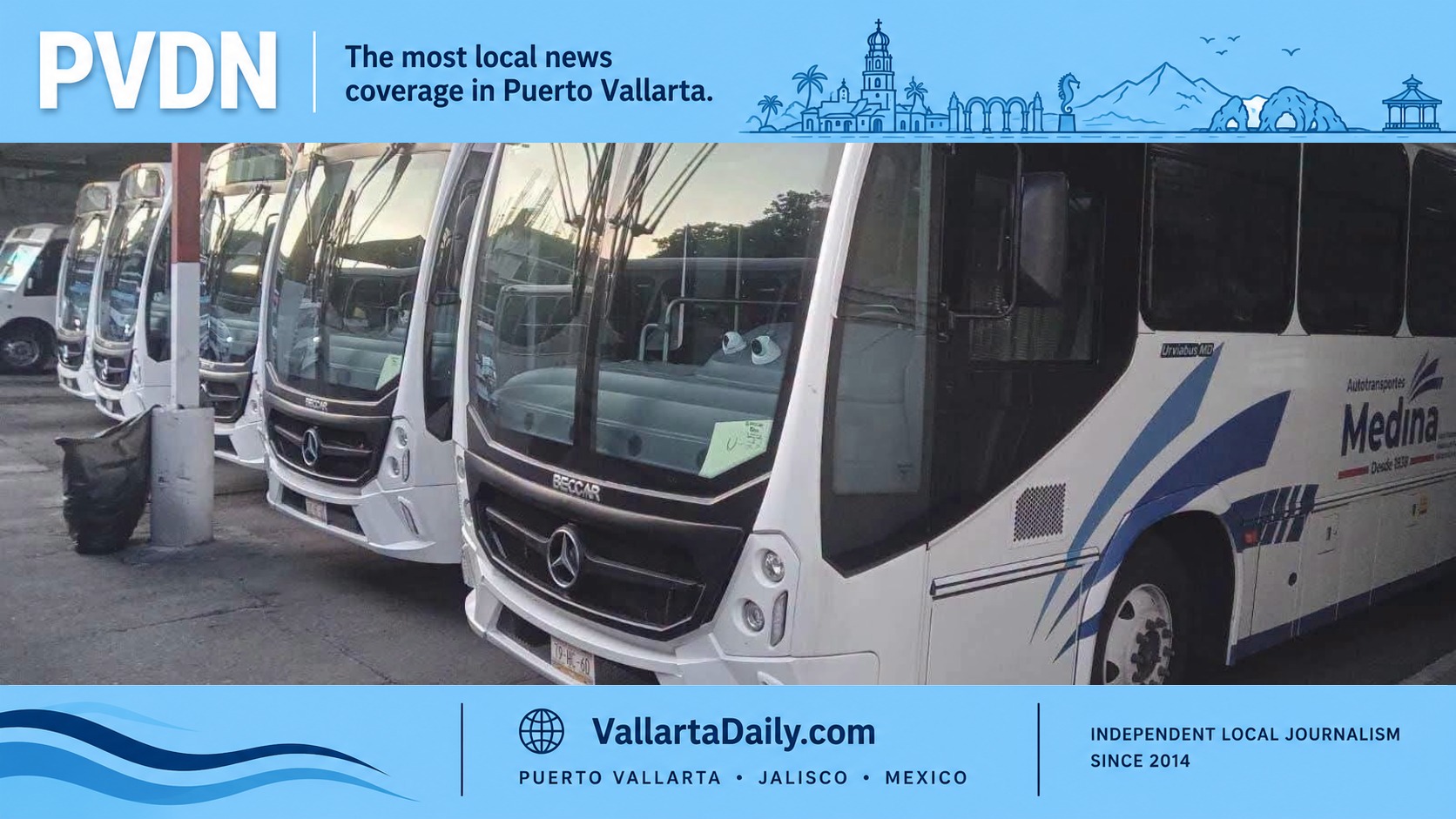
Jalisco Gov. Pablo Lemus says 38 new buses reach Puerto Vallarta next week, kicking off a phased transit upgrade through 2026.
Puerto Vallarta may see new public buses on its streets as soon as next week. Jalisco Gov. Pablo Lemus Navarro said the city is next in line for fresh units after his administration delivered a new batch of buses in the Guadalajara metro area on Friday, December 12.
Lemus framed the move as the first step in a longer renewal effort that he says will roll out across several regions of the state. Puerto Vallarta has watched that process from a distance for months, even as the city continues to grow and daily trips stretch farther into Ixtapa, El Pitillal, and the corridor around the airport.
The governor did not announce route changes or a start date for service. He did confirm the number of units slated for the first delivery, and he tied the Vallarta shipment to a wider transport push that runs into 2026.
Earlier the same day, Lemus’ administration staged a delivery event in Guadalajara that highlighted the state’s broader bus-renewal push. Transport agencies have pitched the program as part of a wider mobility upgrade that runs into 2026, when Jalisco expects heavier travel and more pressure on public services.
Puerto Vallarta sits at the center of that pressure. It is both a working city and a tourist city. The buses that transport hotel workers, students, and shoppers also carry visitors without a car. When service slips, the impact shows up in lost time, missed shifts, and crowded stops. That is why the phrase “next week” carries weight here.
Puerto Vallarta buses and the first 38 units
Speaking after the Guadalajara-area delivery, Lemus said, “Vamos a entregar en Puerto Vallarta 38. O sea, 100 hoy, 38 en Puerto Vallarta la próxima semana.” In plain terms, he promised 38 new units for Puerto Vallarta next week, after 100 units were delivered that same day in the metro area.
State officials have described the rollout as phased. Lemus noted that his government already delivered 15 units in Lagos de Moreno and plans more deliveries in the Ciénega region, including Ocotlán, La Barca, and Poncitlán. The message is that the Vallarta handover is part of a moving schedule, not a one-time announcement.
What the Vallarta batch will look like is still unclear. Officials have not released public details about which routes will receive the new buses first, who will operate them, or what service targets will be used to measure improvement. That matters because riders do not experience “new units” in the abstract. They feel it in the minutes they spend waiting, the crowding on board, and whether a bus actually arrives when it should.
In Guadalajara, transport authorities said the new buses are meant to improve frequency on conventional routes. They also described a broader fleet approach that emphasizes accessibility and lower emissions. Those goals set expectations for what the state wants the public to notice. Puerto Vallarta residents will likely judge the delivery by the same basic standard: do trips become faster and more reliable in the first weeks after the handover?
A state mobility bulletin earlier this year outlined a broader plan to deliver 203 new vehicles, tied to public transport improvements for both the Guadalajara metro area and Puerto Vallarta. That bulletin said the deliveries would be phased in gradually, with a rollout lasting through March 2026, alongside other projects aimed at expanding coverage and reducing crowding in high-demand corridors.
For Puerto Vallarta, the immediate question is simple. When the 38 units arrive, will the state and the operators publish a clear plan that riders can verify on the street, not just at a podium?
Lemus has also promised a second Vallarta delivery window that goes beyond new buses. He said he plans to return in March to deliver an electromobility system on Avenida Francisco Medina Ascencio, the city’s main north–south spine through the hotel zone and the airport corridor.
That second promise matters because it points to a different kind of change. Instead of adding vehicles to existing routes, the state has described the Medina Ascencio project as a redesigned corridor with new infrastructure, modern payment tools, and a fleet built for high-demand trips.
Planning documents released for the Medina Ascencio project describe a fully electric system built around 38 vehicles, supported by stations and stops along the corridor, with unified payment tied to the Mi Movilidad card.
What changes after Puerto Vallarta buses arrive
The project budget in those materials totals roughly 868 million pesos. Most of that cost is in the vehicles themselves, with additional spending on stations, stops, and the fare and monitoring systems that keep a corridor on schedule.
In a January 2025 statement posted on his official site, Lemus described the Medina Ascencio plan in everyday terms. He wrote that the state would deploy 38 electric buses with air conditioning, running from Ixtapa and El Pitillal toward central Vallarta. He linked that shift to a broader package of roadworks around Las Juntas and the airport connection, aimed at easing choke points that frustrate both residents and visitors.
Taken together, the announcements draw a line from next week’s handover to the broader 2026 timeline. The near-term delivery is about adding capacity. The corridor plan aims to reshape how the city moves along its busiest spine. Both will live or die on execution, not speeches.
For riders, the proof will show up quickly. If the new buses end up scattered without a public plan, frustration will linger. If they enter service with predictable headways and a visible improvement on the worst stretches, the city will feel it in daily life. Either way, Puerto Vallarta buses are now a promise with a near-term deadline.