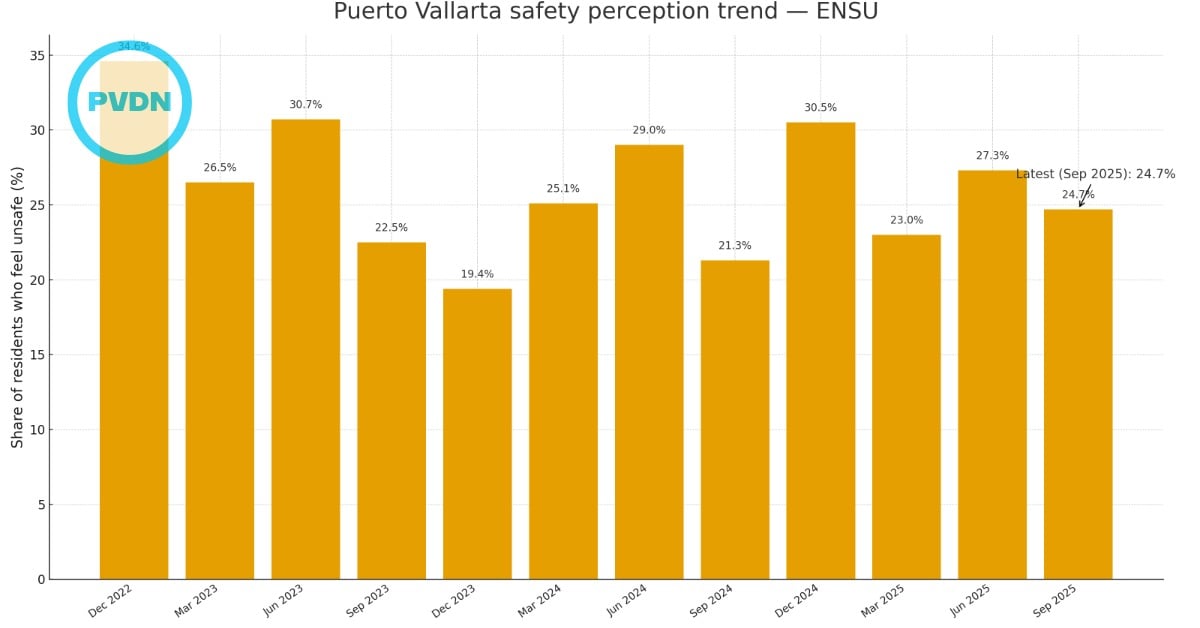
Puerto Vallarta has recorded a slight yet meaningful uptick in how safe its residents feel: 24.7 % of adults now say they feel unsafe living in the city—a 2.6-point improvement from 27.3 % in the previous survey. That puts the city among Mexico’s top ten safest urban areas, but three points lower compared to last year, according to the latest Encuesta Nacional de Seguridad Pública Urbana (ENSU) data by the INEGI.
Why the improvement in Puerto Vallarta security perception
While the numbers show improvement, the journey is not straightforward. In recent years, Puerto Vallarta’s unsafe-feeling figures have swayed: December 2022 showed 34.6 %, then March 2023 26.5 %, June 2023 30.7 %, September 2023 22.5 %, December 2023 19.4 %, March 2024 25.1 %, June 2024 29.0 %, September 2024 21.3 %, December 2024 30.5 %, March 2025 23.0 %, June 2025 27.3 %. These fluctuations reflect local factors and national trends.
Nationally, Mexicans living in 91 urban areas reported that 63.0% felt unsafe in September 2025—a statistically significant increase from 58.6% in September 2024.
Puerto Vallarta’s figure of 24.7% is far below the national average, which helps explain why it remains among the safest cities—even though nearly a quarter still feel uneasy. Official ranking data (though varying by quarter) place Puerto Vallarta in the top ten safest cities.
Several possible factors underpin the improved perception:
- Visible law enforcement and public security efforts in the region.
- Effective local communication and tourism-oriented safety measures, since the city has a major visitor component.
- Comparatively low rates of high-impact crime, or at least crime that filters into public perception.
What the numbers hide: the continued concerns
Despite the positive picture, one in four residents still feels unsafe. That’s not trivial. Compared to other cities, Puerto Vallarta is doing well. But the “24.7% feel unsafe” figure shows that even among the safer urban areas, a significant share of citizens harbour safety concerns.
It’s also worth noting that the ENSU breaks down perception of safety by specific situations: nationally in September 2025, 71.7% felt unsafe using ATMs on the street; 64.9% on public transport; 64.4% in streets generally; and 57.1% on roads. For women, the rates are even higher.
Thus, while overall city-safety perception in Puerto Vallarta improved, there may still be hidden local vulnerabilities—especially in public spaces, at night, or for women.
Reading the ranking: From fifth to eighth place
Puerto Vallarta dropped from 5th to 8th place among the safest cities, compared to last year’s survey in the same month, even while its perception improved by 2.6 points. That paradox partly reflects other cities improving faster. While Puerto Vallarta moved from 27.3% to 24.7%, other municipalities may have made larger gains, overtaking it.
For example, with many cities showing statistically significant reductions in perceived insecurity, the ranking shuffle is expected. The ENSU notes that in the September 2025 edition, 15 urban areas showed statistically significant changes from June 2025: 10 with reductions and 5 with increases.
What this means for residents and visitors
For residents, the message is cautiously optimistic: the sense of living in a safer place is real and improving. But for city leaders, it means sustained effort is required. A figure near 25% still feeling unsafe must prompt questions: Which neighbourhoods? What times of day? Which groups (women/men) feel more vulnerable?
For visitors, the data provides reassurance. Puerto Vallarta’s standing among the safest cities signals a better-than-average safety perception. That is useful for tourism marketing and local business confidence. Still, the city should not relax: constant vigilance, especially in public spaces, remains key.
Final thought
Puerto Vallarta’s security perception is improving, climbing out of higher-fear zones and staying in the national top tier of safe cities. But the reality behind the numbers also reminds us: safety perception is not binary. One in four feeling unsafe—even in a high-ranking town—signals work remains. For local policymakers, the challenge is to convert perception into lived security for every resident, every day.
It is important to remember that these statistics are based solely on citizen perceptions and do not reflect actual crime rates. It is not possible to determine how safe a destination might be based on the ‘feelings’ of citizens. The perception of safety can change daily depending on current events and does not reflect the broader crime or safety of any location.