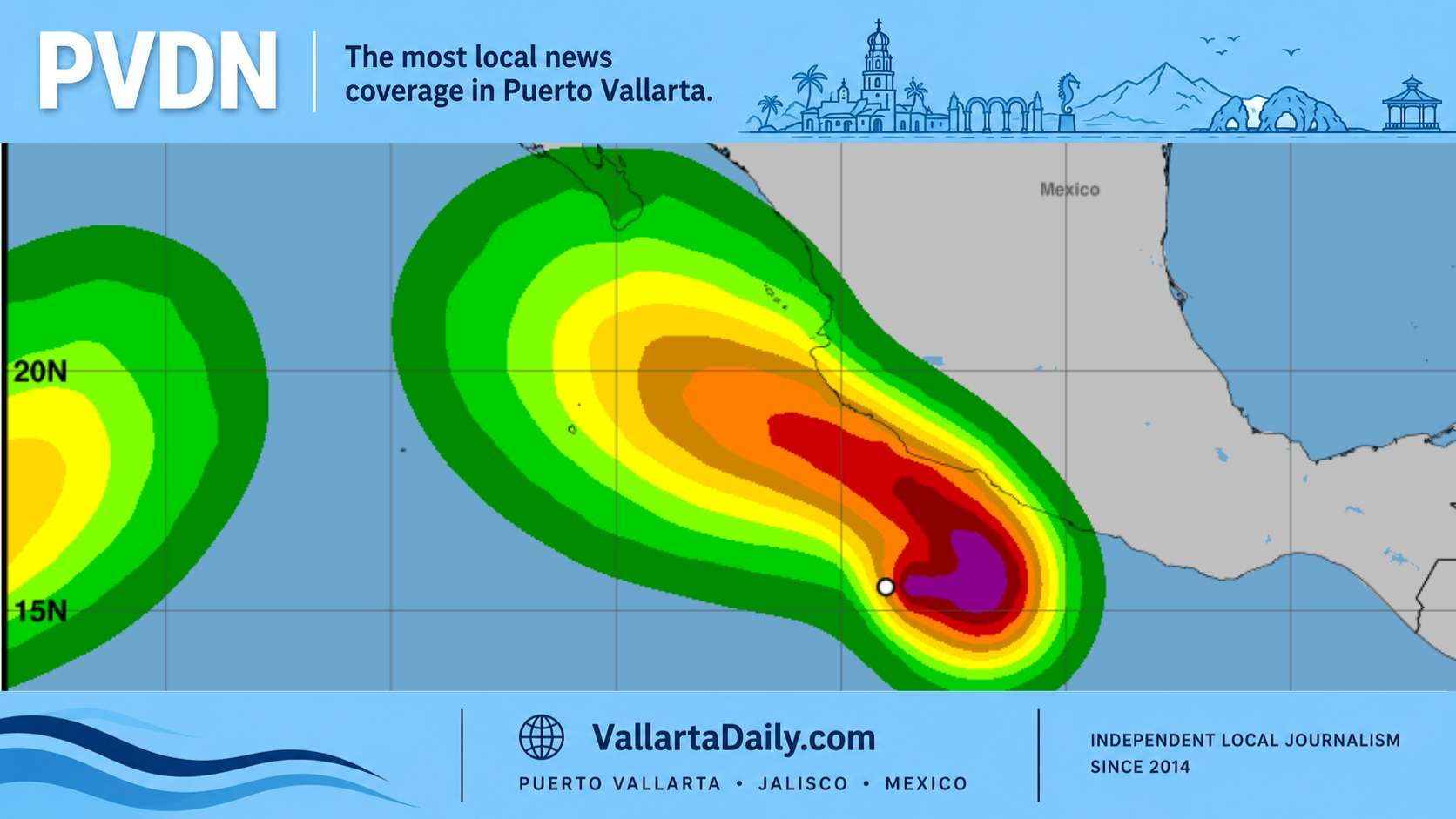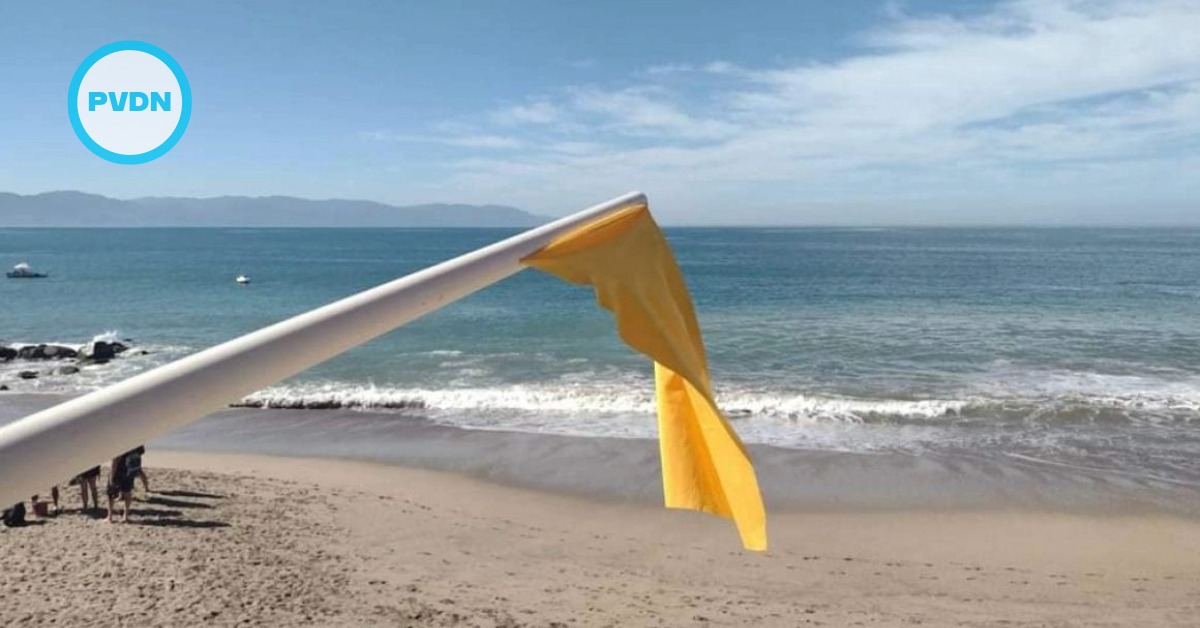
Puerto Vallarta authorities raised purple warning flags on Thursday at Los Muertos, Burros, Malecón, and Camarones, citing red tide conditions during one of the busiest stretches of the Easter holiday period.
At those beaches, purple flags were paired with yellow flags, indicating both an environmental warning and the need for extra caution in the water. Four other beaches, Palmares, Conchas Chinas, Holly, and Playa de Oro, were posted under yellow caution only.
For residents and visitors, this matters because these are not remote stretches of coast. They are among the city’s better-known urban beaches, used by locals, tourists, walkers, and people who may make a last-minute decision to get into the water. A purple flag is not a routine surf advisory. It is a warning that something specific in the marine environment may pose a risk.
Officials advised beachgoers to avoid contact with the water where the warning is posted and to follow instructions from on-site lifeguards. That makes the local message clear even if beach conditions still look calm from the shore.
Why a beach can test clean and still carry a red tide warning
The part that can confuse people is that Puerto Vallarta’s beaches were recently cleared for recreational use ahead of the holiday season. That earlier finding was based on bacteriological testing, which checks for contamination indicators such as enterococci.
A red tide warning points to a different problem. It refers to a harmful algal bloom, meaning certain microalgae have multiplied in large numbers. These blooms do not always turn the water red. In some cases, the color change is subtle or not visible at all. What matters is whether the bloom can irritate people, affect marine life, or produce toxins that move through the food chain.
That distinction is important. A beach can meet the sanitary benchmark used for routine recreational water testing and still have a short-term environmental hazard that triggers a municipal warning flag. One measure is about bacterial contamination. The other is about conditions in the water column that can change quickly in response to currents, temperature, and local marine activity.
So the new warning does not necessarily mean the entire bay is off limits or that all recent testing was wrong. It means the risk officials are watching now is not the same one measured in the earlier water-quality report.
What red tide means in practical terms
For most people, a red tide is less familiar than a rough-surf alert or a storm flag. But it can be more complicated. Harmful algal blooms are natural events, though their intensity and impact can vary. Some pass with limited effect. Others can trigger fish deaths, strong odors, skin or eye irritation, and food-safety concerns tied to shellfish.
The biggest public-health concern often involves oysters, clams, and mussels, which can accumulate toxins as they filter seawater. That is one reason health authorities monitor red tide events separately from standard beach bacteria testing. Even when the shoreline remains open, the underlying issue may still be serious enough to justify a warning.
For swimmers, the degree of risk depends on the species involved, the bloom concentration, and a person’s sensitivity. People with skin irritation, healing wounds, eye sensitivity, or breathing issues may want to be especially careful. For families, the safest assumption is simple: when a purple flag is up, do not treat the water as normal just because others are nearby.
The bigger lesson for expats and frequent beachgoers
One of the easiest mistakes in Puerto Vallarta is to assume beach safety is fixed for the whole week. It is not. Conditions here can change from one day to the next, and the city’s flag system is meant to reflect those shifts in real time.
Earlier this month, municipal monitoring also showed purple warnings at other Vallarta beaches under different conditions. That matters because it shows beach risk is dynamic, not static. A beach day planned around a general holiday water-quality report can still require a same-day check before anyone gets in.
For expats who use these beaches regularly, the takeaway is practical rather than dramatic. Check the flag before entering. Listen to the lifeguards, not the crowd. Be cautious with shellfish when a red tide is in the public warning cycle. And keep in mind that the best-known beaches are often the ones where people are most likely to underestimate a new warning because everything around them still looks active and familiar.
Puerto Vallarta has not lost its beaches to this event. But the city is clearly saying that, at least for now, parts of its shoreline should be treated with more caution than usual.