Puerto Vallarta whale watching is underway as humpbacks arrive to mate and calve. Learn what licensed tours show, and what rules protect them.
Every winter, Puerto Vallarta turns into a front-row seat for one of the Pacific’s biggest seasonal arrivals: humpback whales in Bahía de Banderas. After months spent feeding in colder waters farther north, these whales move into warmer seas to mate and give birth. That’s why the season matters for more than tourism. For a few months, the bay functions as a natural nursery where mothers and calves can spend their earliest weeks in calmer, safer water.
Mexico sets formal windows for whale-watching activity by region, and the current season for Bahía de Banderas runs from December 8, 2025, through March 23, 2026. Within that window, there are still “no-go” spaces meant to reduce pressure where mothers and calves tend to concentrate. A 1.5-kilometer radius around the Islas Marietas is treated as a restricted zone, and so is a two-kilometer-wide coastal strip from Punta Mita to the mouth of the Río Ameca.
For visitors, that mix of predictable timing and protected space is the point. You can plan a trip, but the bay still isn’t a stage. The best encounters usually happen when boats slow down, keep their distance, and let the whales decide how close “close” is.
Puerto Vallarta whale watching
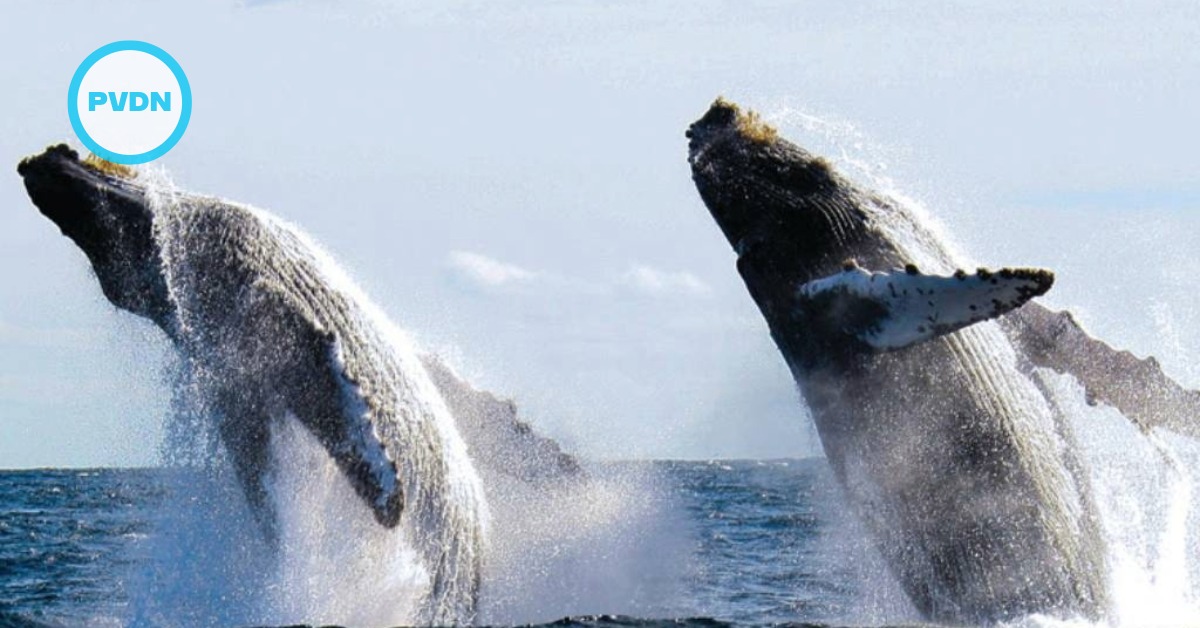
What people most want to know is simple: what can you actually see? On authorized whale-watching trips out of Puerto Vallarta, the signature moment is often a breach. A humpback can lift most of its body out of the sea and crash back down with a sound you feel in your chest. It’s dramatic, but it’s also a reminder that these are wild animals built for ocean-scale travel, not a quick photo op.
There’s a quieter “tell” that guides love just as much. When a humpback dives, it can raise its tail flukes and show the underside for a moment. Those markings matter because the black-and-white patterns, scars, and the shape of the fluke’s trailing edge are unique to each whale. Scientists use those natural “fingerprints” to identify individuals across years, connect wintering areas to feeding grounds, and track migration routes. In plain terms, that one tail lift can turn “a whale” into “that whale,” the same individual that may return year after year.
The long-distance travel leading up to that moment is part of the story. Humpbacks are known for migrations that stretch thousands of kilometers between feeding grounds and tropical breeding areas, and in the Northern Hemisphere, the breeding season is centered on the winter months. Mothers and calves are often found in sheltered, shallower water, where the calf can nurse, rest, and build strength for the eventual return trip north.
That’s part of what makes Bahía de Banderas special. The region lies within a stretch of Mexico’s Pacific coast where humpbacks are known to concentrate during their winter reproductive season. For experienced crews, the work is a mix of patience and pattern recognition. They watch for blows, track surface behavior, and wait for those brief seconds when the flukes rise. Some guides also keep photo logs that can be compared over time, which is how people sometimes learn a whale is a return visitor.
Some tours add another layer with hydrophones. When conditions allow, a hydrophone can pick up low, resonant sounds associated with humpback breeding areas. Male humpbacks are known for producing complex songs during the breeding season, and scientists are still studying what the song communicates and to whom. For passengers, hearing it can be disarming. The bay goes from visually spectacular to unmistakably alive, even when the whales are out of sight beneath the surface. This is also why reputable crews treat sightings as shared space rather than a race on the water.
Why the rules matter in Bahía de Banderas
Whale watching is regulated in Mexico for a reason: the same popularity that supports local jobs can also crowd the animals if it’s not controlled. National rules set out how vessels should behave around whales, including minimum distances that vary by vessel size and species, limits on how many boats can be near the same whale or group, and extra caution around mothers with calves.
The details are practical. Boats are expected to approach in ways that don’t block a whale’s path, keep speeds low, and avoid sudden changes in direction. If a whale approaches a vessel, the vessel is expected to maintain a safe course and avoid sudden acceleration. The rules also cap how long a boat can stay with the same whale or group in an authorized zone, which helps reduce the pile-on effect when conditions are good, and everyone wants the exact moment.
Puerto Vallarta’s winter whale season is an easy place to see what responsible tourism looks like when it’s done right. The payoff is obvious for visitors, but the bigger win is quieter: the bay stays a sanctuary that mothers and calves can keep using year after year.