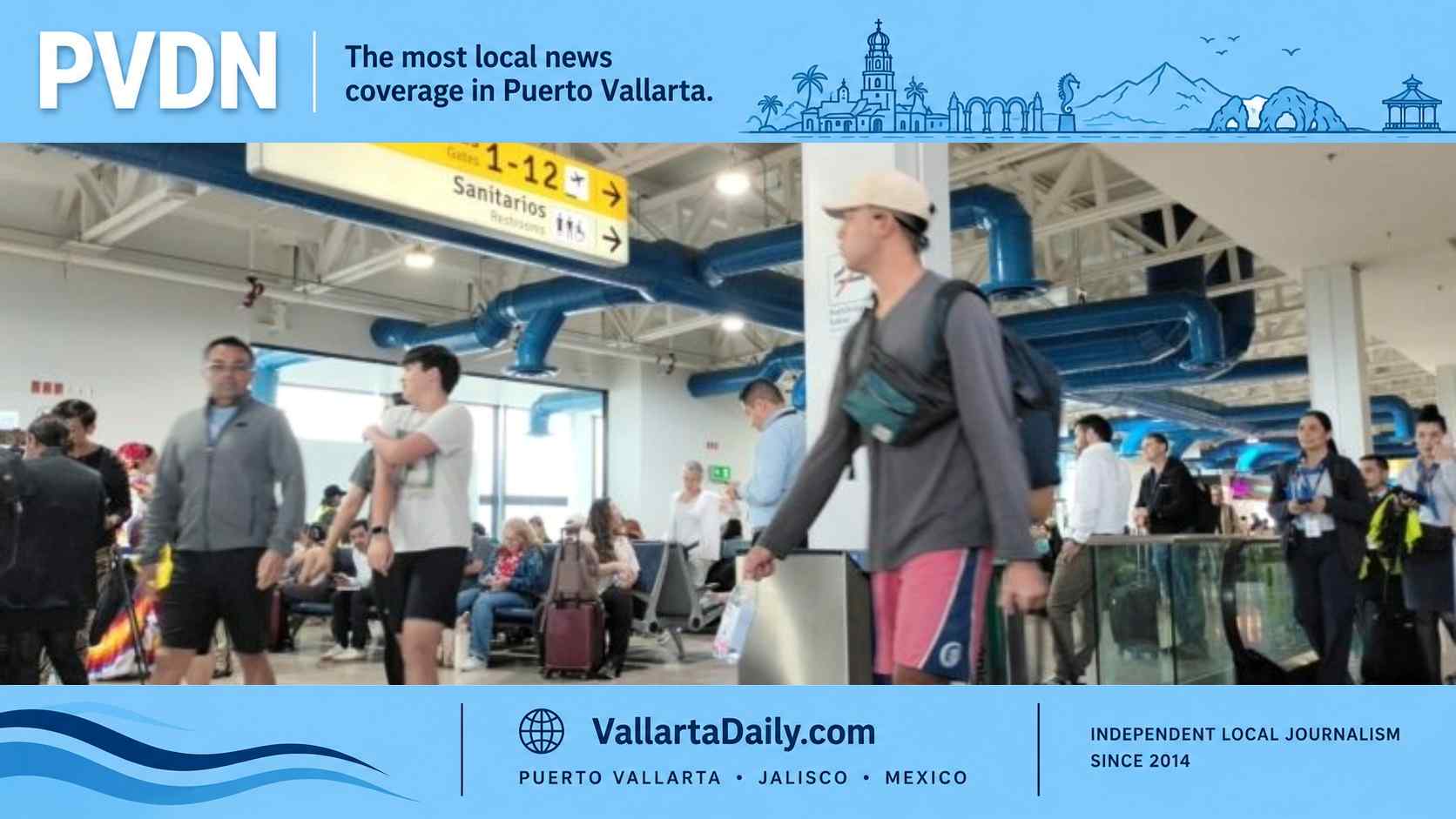
Puerto Vallarta is heading into 2026 with two big developments: tighter security planning and stronger tourism demand. Put simply, the city is preparing for more people, more pressure, and more attention.
That matters because when those two forces rise together, residents feel it in everyday ways. You see it at the airport, on cruise ship days, in traffic, in restaurant staffing, in hotel demand, and in the price of short-term rentals. Visitors may assume Puerto Vallarta can handle all of that without a problem. Sometimes it can. Sometimes the strain shows.
We look at the systems behind that reality. We break down what is confirmed, what remains unverified from public data, and what it all may mean for people who actually live here.
Foreword Summary
Puerto Vallarta’s story in 2026 cannot be explained by a single number. It is really about several systems all working at once — public safety, transportation, airport and port operations, and hotel capacity.
Federal and state officials have publicly described a large security setup tied to 2026 events. That plan focuses on coordination between the armed forces, police, civilian agencies, and regulated private security. It also includes surveillance technology and rapid-response logistics.
At the same time, the airport’s multi-year modernization project is changing how the city handles peak travel periods and how attractive it looks to airlines. Cruise tourism is also rising, with more ship calls and higher estimates of passenger spending. For residents, including expats, the real question is not whether those numbers sound impressive. It is what they actually mean in daily life.
This guide examines what can be confirmed, what remains murky, and what readers should keep an eye on. The focus is on security operations, transportation and infrastructure, tourism demand, and the likely spillover from the 2026 World Cup because of Puerto Vallarta’s proximity to Guadalajara.
Why Puerto Vallarta feels different in 2026
Puerto Vallarta in 2026 sits at a crossroads between local life and international demand. It is not just a beach town. It is also a regional gateway for the wider bay, which puts pressure on it.
Growth is not only about more arrivals. It also means more strain on roads, utilities, staffing, and housing. Housing costs are often one of the first places people notice it. And several signals are all pointing in the same direction. Airline schedules are growing. Cruise calendars are filling up. New hotel projects are moving forward. State tourism officials are also talking about 2026 as a year with unusually high visibility.
A big reason for that is the World Cup. Puerto Vallarta is not hosting matches, but Guadalajara is nearby, putting Vallarta within the travel orbit for teams, fans, and media. For expats and residents, that can be both good news and bad news. More flights and stronger service hours are a plus. Longer waits, tighter availability, and higher prices during peak periods are the tradeoff.
What really makes 2026 stand out is the emphasis on resilience. Officials are not just promoting growth. They are also discussing how the city will handle shocks — whether that is traffic surges, adverse weather, or security incidents.
That became especially clear in late February 2026, when cartels blocked streets with nearly 200 burning vehicles in Puerto Vallarta, a rare and highly visible show of force in the city. Public transport, cruise activity, and other services were disrupted. Then, little by little, service resumed. Officials described continued coordination between state and local teams. After conditions stabilized, transport was again moving around 42,000 riders a day. We used the phrase saldo blanco to describe the safety outcome during that period.
Those moments do not define the entire year, but they do tell us something important about 2026. The expectation is not that problems will never happen. It is that officials want to show a fast recovery and restore confidence quickly. For residents, that means the best things to watch are not always tourism headlines. Road alerts, airport operations, and port updates often tell you much sooner when the city is under pressure.
Security and resilience in practice
The main security framework under discussion for 2026 is Plan Kukulkán. This is a federal strategy tied to the World Cup cycle. Public briefings describe a combined force of roughly 99,000 personnel. That total includes the armed forces, National Guard, civilian agencies, local police, and, in some summaries, regulated private security.
One frequently cited breakdown puts the number of personnel at about 20,000 in the National Guard, Army, and Air Force. Another roughly 55,000 are assigned to the Secretariat of Security and Citizen Protection, along with local police functions. Around 20,000 certified private guards are also described as part of the wider operation. In Jalisco, those same public materials mention tactical vehicles, air assets, and long-range drones.
The goal is layered coverage at airports, ports, hotels, and fan zones. Puerto Vallarta is not a host city, but it is very much on the route many travelers will take. For locals, the effect is most likely to be felt at transportation hubs and during busy weekends. It is also worth remembering that these totals reflect event-level planning, not the normal day-to-day security presence.
Security in 2026 is not just about how many people are assigned. It is also about where they are positioned, how quickly they can detect problems, and how fast they can respond.
Public descriptions of the plan mention aviation patrols, aeromedical evacuation, and drone surveillance. They also mention specialized units, including canine teams trained to detect explosives and narcotics. Some summaries say that thousands of cameras using facial recognition and AI will be deployed at important sites.
That raises practical questions for residents. Where exactly are those “important sites”? How long will these systems stay active? Who controls the data, and how long is it stored? Those answers are not always clear, and they can vary depending on which agency is in charge.
That is one reason some public numbers do not match perfectly from one briefing to the next. For example, staffing figures for Guadalajara and the surrounding metro area vary slightly by source. The safest way to treat the technology claims is as a general direction rather than a fully mapped, publicly documented system unless an agency releases a detailed inventory.
For most people living in Puerto Vallarta, the places where this may be most visible are the airport, the port area, and the city’s busiest traffic corridors.
Connectivity and capacity
If you want the clearest sign of Puerto Vallarta’s growth, look at the airport.
The airport operator, Grupo Aeroportuario del Pacífico, has described a five-year modernization program as part of its 2025–2029 master plan. In one industry account, the amount committed to Puerto Vallarta is listed at about 3.66 billion pesos. In later statements, that number appears closer to 5 billion pesos for the same period.
Why the difference? Most likely because of changes in scope, project timing, and inflation adjustments. But the basic story stays the same: more gates, more platform space, and faster passenger processing.
Routes are part of the picture, too. In early March 2026, state tourism messaging stated that Puerto Vallarta had 14 domestic and 42 international routes. Independent route maps show similar numbers, though those totals can vary by season and by what counts as a “route.” Recent passenger figures put the airport near 7 million travelers a year. Those totals naturally rise and fall month by month because of weather, airline scheduling, and sudden disruptions. But even small shifts matter in a city where so much of the economy depends on service and tourism.
And connectivity is not only about flights. It is also about the roads that move workers, food, supplies, and emergency services.
In early 2026, officials in Jalisco publicly discussed rebuilding the Puente de la Desembocada on the state highway north of the city. The public timeline described demolition and a full rebuild, with completion targeted for July 2026 and an investment of nearly 80 million pesos.
That kind of project matters more than it may seem. When one critical link goes down, detours get longer, and travel becomes less predictable. Inside the city, public transportation is another measure of resilience. Local reporting after the late-February disruption said the system was again carrying around 42,000 daily riders once service stabilized.
Those numbers are tied to a specific moment, but they show how many people rely on the system. For expats and residents alike, the practical lesson is simple: the big travel story is often decided by basic mobility. Airport growth is useful, but it does not solve bottlenecks on key roads.
Cruise tourism and the downtown economy
Cruise tourism runs on its own schedule, and it affects the city in its own way.
Port figures cited in early March reporting, attributed to ASIPONA Puerto Vallarta, put 2025 at 171 cruise calls and roughly 535,000 passengers. That same reporting estimated an annual economic impact of 963 million pesos using standard spending models.
The start of 2026 was also described as strong. January was reported at 25 cruise arrivals, about 25 percent higher than January the year before, with around 68,000 cruise passengers. The estimated economic impact for that month alone was roughly 115.8 million pesos, with average passenger spending of around 1,800 pesos.
Looking ahead, March schedules were described as especially busy, including several days with two ships docking on the same day.
Residents usually experience cruise growth in two predictable ways. First, the benefits are concentrated around the port, the malecón, and the nearby excursion corridors. Second, traffic and parking get worse on peak days even if hotel occupancy stays the same. That is why some weeks can feel much busier than hotel statistics alone would suggest.
It is also important to read cruise “economic impact” numbers carefully. These estimates are usually based on assumed average spending, and they do not necessarily show how much money stays in the local economy. A shore excursion, a taxi ride, and a restaurant lunch all create very different kinds of value. They also come with different costs, from cleanup to road wear to pressure on public space.
So in 2026, the better question is not simply whether cruise traffic is increasing. It is whether the city can manage the concentration of people arriving within a short window. That comes down to things like berth scheduling, pedestrian flow, and traffic control.
Official port statistics exist, but they are sometimes posted in spreadsheet formats that are not especially easy to access on a phone. When that happens, media summaries fill the gap, and numbers can start to drift. For residents, the most practical way to think about cruise days is to view them as a capacity challenge first and a tourism story second. When the system is working well, it shows up in smoother traffic, better emergency access, and fewer chokepoints near downtown.
Hotel investment and service clusters
On the hotel side, 2026 growth is being supported by a mix of new development and reinvestment.
In mid-2025, state officials and the hotel association said there was a pipeline of 38 new hotels across Jalisco, representing about 20 billion pesos in investment through 2028. Puerto Vallarta was one of the municipalities expected to receive part of that expansion.
That matters for more than just how many rooms are available. New hotel inventory changes hiring needs, supplier relationships, and tax revenue linked to lodging. It also affects what airlines and tour companies can realistically sell, because more room supply can make capacity feel more reliable.
For residents, the short-term effect is usually seen first in hiring, wages, and operating hours rather than in dramatic skyline changes. The longer-term question is how the destination positions itself in the market. Does it move upmarket? Stay mixed? Spread into more year-round demand?
A World Cup year can speed up the conversation, but it does not remove normal limits. These projects still depend on permits, financing, and construction realities, especially during a busy season.
Tourism demand is often summed up using a handful of January numbers. One early March 2026 summary said Puerto Vallarta saw about 575,000 visitors in January, average hotel occupancy near 84 percent, an average stay of around 3.5 nights, and an estimated economic impact of 4.1 billion pesos.
Those numbers make sense together, but they are not all fully verifiable from one open public dataset. Part of the problem is that definitions are not always consistent. In Mexico, the term “visitor” can refer to hotel guests, total arrivals, or a broader category that also includes day-trippers. Economic impact numbers are also model-based estimates, not direct cash-register totals.
So the safest way to use those figures is as a signal rather than a precise final count. They suggest a strong January, good occupancy, moderate year-over-year growth, and average stays somewhere in the mid-three-night range. The best way to check whether that picture holds is to compare it with airport passenger totals and later official tourism releases.
Puerto Vallarta’s tourism economy is often described in terms of “clusters,” but the idea itself is simple. Visitors do not spend money in just one place. Hotels depend on transportation, staffing, cleanliness, and reliable services. Cruise days depend on street management, tour operators, and businesses capable of handling high-volume transactions quickly. Food and beverage is one of the biggest employers in the chain, and also one of the most vulnerable when demand swings sharply.
For expats who own or manage small businesses, 2026 may feel like a year that demands tighter operations. That can mean more inspections, closer attention to licensing, and pressure to formalize work relationships with contractors. It can also mean rising wage pressure as hotels and restaurants compete for trained staff.
None of this is unique to Puerto Vallarta. These are common signs that a destination is shifting from seasonal highs to more constant demand. Whether quality of life keeps up depends on whether infrastructure and enforcement keep pace, too.
World Cup spillover and what “official beach” really means
The 2026 FIFA World Cup is shaping how people talk about Puerto Vallarta, even though the city is not hosting matches.
FIFA has confirmed a March 2026 playoff tournament in Guadalajara and Monterrey. The main tournament is set to begin on June 11, 2026, with matches spread across three countries. That timing matters for Puerto Vallarta because it overlaps with the late high season and the start of summer travel.
Local tourism officials have leaned into that reality. Public messaging has described Puerto Vallarta as the “beach” option during the World Cup period. What that really means is that the city hopes to attract travelers who want to combine inland match days with some time on the coast afterward. The air connections support that strategy, and so does the short flight between Guadalajara and Vallarta.
For residents, the important thing to hear behind the slogan is not the marketing. It is the planning. Puerto Vallarta is being positioned for a very specific spike in demand on very specific dates.
But World Cup spillover should be judged by what is actually booked, scheduled, and permitted — not just by optimistic statements.
Claims of full occupancy during match periods are believable but not guaranteed. They depend on room inventory, flight availability, and how many travelers choose Vallarta instead of other beach destinations. They also depend on whether local authorities organize or approve large public match-viewing events.
Some 2026 projections suggest very high rates of event confirmation tied to the destination. At the time of writing, those numbers cannot be fully checked against one public calendar. So residents should see them as directional rather than certain.
The practical preparation is straightforward. Expect stronger demand for short-term rentals, airport transfers, and medical services during the busiest weeks. Expect heavier traffic near the hotel zone and the port when cruise schedules overlap with World Cup-related demand. If you are hosting guests, book domestic flights earlier than usual and recheck schedules close to departure. If you run a business, think about staffing around weekends tied to match dates, not just school breaks and traditional holidays.