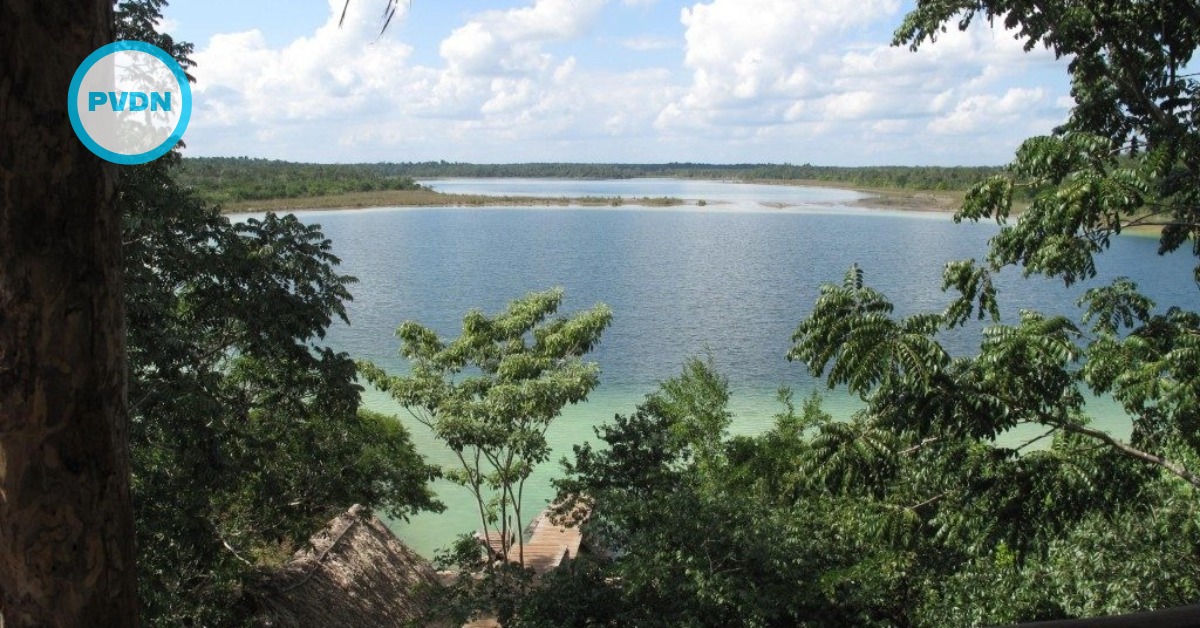
Punta Laguna has long been known as a quiet jungle community built around a blue lagoon and a spider monkey sanctuary. The village sits near Valladolid, Yucatán, but the lake and surrounding forest are in Quintana Roo, inside the Otoch Ma’ax Yetel Kooh protected area. For decades, residents ran a community cooperative, guiding visitors to watch monkeys, paddle canoes, and visit nearby cenotes, even while their legal status remained blurred.
That limbo began to close this month. The National Institute of Indigenous Peoples (INPI) delivered an official certificate that recognizes Punta Laguna as a Maya indigenous community belonging to the municipality of Playa del Carmen. The document, signed by INPI director Adelfo Regino Montes, is declarative, but its effects are concrete. It confirms that the village is part of Quintana Roo and ends a dispute with authorities in Valladolid, Yucatán, who tried two years ago to treat Punta Laguna as a local “comisaría” under their control.
Local leader Hermelindo Be Cituk, from the Asamblea Nacional Indígena Plural por la Autonomía, has been one of the most visible voices in that fight. He explains that the lack of clarity over which state and municipality should attend the village left its roughly 800 residents without steady access to key public resources. For years, the community lost out on programs because it could not prove which government was responsible. As he put it, “por cuestiones políticas y de falta de atención, se están perdiendo estas comunidades.” (Due to political issues and lack of attention, these communities are being lost.)
The INPI certificate does more than draw a line on a map. It formally recognizes Punta Laguna as a Maya community with its own territory, institutions, and systems of self-government, under principles of autonomy and free determination. In practical terms, that recognition is what federal agencies use to decide which localities qualify for indigenous-focused programs. INPI runs schemes like the Programa para el Bienestar Integral de los Pueblos Indígenas, which funds basic infrastructure, roads, and community facilities in recognized indigenous communities through formal agreements with local governments and assemblies. Being on that list is often the first step to even apply.
What Punta Laguna Playa del Carmen recognition means on the ground
For residents, the first expectation is simple: services. With the dispute resolved in favor of Quintana Roo, Punta Laguna now falls under the clear responsibility of the Playa del Carmen municipal government. Community leaders say the next move should be regular public services that other rural localities take for granted, such as road maintenance, waste collection, and more consistent attention from municipal offices. Until now, those requests were often bounced between Yucatán and Quintana Roo.
The new status also changes who sits across the table when the community negotiates support. Any future agreements for water systems, community centers, or transportation links are now expected to be signed with Playa del Carmen authorities, using INPI recognition as a legal base. The certificate affirms that the village’s own assemblies and traditional authorities are legitimate counterparts in those talks, which matters in a region where tourism and land values keep rising.
Tourism is already central to Punta Laguna’s economy. The lagoon and surrounding forest form one of the most important sanctuaries for spider monkeys in the peninsula, and visitors come for guided walks, canoe trips, zip lines, and Maya ceremonies led by local families. Travel guides describe Punta Laguna as a “hidden paradise” where a Maya cooperative regulates access to the reserve, sets rules for visitors, and shares income among members. Recognition as an indigenous community inside Playa del Carmen gives that cooperative a clearer place in the official tourism map of Quintana Roo.
At the same time, the certificate confirms that this is not just another tourist stop, but a living Maya village with deep ties to the land. Federal catalogs of indigenous communities already list Punta Laguna among localities where Maya is spoken and traditional practices remain strong. The INPI decision aligns that cultural reality with the political map by tying the community to a specific municipality and acknowledging its own institutions. For residents who have fought to defend their territory, that legal backing is part of a broader struggle for cultural survival.
A border community steps into the spotlight
Punta Laguna has always lived with borders. The state line between Yucatán and Quintana Roo cuts through the nearby forest. The main access road ties the community to the tourist corridor of Tulum and Playa del Carmen, while its daily trade often flows toward Valladolid. Tour operators promote the lagoon as a day trip from several cities, and national media often describe it as “near Valladolid but in Quintana Roo,” highlighting that uneasy in-between.
The INPI recognition does not erase that complex geography, but it settles who is accountable. It gives Punta Laguna an official address inside Playa del Carmen for paperwork, budget planning, and emergency response. It also fixes the village inside the federal map of indigenous communities that guide language policy, cultural promotion, and infrastructure spending. In a region where protected areas, private tourism projects, and ejido lands overlap, that clarity can reduce some of the conflicts that arise when investors or governments claim to speak for local territory.
For now, the community’s life continues much as before. Families still guide visitors at dawn to watch spider monkeys move through the canopy. Elders still tell origin stories in Maya beside the lagoon. The difference is that those daily routines now sit on firmer legal ground. Punta Laguna is no longer just a name on a tourism brochure or a dispute in a filing cabinet. It is officially a Punta Laguna Playa del Carmen community, with the rights and responsibilities that status carries.
Residents and advocates will be watching what comes next: whether municipal and federal agencies turn the ink on this certificate into water lines, safer roads, support for sustainable tourism, and real respect for Maya self-government. After years in administrative limbo, the people of Punta Laguna now have a document that says clearly where they belong. The challenge ahead is making sure that recognition is felt in homes, not only in archives.