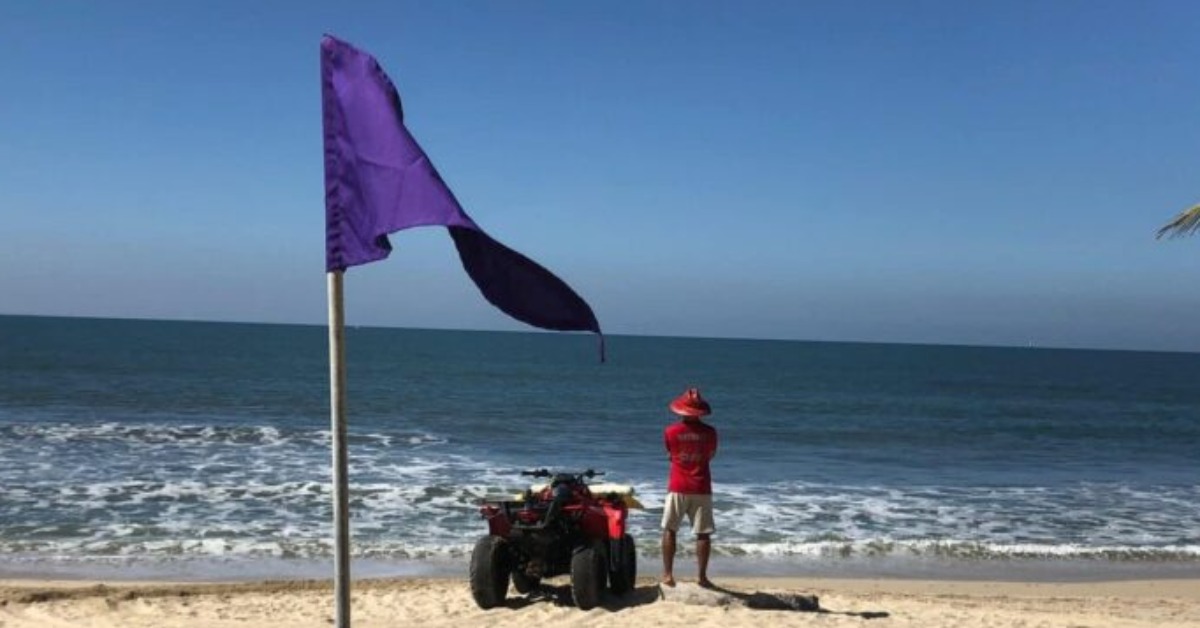
Puerto Vallarta authorities posted purple warning flags at Playa Malecón and Playa Conchas Chinas on Tuesday, warning beachgoers about the presence of marine fauna that could pose a risk. At the same time, other major beaches in the city remained under yellow caution flags, meaning access to the water was still allowed, but only with care.
That distinction matters. Many visitors assume beach warnings only relate to waves or currents. In this case, the concern was not limited to surf conditions. The warning focused on something biological in the water. Officials described it broadly as marine fauna that may represent a risk to people, but the public advisories did not identify a specific species.
For residents and visitors, that leaves an important takeaway. A calm-looking beach is not always a low-risk beach. A purple flag is meant to warn people that danger may come from what is in the water, not just from how the water looks.
What the yellow and purple flags actually mean
Puerto Vallarta uses a color-flag system that gives quick guidance to swimmers and people spending time near the shoreline. A yellow flag signals caution. It usually means moderate surf, changing currents, or other conditions that require care before entering the sea. People may still go in, but they are expected to follow lifeguard instructions closely.
A purple flag serves a different purpose. It warns of marine life that may be harmful or dangerous. In coastal areas, that kind of alert can be used for several reasons, including stinging organisms, other hazardous sea life, or wildlife activity near shore. The key point is that the warning is tied to a biological risk.
On Tuesday, Playa Malecón carried a purple flag, while Playa Conchas Chinas had a mixed yellow-and-purple warning. That mixed status suggests two separate concerns at once. Beachgoers are being told to use caution due to water conditions and warned that marine fauna is present.
The other monitored beaches, including Palmares, Los Muertos, Burros, Camarones, del Holly, and Playa de Oro, remained under yellow flags. That did not mean conditions were ideal. It meant authorities still wanted swimmers to be cautious, even outside the two purple-flag beaches.
Why this matters for international readers
For many foreigners living in or visiting Puerto Vallarta, beach flag colors are not always intuitive. In some countries, people are most familiar with red flags and may not know what purple means. That can create confusion, especially in tourist areas where people see others on the sand and assume the beach is fully open.
The latest warning is a reminder that beach access is not a yes-or-no question. A shoreline can be open for walking, sitting, or supervised activity while still carrying a warning for swimmers. It is also possible for one beach to show a more restrictive message than another, only a short distance away.
That is especially relevant in Puerto Vallarta, where beach conditions can change quickly between locations. River mouths, rocky sections, marine activity, and local currents can all affect how a specific beach is flagged on a given day. Two beaches may look similar to a visitor, but lifeguards may be responding to very different risks.
For people staying near the Malecón or in the Conchas Chinas area, the safest approach is to check the flag before entering the water, not after arriving at the beach. It also helps to ask a lifeguard directly, since conditions can shift during the day.
What beachgoers should watch for now
Tuesday’s advisory did not call for broad beach closures across Puerto Vallarta. Instead, it pointed to a more targeted warning. That is useful, but it also places more responsibility on the public. People need to read the flag system carefully instead of treating every beach the same.
A purple flag should be taken seriously, even when the sea appears manageable. The public message is that the risk may not be obvious from the shore. Families with children, older adults, and visitors unfamiliar with local conditions may want to avoid entering the water in purple-flag areas until authorities remove the warning.
The yellow flags across the rest of the monitored beaches also deserve attention. A yellow flag is not a green light. It means swimmers should enter carefully, stay alert, and listen to lifeguards. That is particularly important for visitors who are not used to Pacific surf conditions.
Puerto Vallarta’s beach flag updates are part of a routine safety system, but they can also change the daily experience of the city. For a place where the shoreline is central to local life, tourism, and recreation, even a limited warning at two beaches is worth paying attention to. The flag itself may be small, but the message is not.