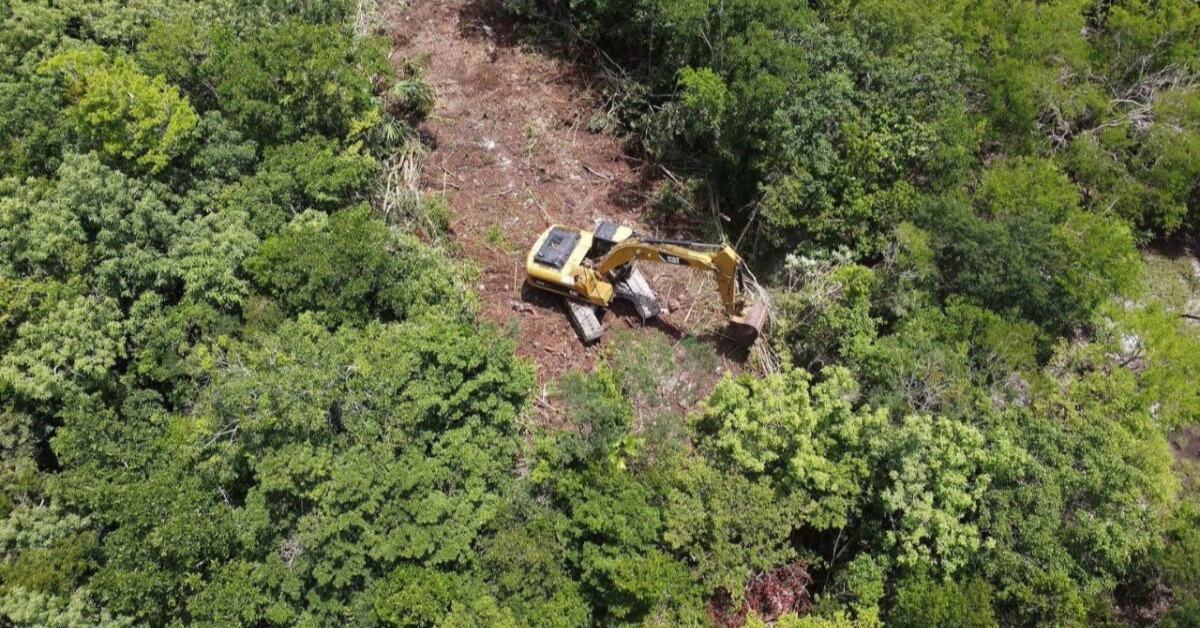
Quintana Roo is again facing questions about how much development its landscape can absorb. A new warning about deforestation has brought attention to the Riviera Maya, where continued growth in Playa del Carmen and Tulum is replacing forest with roads, buildings, parking areas, and other urban infrastructure.
The concern is not only about one headline number. It is about a pattern that has continued for years and now appears to be getting harder to ignore. The state remains heavily forested in many areas, but the pressure on that forest is no longer limited to remote agricultural zones. It is increasingly visible in some of Mexico’s best-known tourism corridors, where demand for housing, hotels, and services, as well as speculation, has pushed development deeper into the surrounding jungle.
That shift matters because the forest is not separate from the tourism economy. In Quintana Roo, the jungle is part of the product. It shapes the scenery, supports wildlife, protects soils, and helps sustain the underground water system that defines much of the Caribbean coast. When that cover is removed, the loss is not only environmental. It also changes the long-term value of the places being marketed and sold.
Why the numbers matter, and why they differ
This week’s figure highlights more than 250,000 hectares of jungle lost in Quintana Roo since 2001. That is a large number, but readers should understand that forest-loss totals are not always measured the same way. Some datasets track tree cover loss, while others focus on natural forest or broader forest-cover change. Different time periods also produce different totals.
Even with those differences, the trend points in the same direction. Independent forest monitoring has shown major loss in Quintana Roo over the last two decades, and more recent assessments suggest the pace remains serious. A separate 2025 regional analysis also found continued forest-cover loss across the Yucatán Peninsula, including substantial losses inside Quintana Roo in recent years.
That distinction is important because it prevents the debate from getting stuck on one disputed number. The broader point is clear. Forest loss is not a problem of the past that has already been absorbed. It is an active process tied to ongoing land-use change. In Quintana Roo, that includes urban expansion, tourism projects, roads, services, and large-scale agricultural activity in other parts of the state.
Why Playa del Carmen and Tulum sit at the center
The attention on Playa del Carmen and Tulum is not accidental. Both areas have become symbols of the development model that has transformed the Caribbean coast. Over time, growth that once followed the shoreline has spread inland, where forested parcels are cleared for subdivisions, condominiums, vacation projects, access roads, and supporting infrastructure.
In practical terms, that means land is often converted permanently. A forest cleared for a building cluster or a paved access road does not easily return to its previous state. That is different from temporary disturbance or traditional land uses that may still allow regeneration. Permanent urbanization changes the ground itself, fragments habitat, and invites more construction around it.
The corridor between Playa del Carmen and Tulum is especially sensitive because it overlaps with one of the region’s most fragile natural systems. Much of this stretch sits atop a porous limestone base that connects to cenotes, caves, and underground rivers. That makes the area unusually exposed to the effects of rapid land clearing, runoff, and poorly planned growth. It also helps explain why environmental disputes in this zone have repeatedly centered on more than trees alone.
The damage goes beyond wildlife
For many international readers, it is easy to read a forest-loss story as a conservation issue that sits apart from daily life. In Quintana Roo, that is too narrow. Deforestation affects what residents and long-term visitors notice directly, even if they do not always connect it to land use.
One effect is on water. Forest cover helps regulate infiltration and protect the broader hydrological system. Another is on heat and urban stress. As vegetation is removed, built areas retain more heat and lose shade. A third is on the region’s environmental identity. Places such as Tulum built part of their global appeal on the idea of proximity to nature. The more that nature is cut back, the weaker that selling point becomes.
There is also a governance problem behind the environmental one. Rapid growth can outpace oversight. That opens space for irregular developments, weak enforcement, or projects that arrive before adequate planning, infrastructure, and safeguards are in place. In that sense, the current debate is not just about how many hectares have been lost. It is also about whether the state still has the institutional capacity to control how land is being transformed.
What happens next
The central question is no longer whether Quintana Roo can continue growing. It will. The real question is what kind of growth the state is willing to accept. A model based on endless clearing may deliver short-term returns, but it also raises long-term costs for ecosystems, public services, and the tourism brand itself.
That is why this story matters beyond environmental circles. It speaks to housing policy, real estate regulation, water protection, infrastructure planning, and tourism strategy. It also forces a more difficult conversation about limits. If the forest is treated as empty land waiting for its next project, the state may keep expanding while eroding the very conditions that made that expansion profitable.
For Playa del Carmen and Tulum, the issue is especially urgent. These are no longer fringe development zones. They are mature tourism markets still pushing outward. What happens there will shape how the rest of Quintana Roo balances investment and ecological survival. The warning signs are already visible. The question now is whether authorities act before more of the damage becomes permanent.