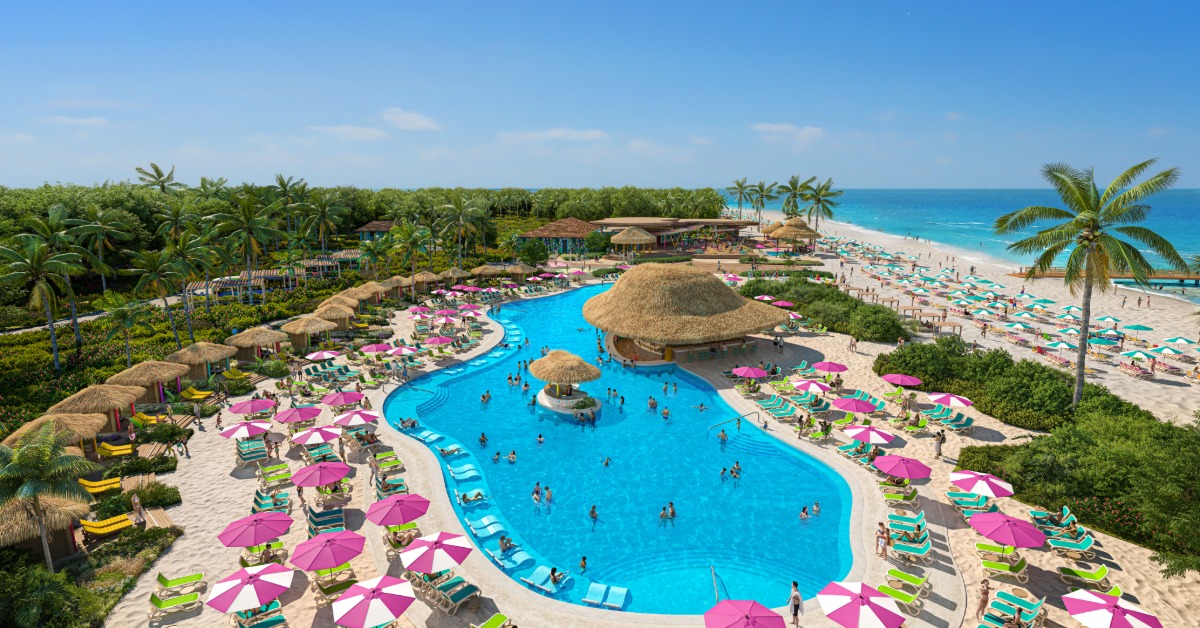
Royal Caribbean’s proposed Perfect Day México water park in Mahahual is no longer moving forward at the site planned for Mexico’s southern Caribbean coast. Federal environmental authorities rejected permits tied to the project after months of opposition over reefs, mangroves, public access, and the pressure of cruise tourism on a small coastal town. The decision now leaves a larger question for Quintana Roo’s tourism model, as officials discuss whether the project could be moved elsewhere.
Royal Caribbean drops Mahahual water park plan after permit rejection
Royal Caribbean has scrapped its proposed Perfect Day México water park in Mahahual after Mexico’s environmental authority rejected permits tied to the project, closing one chapter in a dispute that had become a test case for coastal development in Quintana Roo.
President Claudia Sheinbaum said Wednesday that the project “will not be carried out there,” after federal environmental officials determined the proposal was too invasive for the area around Mahahual, a coastal town near mangroves and the Mesoamerican Reef.
The decision followed the denial of three permits connected to the park, including one involving a pier, according to Sheinbaum. Federal officials are now discussing whether Royal Caribbean could move a version of the project to another site with fewer environmental risks.
Semarnat drew a hard line after weeks of pressure
Environment Secretary Alicia Bárcena had already signaled the federal position on May 19, saying the project would not be approved. “It is not going to be approved,” she said during a public event hosted by Semarnat.
Semarnat later said the environmental procedure for Perfect Day had concluded and that the project components could not be reviewed in isolation. Greenpeace México said the federal environmental review identified risks to mangroves, reefs, the aquifer, protected species, and cumulative impacts, and noted that a final negative resolution for the main project had not yet been publicly issued.
That distinction is important. The project, as promoted by Royal Caribbean, has been withdrawn from Mahahual, but environmental groups are monitoring whether a similar proposal could return in a different format, with a different site plan, or through another legal pathway.
Earlier coverage had tracked how the project moved from legal uncertainty to federal rejection, including a court fight over land-use changes and the later federal decision that the proposal would not be approved.
The scale of the project drove the conflict
Royal Caribbean had promoted Perfect Day México as a major land-based cruise destination scheduled to open in 2027. The proposal included beach areas, pools, bars, and more than 30 waterslides.
The company’s own promotional material described attractions including a large water park, slide towers, and destination-style cruise infrastructure. One earlier environmental filing described a land-side project area of about 82.58 hectares, with capacity claims of up to 21,000 cruise visitors per day, plus thousands of workers.
That scale sharpened local concern in Mahahual, where critics warned that a cruise-driven tourism complex could strain water, wastewater, beach access, coastal vegetation, and the identity of a town already shaped by cruise arrivals.
The environmental setting also raised the stakes. The Mesoamerican Reef stretches along the coasts of Mexico, Belize, Guatemala, and Honduras, and includes coral reefs, mangroves, seagrass beds, coastal wetlands, and beaches. Banco Chinchorro, off the coast of Othón P. Blanco, is a federally protected biosphere reserve and one of the region’s major reef areas.
Royal Caribbean may still seek another path
Royal Caribbean said that, after the earlier permit setback, it regretted the decision but respected Mexico’s environmental authorities. The company also said Mahahual “deserves care and protection,” and said it remained optimistic about investment in Mexico.
That leaves the dispute in a new phase. The Mahahual site is no longer the path forward for the water park plan, according to Sheinbaum. But federal officials have not closed the door on a relocated project if environmental viability can be shown.
Sheinbaum said the government is speaking with the company about whether there is another site without the same impacts, and that any alternative would first need to undergo environmental review. She also said Semarnat and Quintana Roo’s government are evaluating whether Mahahual should receive added protection, including limits that could favor ecotourism under specific conditions.
Greenpeace México called the withdrawal the result of public, social, and environmental pressure, but warned that the case exposed a wider problem with fragmented tourism projects in the Yucatán Peninsula.
For Mahahual, the immediate result is clear. The water park plan that drew national attention has been stopped at that site. The larger fight over coastal tourism, public access, and environmental limits in southern Quintana Roo is not finished.