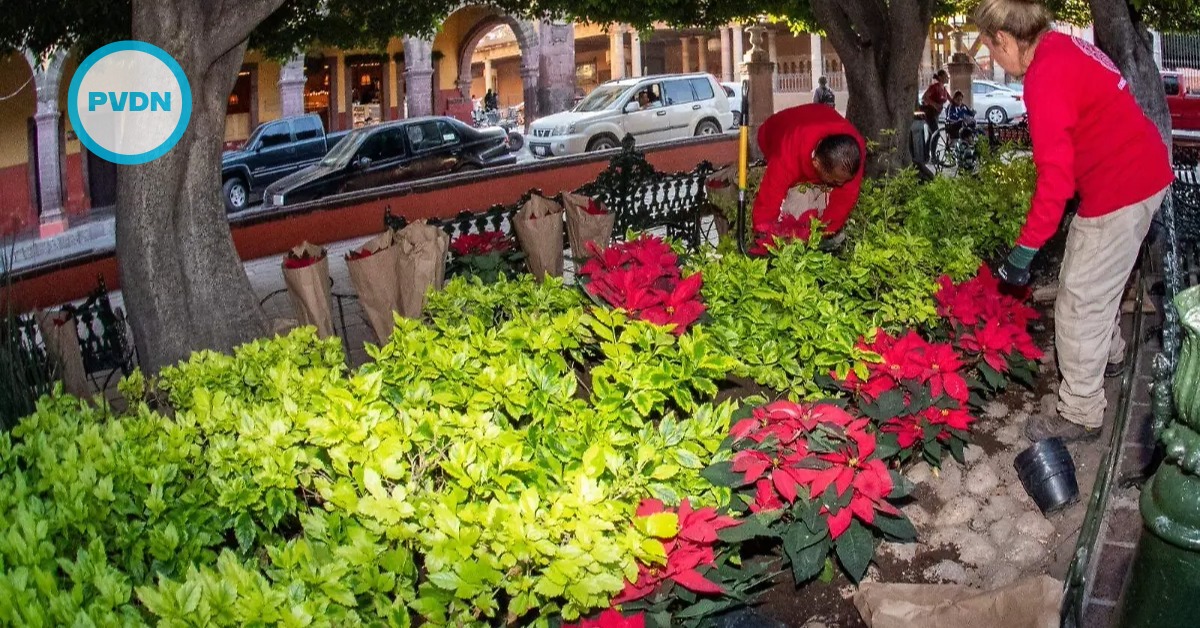
San Miguel de Allende’s historic center turns bright red as city crews plant poinsettias across plazas and parks for Christmas.
San Miguel de Allende’s December makeover began at the start of the month, when brigades from the municipal Environment and Sustainability department fanned out across town with truckloads of poinsettias. They worked their way through neighborhood gardens, main plazas and the narrow streets of the historic core, lowering pots into beds and lining walkways with dense red borders that frame the city’s stone churches and townhouses.
City officials describe the operation as a way to strengthen the festive atmosphere while keeping the urban image consistent with the colonial center that draws visitors from around the world. Crews positioned the plants not only where they would be most visible, but where they could be shielded as much as possible from wind and cold so they last through the season.
At the heart of the effort is a simple message: the flowers belong to everyone. Ernesto Berra, head of Environment and Sustainability, has urged people not to treat the displays as disposable decoration or as free plants to take home. “We are covering the city in red with our poinsettias,” he said. “We ask you to take good care of them; the city, its plants and its decoration are yours. Everything is done so you can enjoy a beautiful season.” That appeal is aimed at locals and visitors alike.
San Miguel Christmas poinsettias and a local ritual
For San Miguel, poinsettias are more than a pretty backdrop. The plant itself is native to Mexico and Central America and has been used here for centuries. Known locally as flor de nochebuena, or Christmas Eve flower, it became tied to Christian celebrations when it was adopted to decorate altars and nativity scenes. Over time, its red and green colors turned into a visual shorthand for the holiday season across the country.
San Miguel de Allende has leaned into that symbolism for years. The city’s environmental area promotes a poinsettia fair and seasonal plantings as part of its December programming, after earlier editions were paused during the pandemic. The current administration has revived the tradition as one of the most visible ways to mark the start of the festive period in public spaces, rather than only in private patios and hotel courtyards.
All of this unfolds within a historic district that has been internationally recognized. San Miguel’s center was added to the UNESCO World Heritage list in 2008, a designation that covers more than 60 blocks of colonial-era streets, churches and plazas. City leaders often frame their Christmas decoration campaigns as part of a broader effort to keep that urban core not just intact, but cared for in everyday ways. Seasonal flowers are one of the few tools that can change the city’s look without touching its architecture.
The poinsettias are also a layer on top of other December traditions. San Miguel’s main garden and surrounding streets are lit with strings of lights and decorative stars, and a tall Christmas tree stands in front of the parish church. Tourism materials describe December here as a month of posadas, markets and evening walks under illuminated facades. The carpets of red flowers now running through plazas and side streets knit that holiday scene together at ground level.
Caring for the flowers and the city
Behind the cheerful color, there is a practical concern. The city has had to remind people that the plants are not souvenirs. The municipal government has asked residents and tourists to avoid stepping into the beds, moving pots or pulling out flowers to take away. Officials frame that as a matter of respect for public space, echoing the broader push to balance San Miguel’s popularity with the daily life of those who live in its center year-round.
The poinsettias themselves are living decorations that require work long after the last pot is set down. Environment brigades must water them, check for damage and rotate any plants that start to suffer. The city notes that the arrangements were designed to keep the flowers healthy through the full holiday period, which in Mexico stretches well into early January. That investment of time and labor is part of why officials insist the public treat the displays as a shared responsibility.
There is also a cultural layer to that request. Mexican institutions often describe the flor de nochebuena as a symbol of hope and of the season’s mix of joy and reflection. By covering the historic center in that flower, San Miguel’s government is inviting people to see the streets not just as a backdrop for photos, but as a place where long-standing traditions still matter. Protecting the decorations becomes a small way of preserving the city’s identity.
In a town that now draws visitors from across Mexico and abroad, that message matters. San Miguel de Allende has seen tourism and second-home demand reshape entire neighborhoods over the past decade. Public gestures like the poinsettia plantings are one way local authorities try to reaffirm that the historic center is still a civic space first. The appeal to “care for what is yours” is as much about the stone benches and old trees as it is about this season’s flowers.
For now, San Miguel Christmas poinsettias are doing their job. They soften the edges of stone planters, highlight church steps and wrap colonial fountains in red. Whether they survive in good shape until the last Christmas lights come down will depend less on the crews who planted them and more on thousands of small choices made by passersby. In a city built on shared rituals, the fate of a few thousand flowers is a quiet test of how well residents and visitors can share the streets.