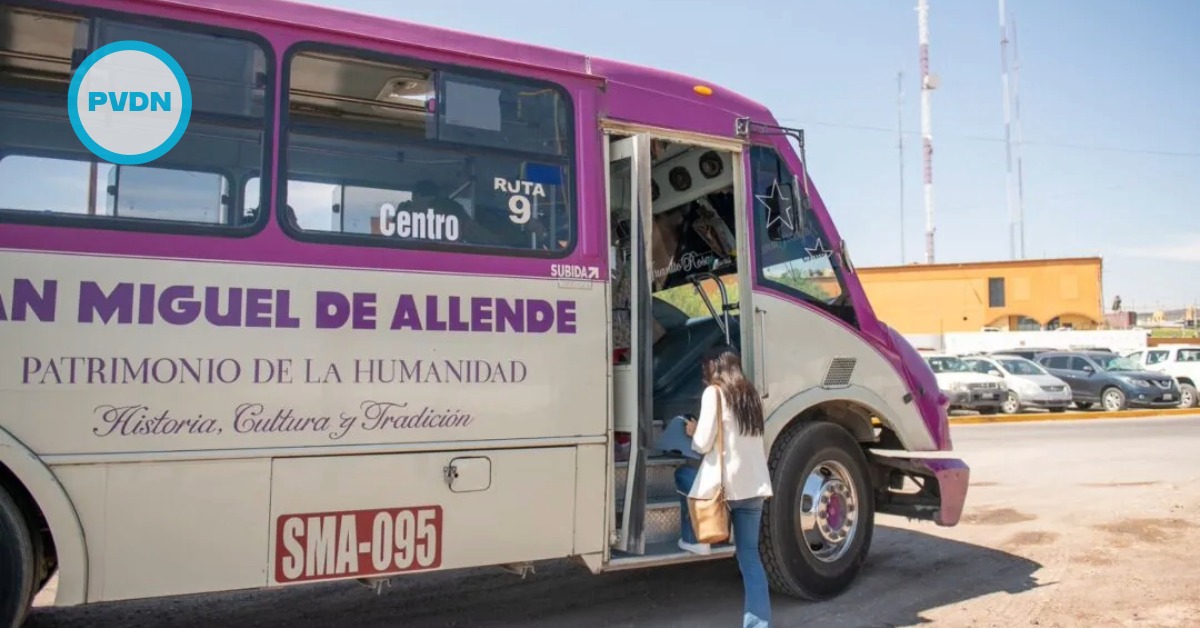
San Miguel de Allende’s bus fare has officially gone up—and the fine print matters. The standard urban ride now costs more, but discounts remain for riders who can show the right credentials. Outside the city, the new tariff list reads like a map of surrounding communities, with prices that climb route by route. City leaders say the increase comes with strings attached: cleaner buses, better-trained drivers, and stricter rules inside the units. The question is whether riders will feel the difference.
A fare hike becomes official
San Miguel de Allende’s long-discussed bus fare increase is no longer a proposal or a headline that might happen “soon.” It became official after the agreement was published in Guanajuato’s state gazette, which is the step that triggers enforcement. The new rates apply across the city’s fixed-route urban and suburban network, covering 28 routes that connect the historic center and neighborhoods to outlying communities.
For many riders, the timing matters as much as the pesos. The agreement takes effect the day after publication, meaning the change isn’t tied to a gradual rollout or a future start date. It’s meant to be immediate—whether every driver and every unit implements it smoothly is another question.
What you’ll pay now
Inside the urban zone, the standard bus fare rises from 8 pesos to 10 pesos. A preferential fare of 6 pesos remains in place for riders who qualify and can present the required credentials, including older adults, people with disabilities, and students.
Suburban routes work differently, and the new tariff schedule reflects that. Instead of one flat price, the fare depends on the route and distance, with a published table listing each origin-destination pair and its general and preferential rates. In practice, that means some trips stay close to the urban fare, while others climb steadily the farther you go from the city.
The table sets many “urban zone and intermediate points” rides at 10 pesos general and 6 pesos preferential, but longer runs cost much more. Trips to Atotonilco, for example, are listed at 15 pesos general with a 10-peso preferential fare. Routes to Puerto de Nieto appear at 19 pesos general and 12 pesos preferential. Some of the highest listed prices include routes such as Tierra Blanca and Juan González at 27 pesos general and 14 pesos preferential, and longer-distance listings that reach 36 pesos general with an 18-peso preferential fare.
What the increase is supposed to buy
The fare increase is formally tied to service expectations, and the commitments aren’t vague. The agreement obligates operators to provide a safe, regular, continuous, and consistent service. It also pushes visible changes that riders can actually judge day to day: drivers are expected to improve their presentation through uniforms, and buses are expected to receive preventive and corrective maintenance rather than being run into the ground.
There’s also a public-facing “image” component. Operators are expected to coordinate a redesigned look for the system with the authorities, including an official color scheme. In plain terms, the city wants buses that look like they belong to a system, not a collection of mismatched units.
One detail that speaks directly to rider experience is the restriction on loud music, especially content that promotes violence, denigrates, or discriminates against people. The stated goal is to improve the onboard environment and prevent buses from being used for political messaging and campaigns.
Local officials have signaled enforcement will be part of the story, not an afterthought. The city has described a zero-tolerance approach to certain driver behaviors, including using a phone while driving, blasting music, or making risky maneuvers. The message is clear: the extra pesos are supposed to come with consequences for bad service, not excuses for it.
What to watch as the new rates roll out
Reactions around town are split in a familiar way. Some riders see a two-peso increase as overdue after more than a decade without one, especially if it breaks the cycle of underfunding, poor maintenance, and worsening units. Others aren’t opposed to paying more in principle, but they’re tired of promises and will judge the change by what shows up on the street: cleaner interiors, safer driving, predictable frequency, and buses that don’t feel one breakdown away from disappearing mid-route.
For expats who use buses occasionally—whether to get across town, reach a market, or head toward a nearby community—the practical adjustment is simple: expect more variation once you leave the urban zone, and don’t assume your old fare applies on every run. As the new pricing settles in, the fairest comparison won’t be what you paid last week, but whether the service you’re getting this month looks and feels like an upgrade.
With information from Periódico Correo, Antonieta Informa, Paralelo X