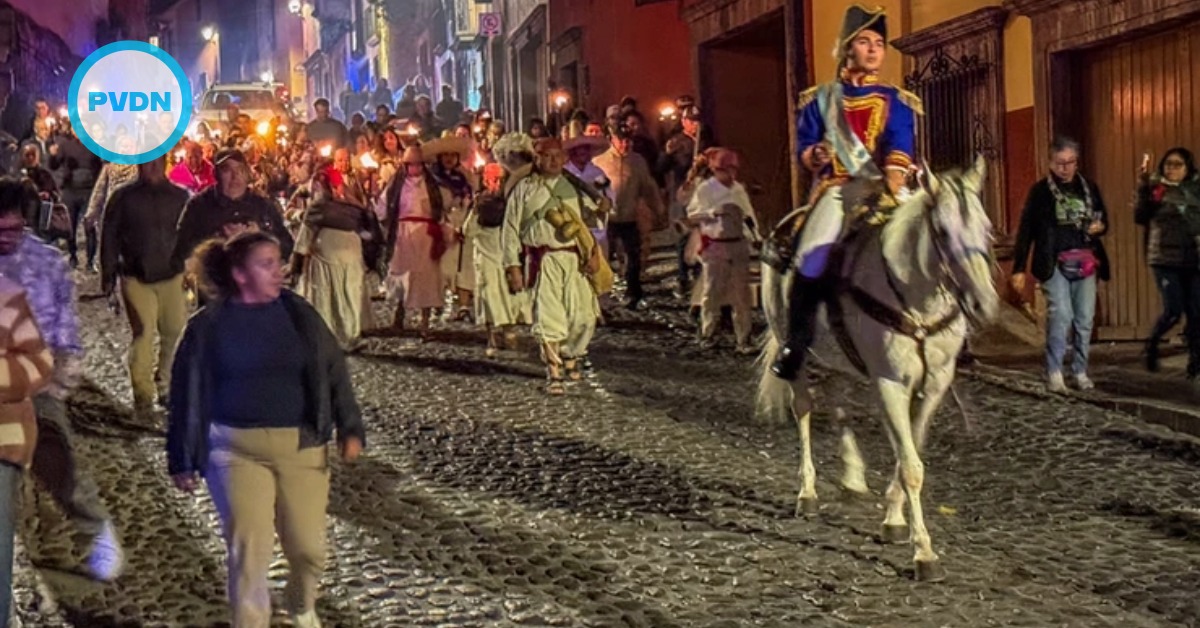
On a January morning, San Miguel de Allende’s postcard calm gives way to boots on cobblestone and drumline snaps. It looks like a parade. It also hints at the city’s real origin story. Officials, soldiers, students, and families move from ceremony to procession. They end at a stone house where history waits. By noon, the historic center feels like a living classroom. The details matter this year, because the birthday tribute is quietly launching something bigger.
A civic-military morning downtown
San Miguel de Allende spent Wednesday morning in a familiar rhythm: flags, drums, and school uniforms moving through stone streets. A torchlight procession the night before had already warmed up the downtown crowd. City officials joined the Army, National Guard, emergency crews, and students to mark the 257th anniversary of Ignacio Allende’s birth. After a formal civic ceremony, the official party moved into the historic center. They stopped at the Casa de Allende for a guard of honor. From there, they continued to the Municipal Palace to watch the civic-military parade.
The Army and National Guard contingent carried eight flags and six guidons. It included 348 personnel, 16 vehicles, and two canine teams. San Miguel’s Citizen Security force added four flags, 175 personnel, and 34 vehicles. The route drew families and visitors to sidewalks and plazas, even before the first cadence call. For many locals, the tribute also kicked off a year-long countdown to the city’s 200th anniversary.
The hometown hero behind the name
Ignacio Allende is not a distant statue in San Miguel. He was born here on January 21, 1769, when the town was still San Miguel el Grande. Trained as a soldier, he built a reputation for discipline and daring long before 1810. When the independence conspiracy in Querétaro erupted into open rebellion, Allende was among the key organizers and commanders. He marched with Miguel Hidalgo in the movement’s first months, then faced hard defeats and internal friction.
By 1811, royal forces had captured him, and he was executed in Chihuahua on June 26. That arc explains why his name is stitched into the city’s identity. A decree in March 1826 elevated the town to city status and adopted “San Miguel de Allende” in his honor. Two centuries later, the annual birthday commemoration still works as a reset button. It reminds residents that this postcard-perfect place also measures time in civic history.
Casa de Allende, up close
For visitors, the Casa de Allende is where the ceremony stops feeling abstract. The building on Cuna de Allende is the family home of Ignacio Allende, now operated as a federal history museum. Inside, rooms are staged to show how a prosperous criollo household lived at the end of the colonial era. Exhibits also walk through the first stage of the independence war, including the break with Hidalgo and Allende’s final capture. The museum’s own story mirrors the city’s habit of renewal. It opened to the public in 1990 and was later updated for the 2010 bicentennial of independence.
On parade day, the mood outside is formal but welcoming, with families watching from the curb. If you live in Centro, expect short closures and detours around the route. If you are new to Mexico, this is one of the easiest civic traditions to read. It is orderly, loud, and deeply local, and it explains the city’s name in real time.
With information from Quadratín Bajío, Gobierno Municipal de San Miguel de Allende, Turismo San Miguel de Allende, INAH Lugares, Sistema de Información Cultural, Secretaría de Cultura, INEHRM, Gobierno del Estado de Guanajuato