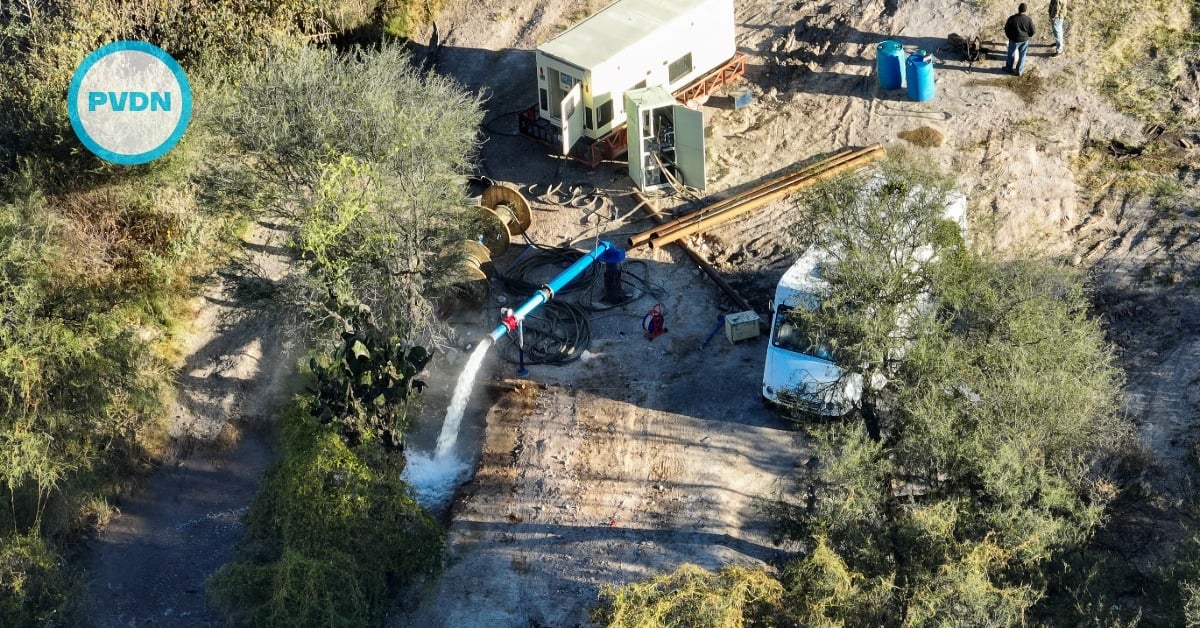
San Miguel de Allende put its newest deep well into operation this week on the banks of Presa Allende, in the rural community of San Marquitos. City hall describes TSA 14 as the final piece of a long-planned hydraulic puzzle: a battery of five interconnected wells that feed directly into the main potable network for the urban area.
According to the municipal government, the new well alone can deliver about 62 liters of water per second, enough, in the mayor’s words, to supply roughly half of the city’s urban zone. The project required a little more than 8 million pesos in local investment for drilling, equipment, and electrical works at the site. Combined with the existing wells TSA-01, TSA-05, TSA-06, and TSA-13, the system now pushes an estimated 300 liters per second into the city’s distribution grid along a 5.2-kilometre ductile-iron pipeline with diameters of up to 24 inches.
Municipal officials say this five-well battery was four years in the making, framed from the start as a way to “recover water” for the city as population and construction pressures mount. With TSA 14 online, Mayor Mauricio Trejo has declared the project complete and insists that the urban network is guaranteed a steady flow of potable water for the next half-century. The city estimates that more than 130,000 residents will benefit directly, including about 2,000 families in the communities of San José de la Posta and San Marquitos, which now have their own distribution lines and constant service.
San Miguel water supply hinges on Presa Allende wells
On paper, the numbers are striking. A ring of high-capacity wells near Presa Allende now lifts water toward a central pumping plant and onward into the city. The pipeline that links them climbs nearly 300 meters in elevation between the dam and higher neighborhoods, making this one of the most ambitious municipal water projects San Miguel has attempted in decades.
For residents used to intermittent service, low pressure, or dry taps at the end of long weekends, the promise of a more robust flow feels like a tangible change. City leaders frame the project as a cornerstone of “orderly urban development,” arguing that a reliable San Miguel water supply is essential if the historic center and surrounding subdivisions are to absorb new homes, hotels, and visitors without collapsing basic services.
The wells also sit at the intersection of water and equity. By tying rural communities like San Marquitos into the main system, the project begins to close some of the gaps between the UNESCO-listed center and the countryside that supports it. Municipal estimates suggest that families in these outlying settlements will now receive the same treated, pressurized water as residents closer to downtown, instead of relying on aging local infrastructure or trucked-in deliveries.
Yet even as officials cut the ribbon, the long shadow of the region’s groundwater problems hangs over the celebration. San Miguel draws nearly all of its drinking water from the San Miguel de Allende aquifer, part of the Upper Río Laja basin, which federal studies have placed under special extraction restrictions for decades because recharge is limited and rainfall is modest.
Environmental organizations that have followed the project closely describe the Presa Allende well ring—known locally as the “Acuaférico”—as both a feat of engineering and a source of unresolved questions. A 2022 analysis by the local nonprofit Caminos de Agua documented how six new and existing wells around the reservoir were interconnected through roughly 12 kilometers of piping and controlled from a central pump station, with an estimated cost of at least 105 million pesos for the early phases. The group argued that without transparent data on groundwater levels and water quality, it is hard to know whether the extra extraction will deepen long-term risks.
Fifty-year horizon, uncertain aquifer
Independent studies over the last decade have painted a worrying picture of water security in San Miguel and the broader Guanajuato highlands. Research cited by climate programs working in the city notes that the aquifers feeding this World Heritage destination are already classified as overexploited, with climate models projecting up to a 14 percent drop in rainfall that could further shrink natural recharge. In a trend scenario, they warn, San Miguel could face a “Day Zero” style crisis similar to the one Cape Town confronted when reservoirs ran dry.
Caminos de Agua and other advocates have also highlighted the health dimension of deep groundwater extraction in the Upper Río Laja region. As wells are drilled deeper and the water table falls, naturally occurring arsenic and fluoride levels can climb, posing long-term risks such as bone deformities, kidney disease, and certain cancers if water is not properly treated. The Presa Allende well field concentrates several high-capacity wells in a small area, which some hydrogeologists say can create cones of depression that further disturb underground flow patterns and potentially increase contaminant exposure.
Urban water conflict is not new here. Academic work on San Miguel has documented how tourism-driven growth, foreign real-estate investment, and an expanding industrial and agricultural belt across Guanajuato have all competed for the same finite groundwater. In that context, a massive new supply project aimed squarely at the urban grid raises questions about how benefits and burdens are shared between the historic center, new gated communities, and rural villages where shallow wells have already failed.
City hall counters that the five-well aqueduct is precisely about planning ahead, not only for residents who live inside the colonial core but for families across the urban footprint. Officials argue that tying more communities into the main system, investing in modern pumping and monitoring equipment, and spreading extraction across several wells near Presa Allende will protect both service continuity and natural resources.
What remains missing, experts and community groups say, is a shared public roadmap that connects big infrastructure to a broader strategy for demand management, groundwater protection, and climate resilience. That could include stronger controls on high-volume agricultural and industrial users, accelerated rainwater harvesting and household cistern programs, and clear limits on new large-scale developments in water-stressed zones.
For now, San Miguel de Allende has a new symbol of confidence rising from the shore of Presa Allende and a mayor who insists the city’s families can stop worrying about the tap for “the next 50 years.” Residents who have endured rationing and low pressure may welcome that promise. But in a region where the aquifer is finite and the climate is shifting, the real test of this project will be whether the water still flows for today’s children—and for the ones who will inherit the city after them.