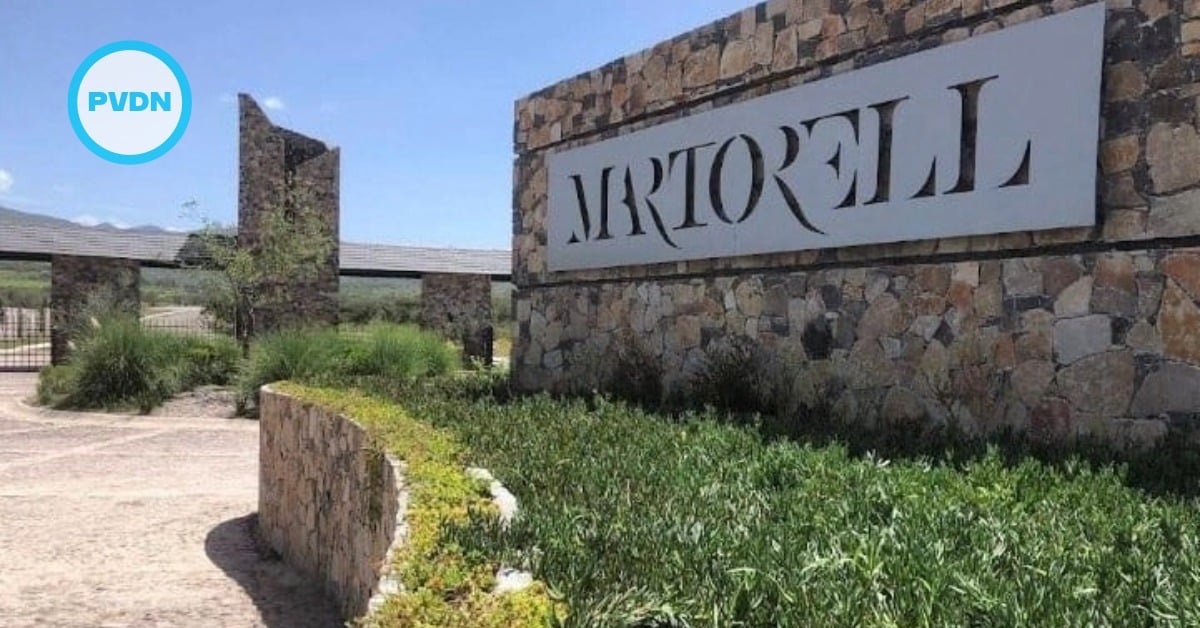
Guanajuato’s environmental watchdog fined Espacio Vivo for altering a stream near San Miguel de Allende without permits, putting the Río Laja at risk.
A luxury subdivision branded as minutes from San Miguel de Allende is now at the center of a legal and environmental fight. State inspectors say the Martorell Residential project narrowed a natural stream, stripped native vegetation, and ignored suspension orders, all in a basin that feeds the Río Laja and the Ignacio Allende dam. The case could shape how aggressively Guanajuato enforces environmental rules on fast-growing real estate corridors and what that means for San Miguel’s future growth.
How a “green” project reshaped a Guanajuato stream
On paper, Martorell Residential sells a dream. Marketing materials describe a 323-hectare “sustainable community” on the Wine Route between Comonfort and San Miguel de Allende, about 15 minutes from San Miguel’s historic center, with more than 40 percent of the land reserved for green areas, organic orchards and ecological reserves.
Behind that promise sits a different set of documents. In an administrative resolution identified as DP-0340-2022B, Guanajuato’s Environmental and Territorial Prosecutor’s Office (PAOT) concluded that Espacio Vivo, SAPI de CV, the company behind Martorell, altered the natural course of the Arroyo del Pescado without the state authorization required for works in or next to a waterway.
Inspectors documented the use of heavy machinery to narrow and modify the stream bed and to level the surrounding land. They also reported the removal of native vegetation typical of the semidesert around San Miguel, including nopales, huizaches and mesquites, which play a key role in stabilizing soils and helping rainwater infiltrate the ground.
The file describes a pattern of resistance to oversight. On 20 February 2023, PAOT staff arrived at the site to request the environmental authorization, but were denied access, according to the inspection record. A suspension of works followed. During a subsequent visit on 22 March, inspectors found construction still underway despite the order to halt activities.
When officials returned on 5 July 2023, they found the suspension banner that should inform the public had been turned around so its message could not be read. For PAOT, that act was evidence of an attempt to hide the measure and mislead visitors and potential buyers about the project’s legal status.
The agency ultimately imposed a fine of 1,076,905 pesos on Espacio Vivo, describing it as the highest environmental sanction against a private developer in recent state history. The company has not publicly announced payment of the fine.
All this contrasts sharply with Martorell’s brand. Brochures and sales sites present the project as Mexico’s first “agrihood”, promising rainwater harvesting, wetlands, native landscaping and conservation of local flora and fauna.
San Miguel environmental damage
Although the subdivision is legally located in Comonfort, its business model leans heavily on San Miguel de Allende. Real estate listings and the project’s own websites repeatedly describe the development as “in San Miguel de Allende” or minutes from its center, highlighting the UNESCO-listed colonial city and its international tourism as key selling points.
Environmentally, the project also sits inside a wider system that binds Comonfort and San Miguel. The Arroyo del Pescado is a tributary of the Río Laja, one of Guanajuato’s most important rivers. The Laja forms part of the Cuenca de la Independencia, supplies the Ignacio Allende dam next to San Miguel de Allende and supports irrigation and ecosystems downstream.
Environmental researchers have warned for years that the Laja basin is under pressure from groundwater over-extraction, sand mining and loss of riparian vegetation. Those pressures reduce the river’s ability to recharge aquifers, erode riverbanks and fragment habitat.
State planning documents acknowledge the stakes. Guanajuato’s own environmental program highlights how changes in land use, particularly deforestation and the clearing of native vegetation, affect water infiltration and the stability of soils. San Miguel de Allende’s urban and ecological development program, updated in 2019, is intended to align local land use with state-level goals and federal environmental order rules.
In that context, what happens on the slopes between Comonfort and San Miguel is more than a local zoning dispute. When a 323-hectare subdivision modifies a tributary and its surrounding vegetation without approved mitigation, the effects can ripple through the Río Laja system, from upstream communities to the dam that frames San Miguel’s skyline.
For residents and buyers drawn by San Miguel’s image as a place of culture and nature, the case also raises uncomfortable questions. A project marketed as an ecological refuge is now tied to a state finding of significant environmental damage. A real estate corridor promoted for its vineyards, views and “sustainable living” is being tested against the legal limits meant to protect the very landscape that makes it attractive.
The outcome of the enforcement process will matter beyond one gated community. It will show how far Guanajuato is willing — and able — to go when a high-end development near San Miguel de Allende crosses environmental lines, and whether the promise of “green” growth in the Laja basin can be squared with the rules on the books.