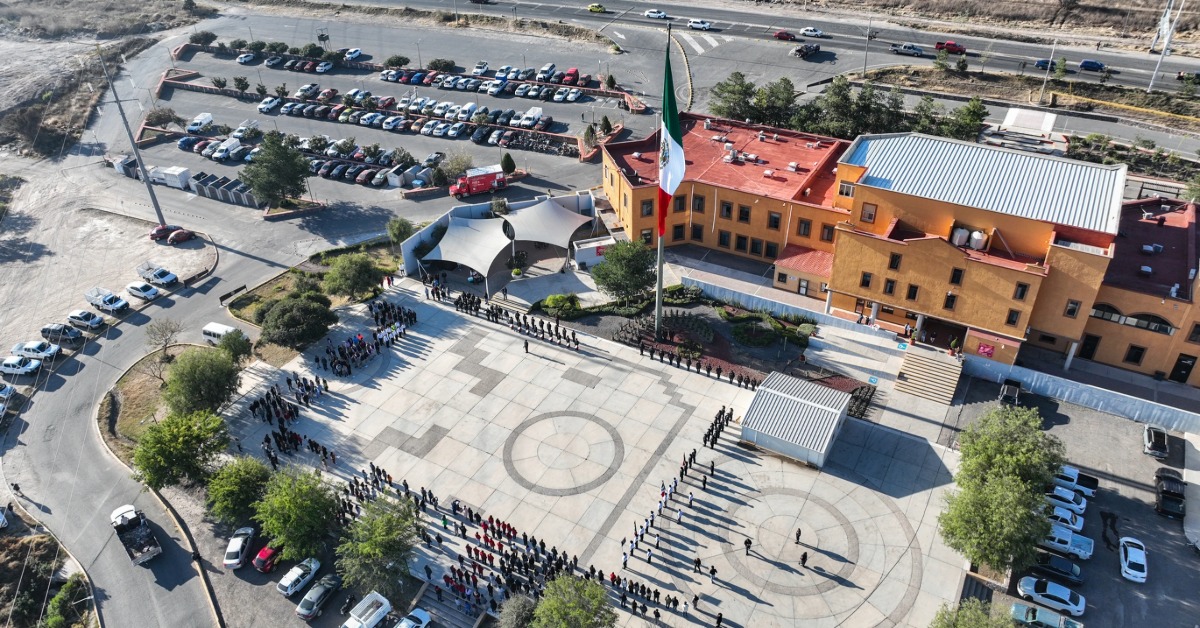
Every February 24, cities across Mexico repeat a civic ritual around the flag. It is easy to recognize once you see it. In San Miguel de Allende, municipal staff and security bodies gathered with a local school unit. They held an official flag-raising and formal honors. The sequence is familiar: the flag moving, a salute, and the national anthem. This year’s ceremony offers a small window into how municipal routine and tradition meet in public space.
Ceremony at the municipal administrative building
On February 24, San Miguel de Allende observed Día de la Bandera with an official flag-raising. The ceremony took place on the esplanade of the municipal administrative building. Department heads and staff attended, along with other municipal employees. Representatives of the local Secretaría de Seguridad Ciudadana were also present. Elements of the Policía Municipal conducted the izamiento of the national flag. The program then moved into honores a la bandera, as used in public institutions across Mexico. A drum-and-bugle unit from Escuela Secundaria Técnica 42 directed the formal honors. Escort teams from Protección Civil, Tránsito Municipal, and police accompanied the protocol. The schedule included the saludo civil and the Himno Nacional Mexicano. In brief remarks, the municipal Secretaría de Gobierno framed the ceremony as a reminder of past generations and present obligations. The message also highlighted responsibility, congruence, and adherence to the law in public service. The event closed with the final protocol and dismissal.
What Flag Day protocol requires
Mexico marks Día de la Bandera every 24 de febrero. Federal law designates the date and calls for civic activities by authorities at all levels. In many public buildings, the flag is raised and honored as part of an official routine. The basic sequence is familiar to anyone who has attended a school ceremony in Mexico. It starts with the flag’s movement under guard. It continues with a coordinated saludo civil by those present. The Himno Nacional is performed as part of the honors. The same legal framework also defines how civilians salute, with the right hand placed over the chest. For many municipalities, Flag Day is also a moment to bring schools into public space. Bands, escoltas, and uniformed services often share roles during the ceremony. That mix was visible in San Miguel’s program, where education and security bodies participated together. The result is a short event with a clear order and a fixed purpose: to honor a national symbol through a standardized public ritual.
What residents and newcomers may notice
For many expats, Flag Day is easy to miss until it happens in front of you. You may notice a larger Bandera Nacional flying at full mast. You may hear a drum cadence or the opening notes of the Himno Nacional near a plaza or school. In San Miguel, the municipal ceremony followed the same pattern many towns use, so similar events can appear across the city. If you pass one, the etiquette is straightforward. People pause, face the flag, and complete the saludo civil during the honors. The legal definition of the salute includes placing the right hand over the chest. Men are also expected to uncover their heads during the salute. None of this requires speaking Spanish to understand what is happening. The sequence is visual and highly scripted. For residents, it is also a reminder that civic life is not limited to elections or paperwork. It appears in public spaces, often led by schools and local services, and occurs on a date set aside for the flag.
With information from El Sol del Bajío (OEM), San Miguel City Hall, Cámara de Diputados, Ley sobre el Escudo, la Bandera y el Himno Nacionales (PDF)