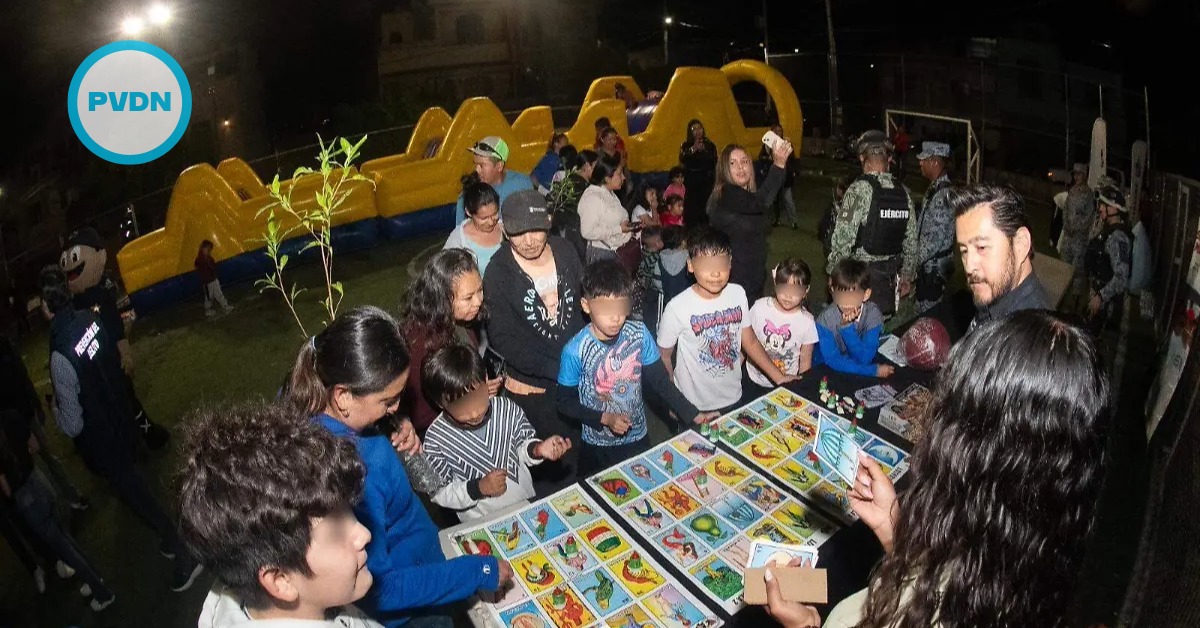
San Miguel’s security fair in San Rafael unites families, agencies and kids to swap toy weapons, share safety tips and promote non-violent play.
San Miguel de Allende’s latest San Miguel security fair turned a corner of colonia San Rafael into a classroom, playground and help desk all at once. On November 28, local families spent the afternoon trading toy guns for soccer balls, learning how to handle fireworks safely and talking directly with the people in charge of keeping their streets safe.
The event, called the Peace and Security Fair, was organized by the municipal government through the Secretaría de Seguridad Ciudadana. Its prevention unit, the Municipal Commission for the Social Prevention of Violence and Crime, coordinated a full roster of activities with Civil Protection, the municipal water utility SAPASMA, the Environment and Sustainability department and support from the National Guard and the Army. Together they brought information, services and face-to-face attention into San Rafael, a small locality just a few kilometers from the city center.
Officials describe these fairs as part of a long-term push to make prevention the heart of local security policy. Instead of waiting for violence to happen, the city is trying to reduce risk factors early, strengthen ties between neighbors and authorities and keep human rights at the center of every interaction.
San Miguel security fair focuses on prevention
Throughout the afternoon, families rotated between workshops, talks and games designed to turn big security concepts into everyday habits. One station showed parents how to spot risks around their homes and on nearby streets. Another explained when and how to ask for help through emergency numbers and municipal services. Children learned to recognise their own rights and to speak up if they feel unsafe, whether at school, online or in public spaces.
Civil Protection staff used the coming holiday season to anchor a very concrete message: fireworks can turn a celebration into an emergency in seconds. They walked children and adults through real-life examples of burns, fires and hearing damage caused by misuse of fireworks, then offered simple ways to reduce risks at home and during community festivities.
One of the day’s most visible moments was the “Intercambio de Juguete Bélico,” or toy-weapon exchange. Girls and boys lined up to hand in plastic pistols, slingshots and imitation knives. In return, they chose from soccer balls, lunchboxes and other items meant for play that does not mimic violence. The idea is less about blaming families for what their children play with, and more about opening a conversation on what those games teach and what alternatives exist.
Behind the stands and banners there is a broader reality. Guanajuato has spent years at the top of the national charts for homicides, with more than four thousand killings recorded in 2024 alone. For many residents, that distant number becomes real when they decide not to walk home after dark, avoid certain streets or keep children indoors more than they would like. San Miguel’s own crime statistics show that reports of high-impact offences have risen in recent years, even as authorities insist they are working to reverse the trend.
In that context, the fair is less a one-off event and more a piece of a wider prevention puzzle. State and municipal policies now talk about rebuilding the “social fabric” through neighborhood committees, youth programs and school-based campaigns. Fairs like the one in San Rafael try to bring those ideas down to earth, block by block, by giving families practical tools and direct contact with the agencies that serve them.
Toy exchanges and trust building in San Rafael
The choice of San Rafael is not casual. It is a small locality on the southwest edge of San Miguel, with only a few hundred residents recorded in recent population data. When a fair of this kind arrives there, neighbors see that prevention efforts are not limited to the historic center or tourist corridors, but also reach residential areas where day-to-day life unfolds.
By bringing the fair into the neighborhood, authorities asked families to see themselves not as passive beneficiaries but as partners. Adults were invited to sign up for follow-up programs, local committees and school talks. Children did not just receive lectures; they were encouraged to ask questions, share what they see on their blocks and imagine safer ways to spend their afternoons that do not involve toy guns or risky fireworks.
For the municipal security team, that kind of dialogue is a way to soften the traditional image of police as distant or only present in moments of crisis. Standing next to firefighters, environmental staff and water-utility workers, officers had the chance to speak with neighbors about everyday worries, from street lighting to safe routes to school. Those conversations rarely make headlines, but they shape whether residents feel they can call for help without fear or distrust.
The fair ended the way many community events in San Miguel do: families drifting home with new balls under their arms, flyers folded into pockets and children still talking about the day’s games. No single afternoon can undo years of violence in Guanajuato, or erase the anxiety many families still carry. But in San Rafael, the message was clear. Security is not only about patrols and arrests; it also starts with how children play, how neighbors look out for each other and how willing authorities are to show up, listen and stay present long after the tents come down.